EUROPE AND CENTRAL ASIA
BALTIC SEA REGIONAL PROJECT - PHASE 1
Project Appraisal Document
Europe and Central Asia Region
ECSSD
Date: January 6, 2003
Team Leader: Inesis Kiskis
Sector Manager/Director: Laura Tuck, Jane E. Holt
Sector(s): Animal production (75%), General agriculture,
Country Manager/Director: Julian F. Schweitzer, Roger fishing and forestry sector (25%)
W. Grawe
Theme(s): Biodiversity (P), Environmental policies and
Project ID: P048795
institutions (P), Other environment and natural resources
Focal Area: I - International Waters
management (S)
Project Financing Data
[ ] Loan [ ] Credit [X] Grant [ ] Guarantee [ ] Other:
For Loans/Credits/Others:
Amount (US$m): 5.50
Financing Plan (US$m): Source
Local
Foreign
Total
BORROWER/RECIPIENT
1.79
0.00
1.79
GLOBAL ENVIRONMENT FACILITY
0.00
5.50
5.50
FINLAND, GOV. OF (EXCEPT FOR MIN.FOR FOREIGN
0.16
2.00
2.16
AFFAIRS)
US, GOV. OF
0.00
0.50
0.50
NORWAY: MINISTRY OF FOREIGN AFFAIRS
0.00
0.14
0.14
SWEDEN: SWEDISH INTL. DEV. COOPERATION AGENCY
0.00
1.05
1.05
(SIDA)
FOREIGN MULTILATERAL INSTITUTIONS
0.98
0.00
0.98
(UNIDENTIFIED)
Total:
2.92
9.19
12.12
Borrower/Recipient: HELCOM
Responsible agency: ESTONIA, LATVIA, LITHUANIA, POLAND, RUSSIAN FEDERATION
Coordinated by: The World Bank, Lithuania
Address: Jogailos str. 4, LT-2601 Vilnius Lithuania
Contact Person: Inesis Kiskis
Tel: (370-5) 2107680
Fax: (370-5)212-68-29
Email: ikiskis@worldbank.org
Other Agency(ies):
HELCOM
Address: Katajanokanlaituri 6 B SF-00160 Helsinki, Finland
Contact Person: Mieczyslaw Ostojski
Tel: (358-9)6220-2233
Fax: (358-9)6220-2239
Email: mostojski@helcom.fi
Estimated Disbursements ( Bank FY/US$m):
FY
2003
2004
2005
2006
Annual
2.00
3.50
4.00
2.62
Cumulative
2.00
5.50
9.50
12.12
Project implementation period: March 2003 - June 30, 2006
Expected effectiveness date: 03/15/2003
Expected closing date: 06/30/2006
OCS PAD Form: Rev. March, 2000
- 2 -
A. Project Development Objective
1. Project development objective: (see Annex 1)
Project Development Objective:
Project Development Objective. The development objective of the Baltic Sea Regional Project - Phase 1
is to create some preconditions for application of the ecosystem approach in managing the Baltic Sea
Large Marine ecosystem in order to acheve and maintain sustainable biological productivity of the Baltic
Sea. The project activities would be undertaken in Estonia, Latvia, Lithuania, Poland and the Russian
Federation, along their Baltic coastal areas and in the adjacent coastal and open sea area.
The Baltic Sea Regional Program and Phased Approach:
Program Phasing. The Baltic Sea Regional Project - Phase 1 is a part of a broader Program designed to
achieve the development objectives described above in a phased manner over a 6-year period. The Baltic
Sea Regional Program consists of 3 complementary projects to be implemented in sequence
asperformacew targets of each phase are achieved. In February 2001, the overall program with an
estimated cost of USD 40 million and a proposed GEF financing of USD 18 million was presented to the
GEF Council. At that time, the GEF Council approved USD 5.5 million to finance the first phase pf the
PRogram with the expectation that approval for funding phases 2 and 3 would be granted at alater stage.
The Program includes the following phases:
Phase 1, (The current Project). Introduction of the Ecosystem Approach (2003-2006). US$5.5
million. Establishment of the regional framework for introduction of the ecosystem approach in
managing the Baltic Sea Large Marine Ecosystem (BSLME); mobilization of partners in
management of coastal and open sea marine resources; initial activities for land and coastal
management; and initial investment to mitigate agricultural run-off.
Phase 2. Demonstration of the Ecosystem Approach (2006-2008). US$9.0 million. Undertaking
cooperative activities for assessment and management of coastal and open sea marine resources;
expansion of activities for land and coastal management; joint activities for linkage of land, coastal
and open sea management programs; and continuation of investment program in the agricultural
sector.
Phase 3. Expanding Application of the Ecosystem Approach (2008-2009). US$3.5 million.
Identification of next steps by the cooperating parties for expanded application of the ecosystem
approach for land, coastal and open sea management; completion of field based management and
demonstration activities; and preparation and evaluation of assessment studies.
As Phase 1 progresses, the project documents for Phases 2 and 3 will be prepared and submitted for
endorsement by the GEF Council and approval by Bank's Board of Directors.
Annex 1, the Project log-frame, provides the key performance indicators for progress towards achieving
the program purpose, which will be tracked through a monitoring and evaluation system. This system is
detailed in the Project Implementation Plan and Project Procurement Plan (PIP/PPP). Annex 2 provides
description of the overall project.
- 3 -
Global Objective and GEF Operational Strategy:
Global Environmental Goal. The Project's global environmental objective is to facilitate the restoration
of ecosystems, improve coastal zone management and reduce agricultural non-point source pollution
through the introduction of ecosystem-based approaches in selected localities for land, coastal and open
sea environmental management in five recipient countries. Project activities support implementation of
the Baltic Sea Joint Comprehensive Environmental Action Program (JCP), developed by the Helsinki
Commission (1992, 1998). The JCP provides the basis for the Project, which is fully consistent with GEF
Operational Program Number 9 (OP-9), "Integrated Land and Water Multiple Focal Area Operational
Program"* The objective of OP-9 is to support "better land and water resource management practices on
an area wide basis." The Project provides opportunities for the GEF to be a "catalyst for action to bring
about the successful integration of improved land and water resource management practices on an area
wide basis while providing preventive measures to address threats rather than remedial measures." The
Project has a regional focus, involving local communities and stakeholders; its biodiversity
considerations focus on "prevention of damage to threatened waters." As part of an integrated approach,
Project activities will support linkages with activities of the cooperating countries, international financial
institutions, European Union, bilateral donors and NGOs.
Removing Barriers for Transboundary Management. Designed within the context of the Large Marine
Ecosystem (LME) concept, the Project includes activities for improved ecosystem health and
productivity, social and economic development, and provision of ecosystem management tools for
decision-makers to address transboundary issues identified in Annex 12. The most important aspects of
the Project are its linkages between land-based activities, coastal zones and open sea environments. The
GEF funds, as incremental costs, will achieve global environmental benefits by removing barriers to
transboundary management of land and open sea resources.
Cooperation and Coordination. With the support of the Global Environment Facility (GEF), UNDP and
the World Bank, Project activities will assist the recipient countries in implementing the Helsinki
Convention, other international agreements, and national policies and legislation. To some extent, it will
also support Estonia, Latvia, Lithuania and Poland in meeting their obligations under the European
Union accession process. The Project provides the basis for strengthening cooperation among the three
international bodies - HELCOM, IBSFC, ICES; recipient country counterparts and other cooperating
organizations. Preparation of the Project has been coordinated with the Rural Environmental Protection
Project in Poland and the Global International Waters Assessment (GIWA), which are both supported by
GEF. UNDP has participated in the development of the Project and will manage GEF funded activities
during Phases 2 and 3.
* Global Environment Facility (April 1997). GEF Operational Programs.
2. Key performance indicators: (see Annex 1)
The Project will be implemented as an integrated activity, with HELCOM serving as the GEF executing
agency, and working in coordination with IBSFC and ICES. Achievement of Project objectives will be
judged by following key indicators:
Institutional arrangements are in place for joint monitoring, assessment and evaluation of living
marine resources;
A technical assessment and joint monitoring system developed to determine abundance dynamics of
the key Baltic fish species, as well as the alien species;
- 4 -
Increasing number of farms and individual farmers (25-30 in Phase 1) participate in
agri-environmental investment scheme;
Surface and groundwater monitoring stations established in demonstration watersheds to track the
nutrient levels; and
One wetland being restored
The Baltic Sea Steering Group established and operational
B. Strategic Context
1. Sector-related Country Assistance Strategy (CAS) goal supported by the project: (see Annex 1)
Document number:
Estonia -- CAS document number 13539-EE,
Latvia -- CAS document number 23610-LV,
Lithuania -- CAS document number 19135-LT
Poland - CAS document number 16484-POL
Russian Federation -- CAS document number 24127-RU
Date of latest CAS discussion:
Estonia: September 21, 1994.
Latvia: April 25, 2002
Lithuania: April 19, 1999
Poland: April 14, 1997; update discussed September 16, 1999
Russian Federation: June 6, 2002
Sector Related CAS Strategies. For all recipient countries, the Project is consistent with CAS
development objectives pertaining to sustainable rural development, strengthening local institutions,
protection of natural resources and mitigating environmental decay.
Estonia CAS document number 13539-EE, Date of latest CAS discussion September 21, 1994.
A primary CAS objective is to prepare the agriculture sector for EU accession, reform production and
improve management practices; this is addressed within Component 2.
Latvia CAS document number 23610-LV, Date of latest CAS discussion April 25, 2002.
Rural areas are some of the most economically depressed areas in Latvia. The CAS goal is to stimulate
the economy in rural areas, and improve environmental management to promote regional development
and build sub-national government capacity. The Rural Development Project (Report No. 18158 /FY99)
supports sustainable agricultural activities to lay the groundwork for increasing income levels and
improving living standards of the rural population; this Project builds on those activities.
Lithuania CAS document number 19135-LT, Date of latest CAS discussion April 19, 1999.
Two CAS goals are to develop the rural economy and meet the formal EU accession agenda in
agriculture. This will require institutional strengthening, improvements in agricultural efficiency and
product quality, and upgrades and maintenance of infrastructure and environmental management. The
proposed activities for Component 2 focus on these goals.
Poland - CAS document number 16484-POL, Date of latest CAS discussion April 14, 1997; Update was
discussed September 16, 1999, Document number R99-167 (IFC/R99-148). The new CAS will
- 5 -
be discussed in summer 2002.
One of the CAS's overarching objectives is to achieve environmental sustainability and meet the
requirements of the EU environmental directives. Specifically the CAS describes the Bank's objective to
help the Government reduce pollution from dispersed (or "non-point" sources) and move towards
compliance with EU directives and international agreements in a cost-effective manner. The indirect
long-term objective is managing the transformation from a state economy to a market economy and
enhancing market institutions and productivity in agriculture. This Project supports these objectives and
complements the current GEF supported Rural Environmental Protection Project (Report No. 19868).
Russian Federation CAS document number 24127-RU, date of latest CAS discussion June 6, 2002.
The Russian Federation faces several constraints on sustainable poverty reduction; a number of
simultaneous actions are being taken to reduce poverty. The CAS objective pertains to strengthening
institutional frameworks and enforcing existing national and international laws and regulations; utilizing
environmentally responsible practices; and reducing widespread degradation of land, fisheries, and
forests. The Project addresses this objective by supporting practical actions to improve management of
fishery resources, coastal zones and agricultural production in the Kaliningrad Oblast, and potentially in
the Leningrad Oblast during the later phases. The Project complements the recently approved Municipal
Water and Wastewater Project (Report No. 21416-RU) that will support investments in several
municipalities in the Baltic Sea drainage basin.
1a. Global Operational strategy/Program objective addressed by the project:
Global and Regional Strategies. The Project is consistent with the goals of Bank's Environment Strategy
to support sustainable development, reduce poverty, and improve quality of life by removing the
environmental constraints to economic development, and empowering people and societies to manage
their environmental resources. At the ECA level, it is consistent with the regional ECA Environment
Strategy and the Regional Natural Resource Management Strategy. In addition, the Project is consistent
with the Bank's high-level commitment since 1990 to work with HELCOM and its member countries to
support implementation of the JCP in order to achieve the long-term objective of "[restoring] the
ecological balance of the Baltic Sea." The proposed Project would be the first regional project
undertaken by the Bank to support the JCP and would build upon successful experience with previous
national level JCP related projects in Estonia, Latvia, Lithuania, Poland and the Russian Federation.
2. Main sector issues and Government strategy:
Since the late 1980s, the status of the Baltic Sea marine environment has been a major concern of the
riparian country Governments. The Baltic Sea Joint Comprehensive Environmental Action Program,
which is coordinated by the Helsinki Commission (HELCOM), also known as the JCP, was mandated by
Heads of Government meetings held in Ronneby, Sweden (1990); Visby, Sweden (1996); and Riga,
Latvia (1998). The long-term objective of the JCP is to restore the ecological balance of the Baltic Sea
through a series of complementary preventive and curative actions. It includes actions at over 130
municipal, industrial and agricultural area "hot spots" that are significant sources of pollution to the
Baltic Sea. The JCP also includes actions for management of the ecologically important coastal lagoons
and wetlands on the Baltic Sea.
The first phase of the JCP addressed primarily municipal and industrial pollution sources in all riparian
countries. World Bank played a visible role in implementing the JCP in the three Baltic States and
- 6 -
Poland, by supporting environmental projects in Haapsalu-Matsalu Bays, Estonia; Daugavpils and
Liepaja, Latvia; and Klaipeda and Siauliai in Lithuania. These projects helped the recipient countries to
improve their water and wastewater services and to launch activities to reduce agricultural non-point
pollution. Also, introduction of integrated coastal zone management practices was an key part of the first
phase JCP projects. In the case of Poland, support was first provided through the Environmental
Management Project and lending operations to support improved municipal water and wastewater
services. In the Russian Federation, the Bank has worked to rehabilitate and upgrade water and sanitation
services in St. Petersburg.
The Program entered a second phase of implementation in March 1998, following approval by the
Ministers of Environment of the region of the JCP "Recommendations for Updating and Strengthening,"
which reviewed progress to date, identified priorities for future action and developed lessons learned to
guide upcoming efforts. Addressing the non-point source pollution remains high on the environmental
agenda as it contributes nearly half of the nutrient pollution load to the Baltic Sea. The Polish Rural
Environment Protection Project launched a series of "second generation" projects, which are jointly
supported by the GEF, NEFCO, and the World Bank in cooperation with the EU, bilateral donors and
operational NGOs. The Municipal Water and Wastewater project in the Russian Federation will support
investments in several municipalities in the Baltic Sea drainage basin.
The recipient countries, as contracting parties of the Helsinki Convention, are obligated to reduce point
and non-point source pollution, improve coastal zone management, and support sustainable fishery
practices, to restore over the long-term the ecological balance of the Baltic Sea. To this end, they have
established environmental policies and priorities that support the Helsinki Convention and the JCP. Other
than the Russian Federation, the recipient country governments are committed to moving into compliance
with relevant EU directives as part of the accession process.* The national governments recognize this
Project as a critical mechanism for supporting national programs and meeting the regional obligation of
improving environmental management of the Baltic Sea.
* This includes the European Union Nitrates Directive, Environment Directives, and the Water Framework Directive.
3. Sector issues to be addressed by the project and strategic choices:
The Project represents a strategic choice to concentrate human and financial resources to strengthen
regional management within the fisheries and agriculture sectors to achieve sustainable ecosystem
management over the medium and long term. It also includes measures to support coastal zone
management, which is a critical link between land, coastal and open sea environments. Component 1
addresses the marine sector and supports a coordinated approach to monitoring and assessment of coastal
and open sea resources, improving fisheries management practices, and strengthening regional
management for decision-makers. Component 2 addresses the agriculture sector, promotes investing in
environmentally responsible agricultural practices, supports monitoring and assessment of land-based
inputs to the coastal and open sea ecosystem, and strengthens national and regional capacity for
integrated management. Component 2 together with Component 1 will include targeted activities for
coastal zone management that are in the areas influenced by the agricultural demonstration sites.
Component 3 in Phase 1 is financed by donor contributions, and provides support for institutional
strengthening and capacity building measures that are necessary for implementation of the ecosystem
management approach promoted by the Project.
- 7 -
C. Project Description Summary
1. Project components (see Annex 2 for a detailed description and Annex 3 for a detailed cost
breakdown):
The Project components are based on the Large Marine Ecosystem (LME) concept and include integrated
land, coastal and open sea activities to strengthen the local and regional capacity to achieve sustainable
ecosystem management of the Baltic Sea resources. Sustainable management will improve ecosystem
health while providing social and economic benefits to farming, coastal and fishing communities and
sectors such as businesses and tourism. The Project has four complementary components described
below. Annex 2 provides the Project description, identifies the management and implementation
responsibilities, Annex 2, Figure 1 illustrates the project design; the Project's organizational structure is
represented in Figure 2, and Table C summarizes the Component activities, sub-activities and tasks, and
the proposed phases for component activities.
Component 1 Large Marine Ecosystem Management Activities (US$5.62 million, or 46.5 percent of the
total cost). The prevailing coastal and open sea water management issues in the Baltic Sea are ecosystem
impacts from eutrophication and over fishing. Successful management of these issues requires
strengthened institutional and technical coordination of information, resources and management activities
at the regional and local levels. While threats to the system and other transboundary issues have been
identified, current resource management policies and practices are not holistic and ecosystem-based. To
address these issues and meet national obligations under the Helsinki Convention, the Component was
designed within an LME context with an ecosystem-based approach to monitoring, assessment, and
management of the Baltic Sea resources. The component's primary objective is to introduce the
principles and demonstrate the application of the LME concept for Baltic Sea coastal and open sea
resources. Component activities are interdependent and will be used jointly to overcome short-term
sector-by-sector attempts to manage resources and environments. Component 1 will introduce jointly
planned and implemented multi-national monitoring surveys that facilitate local cooperation and
coordination and use of innovative methodologies for assessing the changing state of the ecosystem and
development of effective strategies for the management of these shared resources. Component activities
provide the mechanisms to meet these objectives through improving coastal and open sea monitoring and
assessment practices, understanding the carrying capacity of the coastal and open sea ecosystem,
promoting sustainable fishery practices, and supporting strengthened regional management and local
capacity. In coordination with the other Project components, Component 1 will: (i) establish local and
regional administrative and organizational mechanisms, through the Coordination Centers, for
cooperative monitoring and assessment activities, (ii) develop management tools through modeling and
assessment to provide proposals for ecosystem-based management of land, coastal zones and open sea
waters, and (iii) support cooperating countries to move toward compliance with international agreements,
regional priorities and national policies, including the Helsinki Convention, Baltic 21, and EU
environmental and water management directives (Russian Federation excluded). The Project will support
activities in the coastal near shore environment of the Eastern Baltic Sea and in selected adjacent sections
of the open sea environment. In general, the coastal near shore activities and monitoring network will
correlate with land-based coastal and associated demonstration activities supported under Component 2.
Component 2 Land and Coastal Management Activities (US$4.99 million, or 44.0 percent of the total
cost). Addressing land-based agricultural inputs to coastal and open sea waters and improving coastal
zone management are critical for management of the Baltic Sea ecosystem. The JCP highlights
management of agriculture inputs and coastal areas of the Baltic as priority issues. The agricultural
element of the Component will (i) test administrative and organizational mechanisms (regional and local)
and provide advice and support to the farming community; (ii) assess farmers' interest in and willingness
- 8 -
to pay for improving their environmental management practices; (iii) assist farmers to lower both the risk
and barriers that currently hinder adoption of new practices; and (iv) provide support for small-scale
environmentally responsible agricultural investments. The Project will partially finance investment costs
for on-farm environmental facilities, operating expenses of local implementers, equipment recommended
by the farm management plans, and recurrent costs for local capacity building. The coastal zone
management element of the Component will (i) focus on the role that can be played by local communities
in sustainable management of coastal resources; (ii) link activities in the demonstration watershed to
activities being taken on the coast; (iii) support implementation of previously prepared management
plans; and (iv) assist local communities to overcome barriers to adoption of new planning and
management methods in these sensitive areas. The Project will partially finance costs for management
activities, small-scale investments and demonstration activities and selected costs for local capacity
building.
Component 3 Institutional Strengthening and Regional Capacity Building. (US$0.15 million, or 1.2
percent of total cost). During Phase 1, activities under Component 3 will be limited in scope whereas
they will expand significantly during Phases 2 and 3. The Component's primary objective is to strengthen
regional and local capacity to successfully utilize outputs and recommendations from Component 1 and
Component 2 activities for sustainable ecosystem-based management. It will include activities for (i)
regional capacity building that will focus on regional administrative, socioeconomic, and technical
matters as they pertain to management of Baltic Sea resources; (ii) targeted activities to facilitate
improved regional level coordination and cooperation between HELCOM, IBSFC, ICES and regional
stakeholders; (iii) support for improved valuation of ecosystem goods and services though an evaluation
of the socioeconomic implications of reduced eutrophication on ecosystem resources; (iv) a program to
support training activities for community-based groups and local NGOs; and (v) a regional public
outreach program.
Component 4 Project Management (US$1.36 million, or 11.2 percent of total cost). Component costs
are, inter alia, for local and regional Project management, contracting procurement services, and costs
for the social assessment and required financial audits.
Provisions for Reallocation of Funds. If in the course of implementing the overall BRSP, including
Phase 1, it becomes necessary to reallocate funds within the project the steps outlined in this section
would be used consistent with existing procedures. Reallocations of funds could be required due to either
political/administrative issues arising with one or more cooperating countries or for technical reasons
based on implementation experience. If such a situation arises, HELCOM in coordination with the Bank,
would undertake the following steps: (a) identify the need for a potential reallocation and document its
causes; (b) based on the technical aspects of project design and the implementation performance record
within project supported activities it would propose how the funds would be reallocated between the
Components; and (c) as part of this process HELCOM would provide a technical description of the
activities to be undertaken, assess their benefits with regard to achievement of the Project objectives,
provide an estimated budget and present an implementation plan and schedule. This request for
reallocation would be provided to the Task Team Leader, who review and approve the proposed
reallocations in consultation with the GEF Regional Coordinator, Legal and Loan Departments, and
when appropriate, with GEF Secretariat. The activities supported by the allocated funds would be
integrated into the overall implementation plan for the BSRP and be subject to evaluation as part of the
regular project supervision and Implementation Completion Report (ICR) for the BSRP.
Indicative
Bank
% of
GEF
% of
Component
Costs
% of
financing
Bank
financing
GEF
(US$M)
Total
(US$M)
financing
(US$M)
financing
- 9 -
Component 1
5.62
46.4
0.00
0.0
2.60
47.3
Large Marine Ecosystem Management Activities
Component 2
4.99
41.2
0.00
0.0
2.50
45.5
Land and Coastal Management Activities
Component 3
0.15
1.2
0.00
0.0
0.00
0.0
Institutional Strengthening and Capacity Building
Component 4
1.36
11.2
0.00
0.0
0.40
7.3
Project Management
Total Project Costs
12.12
100.0
0.00
0.0
5.50
100.0
Total Financing Required
12.12
100.0
0.00
0.0
5.50
100.0
Percentages add up to more than 100% due to roundings of decimals.
2. Key policy and institutional reforms supported by the project:
Although the Project does not include policy or institutional reforms as a specific activity, it is inherent
in the overall objective to facilitate strengthening of regional, national and local capacities to promote,
support and implement improved ecosystem-based management. This Project will provide the recipient
countries with opportunities to develop mechanisms to implement and/or reinforce existing regional,
national and local policies.
Component 1 - Large Marine Ecosystem Management Activities. This Component will provide
opportunities for improving current fisheries management practices and subsequent policy reforms
compatible with IBSFC and HELCOM recommendations for fisheries and application of EU
directives in its member countries within the Baltic Sea region.
Component 2 - Land and Coastal Management Activities. Through support for agricultural run-off
demonstration activities and farm level management actions and investments, this Component will
assist in application of the Code of Good Agricultural Practices, which will support national
sustainable agriculture policy reforms. Coastal zone management activities will facilitate
implementation of demonstration activities in areas that have benefited from cooperative planning
and management studies prepared by national and local governments. This will allow for operational
experience with the coastal zone management process.
Component 3- Institutional Strengthening and Regional Capacity Building. This Component will
build local and regional capacity and strengthen institutions, providing them with experience in
development and application of ecosystem based management tools. The proposed Baltic Sea
Steering Group (BSSG) will serve as a mechanism for overall oversight of project implementation,
and its members will be instrumental in resolving the emerging issues and disseminate information
and experiences throughout the region.
Component 4 - Project Management. This Component will provide an opportunity for expanded
operational level cooperation among the three international bodies - HELCOM, IBSFC and ICES -
all of which have roles in management of the common resources of the Baltic Sea.
3. Benefits and target population:
The primary regional benefit lies in strengthening the decision making process at the regional, national
and local level for sustainable ecosystem-based management of the Baltic Sea resources. This should
result over medium and long-term in:
Strengthened regional institutional capacity for coordinated decision making and dissemination of
recommendations;
- 10 -
Empowerment of local communities in the management of agricultural and coastal resources;
Demonstration of an effective mechanism for environmental management and on-farm environmental
investments in agriculture;
Demonstration of community based coastal zone management activities;
Reduction of nitrate input to Baltic Sea coastal and transboundary waters;
Sustainable use of fishery resources at the regional and national levels;
Improved marine ecosystem health and related benefits associated with fisheries, other living
resources and coastal populations; and
Progress towards meeting HELCOM's goal of restoring the ecological balance of the Baltic Sea.
The Project's target population and beneficiaries include:
The Three International Bodies--HELCOM, IBSFC, and ICES: will benefit from the efforts to
facilitate regional cooperation and coordination in the decision-making process;
Recipient Country National and Local Governments: will have an opportunity to improve their
technical capacities and participate as equal technical and political partners in the three international
bodies;
Farming Communities: through farm investments, farmers will save money by not using chemical
fertilizers, increase revenues from improved productivity, and reduce noxious impacts from odor;
Coastal Communities: will be able to utilize resources from a better managed coastal ecosystem,
which will indirectly benefit the local businesses and employment through an increase in tourism;
Fishing Communities: will be able to use more efficient technologies and methodologies for
sustainable use of fishery resources; and
Tourism Interests: will benefit in the long-term through a rise in sustainable coastal tourism that
emphasizes natural resource and cultural values.
4. Institutional and implementation arrangements:
Project Coordination. HELCOM will serve as the executing agency for the Project and will undertake
this work in full coordination with IBSFC and ICES. A Project Implementation Team (PIT) will be
established in HELCOM headquarters in Helsinki. The PIT will be staffed by two HELCOM
Professional Secretaries and the Administrative Officer of HELCOM. This staff will be assisted by a
Financial Assistant and a Procurement Consultant that will support procurement and disbursement
actions as well as by a Project Assistant in co-operation with the Component Coordinators (C1C and
C2C). The Executive Secretary of HELCOM will supervise the work of PIT. The The Baltic Sea Steering
Group (BSSG) will be established and will provide broad-based support for the implementation process.
The BSSG will consist of members from HELCOM, IBSFC, and ICES, senior level representatives of the
Baltic riparian countries, and NOAA. The PIP/PPP will provide TORs and details of the administrative
and Project management arrangements.
Management of the Components. The following arrangements will be used for management of the
components included under the Project:
Component 1 - Large Marine Ecosystem Management Activities. Component 1 will be implemented
under the supervision of ICES, working closely with IBSFC and HELCOM. The Component 1
Coordinator (C1C), stationed in ICES, Copenhagen, will be responsible for overall management of
Component 1 and will supervise the implementation of Project-supported activities. The C1C will be
responsible for day-to-day Project management and administration, and will work directly with the
- 11 -
Local Project Managers (LPMs) at the Data Coordination Centers. The LPMs will be responsible for
day-to-day implementation in their respective countries. The PIP/PPP will provide TORs for the C1C
and LPM/Coordination Centers.
Component 2 - Land and Coastal Management Activities. Component 2 will be implemented under
the supervision of HELCOM, by the SLU and WWF.
o
Agricultural Activities. The Swedish University of Agricultural Sciences (SLU) will manage the
agricultural activities under this component on behalf of HELCOM. The SLU will provide a
Component 2 Coordinator (C2C), stationed in Uppsala who will be responsible for overall
management of Component 2 and will work with existing field structures established under the
Swedish supported BAAP Project and the Rural Environmental Protection Project in Poland. An
LIU will operate in each country and will be responsible for day-to-day Project implementation
and administration. The LIUs will be staffed with a unit manager, accountant, technical
specialists, and agricultural advisors. The PIP/PPP will provide TORs for the C2C, and the LIUs.
o
Agri-environmental Interventions. HELCOM will contract the Nordic Environmental Finance
Coproration (NEFCO) to jointly finance pilot scale investments in eligible farms. A total of USD
700,000 of GEF funds has been allocated to support agri-environmental interventions. The LIUs
will market the investment scheme among the farmers. Eligible farmers will be invited to attend
special agri-environmental and economic courses offered through the local Agricultural Advisory
Services (AAS). As a result of these courses, the participating farmers will prepare a business
plan which they will present to NEFCO for financing. NEFCO may approve the submitted plans
or reject them. If approved, the GEF money will be used to soften the NEFCO loans so that
farmers can repay it over a 10 year period. Total cost of a single sub-project (NEFCO loan+GEF
grant) should not exceed USD 200,000 equivalent, and the maximum amount of a GEF grant for
each sub-project shall not exceed the equivalent of USD 30,000. All funds (GEF and NEFCO)
will be paid to contractors/suppliers directly. The LIU staff will supervise implementation
progress of subprojects and will report to NEFCO and HELCOM accordingly. More details on
the selection of subprojects and practical arrangements for implementation of subprojects will be
provided in the PIP/PPP.
HELCOM will transfer funds in several installments for agri-environmental investments to a
subaccount held by NEFCO. The installments will not exceed 15% of the total amount
earmarked for agri-environmental investment. HELCOM will replenish the GEF funds when
80% of the original installment have been spent for subprojects. To justify replenishment,
NEFCO will provide HELCOM with proof of eligible expenditures and loan committee
decisions on allocation of the grant portion for each specific project, contracts and invoices from
contractors/suppliers, and reports from LIUs on progress of works in the field.
o
Coastal Zone Management Activities. The coastal zone management activities under Component
2 will be coordinated with Component 1 and managed by the WWF, who will provide a
coordinator to work with the Area Task Teams, established in the demonstration areas during the
earlier HELCOM PITF MLW supported planning and management studies. The studies will
serve as the basis for implementation of these activities, and will be coordinated by local
governments, community based organizations and nongovernmental organizations. The PIP/PPP
will provide TORs for the coordinator and local counterparts.
Component 3 - Institutional Strengthening and Regional Capacity Building. Component 3 will be
managed by HELCOM in cooperation with IBSFC and ICES. The BSSG will work with these three
institutions to review and disseminate information and management tools developed under the
- 12 -
Project.
Component 4 - Project Management. Component 4 will provide support for Project management by
HELCOM and the cooperating parties. This includes support for the PIT at HELCOM and the
various administrative services required for Project reporting, procurement, disbursement and
financial management. As noted above, HELCOM will retain the services of qualified consultants,
with significant experience in Bank procedures, to assist with procurement and disbursement actions.
The consultants will undertake preparation of the bidding documents and review of bids for civil
works and equipment, and preparation of terms of reference for services and facilitate evaluations
and support HELCOM in negotiations.
Accounting, Auditing and Reporting Requirements. The Project will comply with the "Guidelines for
Financial Reporting and Auditing of Projects Financed by the World Bank." The Bank together with
HELCOM will agree upon reporting requirements for Financial Monitoring Reports (FMR). Project
progress will be reported through annual, semi-annual and quarterly Project progress reports. An
Implementation Completion Report (ICR) will be prepared within six months of Project completion.
The Project will be consistent with the provisions of the World Bank, updated financial management
requirements. HELCOM's financial management capacity assessment and an up front agreement on
accounting and auditing procedures that are acceptable to the Bank were reached in May 2000 with
HELCOM. These were reviewed once again during the appraisal mission. This agreement includes a
time-bound action plan to address financial management issues and a reporting system that fully
complies with the updated financial management requirements. The HELCOM entity accounts will
be audited by Finnish State Auditor's office, based on HELCOM's Headquarter's Agreement with
Finnish Government. The Project and Special Account will be audited by competitively selected
auditing firm with qualifications acceptable to Bank and in accordance with terms of reference
acceptable to Bank. The PIP/PPP will detail the relevant Bank policies and requirements.
Project Monitoring and Evaluation. HELCOM will report to the Bank and be responsible for ensuring
that all GEF funded activities are carried out in compliance with Project design and contracts. The
Project will comply with the required monitoring and evaluation procedures as required for the
Implementation Completion Report. The evaluation will rely on both qualitative and quantitative criteria
using Bank guidelines, "Monitoring and Evaluation of Program Impacts." Resources have been set aside
to support the conduct of both these evaluations by independent reviewers. The ICR for Phase 1 will
provide suggestions on possible improvement of the implementation plan and steps that could be taken to
ensure achievement of Project goals during Phases 2 and 3. The Implementation Completion Report will
be completed no later than six months after the closure of the Project. The PIP/PPP will detail the process
for these reviews.
D. Project Rationale
1. Project alternatives considered and reasons for rejection:
In designing the Project, several options were considered. In terms of financing, the Project was
originally planned and submitted to GEF as a traditional Bank operation. However, due to cash-flow
concerns within the GEF, the Project was restructured into three complementary, although separate,
phases to match availability of GEF resources. In terms of Project design, the proposed Project was
selected on the grounds that it provides for an integrated approach to addressing the land, coastal and
open sea issues while achieving JCP priorities. Component 1 is designed to provide linkages with
existing regional programs and initiatives and to meet Helsinki Convention obligations, while
Component 2 builds on and expands the successful pilot demonstrations begun under the BAAP, and
complements the GEF supported Rural Environmental Protection Project in Poland. It also supports
- 13 -
implementation of the Coastal Lagoon and Management Plans developed by the HELCOM PITF MLW
and builds upon earlier experience with coastal management under Bank supported projects in Estonia,
Latvia, and Lithuania. Component 3 is critical to facilitate the strengthening of regional and local
capacity. The other design alternatives reviewed and considered include:
Individual National Programs: These would be costly and likely result in duplication and
inconsistencies. Individual programs could not address transboundary issues or the need for
systematic and coordinated monitoring and assessment for regional management of the Baltic Sea
resources.
Curative Investment Programs: These would respond only to problems rather than proactively
addressing the problems' source. Ultimately this type of program would be expensive with minimal
sustainable results, and provide little opportunity for coordinated regional management.
Sector Specific Programs Agriculture, Coastal or Open Sea Resource Programs: These would
have limited benefits, as they would address only half of the ecosystem issues. Addressing only the
open sea issues, for example, ignores the predominant problem of pollution from non-point sources.
Again, sector specific programs would not provide opportunities for regional management.
2. Major related projects financed by the Bank and/or other development agencies (completed,
ongoing and planned).The BSRP, builds on the lessons learned from complementary projects, and
provides linkages with ongoing projects in the area. This Project has been designed in conjunction with
the Rural Environmental Protection Project in Poland and has been coordinated with the work of GIWA,
which is conducting a pilot study on the Baltic Sea.
Latest Supervision
Sector Issue
Project
(PSR) Ratings
(Bank-financed projects only)
Implementation
Development
Progress (IP)
Objective (DO)
Bank-financed
Estonia - environmental management
Haapsalu and Matsalu Bays
S
S
in coastal areas
Environment Project
(completed)
Estonia - strengthening agricultural
Agricultural Development
S
S
practices
Project (completed)
Latvia - environmental management in Liepaja Environment Project
HS
HS
coastal areas
(completed)
Latvia - strengthening agricultural
Rural Development Project
HS
HS
management practices
(completed)
Lithuania - watershed and water
Siauliai Environment Project
S
S
quality management
(completed)
Lithuania - water quality and
Klaipeda Environment Project
S
S
environment management in coastal
areas
Poland - GEF supported development Rural Environmental
HS
S
of environmentally responsible
Protection Project
agricultural practices
Poland - strengthening environmental Environment Management
HS
HS
management capacity
Project (completed)
- 14 -
Poland - strengthening agricultural
Rural Development Project
S
S
management practices
Other development agencies
Regional - Government of Sweden
Baltic Agricultural Run-off
Action Program (BAAP)
IP/DO Ratings: HS (Highly Satisfactory), S (Satisfactory), U (Unsatisfactory), HU (Highly Unsatisfactory)
3. Lessons learned and reflected in the project design:
Lessons learned in the region, including those from GEF projects* were considered during Project
preparation. A review of "lessons learned" prepared for the first phase of the JCP and development of
Baltic 21 identified three key measures as critical to the success of activities at the regional, national and
local level: (i) sustained political and public commitment to the long-term objectives of the program; (ii)
a "shared vision" provided through a commonly prepared "strategic action program" or similar
document; and (iii) a broad based partnership to support implementation of the agreed "preventive" and
"curative" actions. It has been recognized that the major challenge facing all regional environmental
programs/projects is translating plans into action. At the operation level, the key lessons learned by the
donors and recipient countries that have worked in the region on agricultural and environment projects
include:
Long-term commitment is required from the recipient countries to address the regional issues.
The recipient and cooperating countries are members of HELCOM, and have a demonstrated record
of taking actions to meet their commitments under the Helsinki Convention.
All participants must have a shared understanding of the goals necessary to address the issues.
The three cooperating international bodies and representatives of the recipient countries have
actively participated in the Project preparation process and in the previous activities related to
implementation of the JCP.
Linkages with other ongoing activities are necessary to optimize benefits for the recipient countries.
The Project design builds on BAAP Project activities, and links with GEF, EU, and Bank projects
where appropriate. Special measures will be used for coordination with the Rural Environmental
Protection Project in Poland and the Baltic Sea pilot study supported by GIWA.
Capacity building is critical for innovative and effective decision-making and management.
The Project objective is to build regional, national and local capacity to strengthen the decision
making process for sustainable ecosystem-based management of the Baltic Sea resources.
Consistent procedures are needed to evaluate and monitor transboundary issues.
The Project supports upgrading of the quality of the systems used by HELCOM, IBSFC and ICES to
evaluate, assess and monitor transboundary environmental conditions in the Baltic Sea. These
systems will be used by regional, national and local organizations for more effective environmental
management. The PIP/PPP will detail the monitoring and evaluation process, which addresses
transboundary issues.
The project design considers the cost-effectiveness and affordability of project activities.
The activities for Component 1 focus on streamlining current practices and optimizing more
cost-effective monitoring and assessment processes. Experience from BAAP activities for
agricultural management and previous Bank and WWF supported coastal zone management activities
- 15 -
confirms that the proposed activities are cost-effective.
In addition, the Bank's experience in the region has generated important lessons for Project design and
implementation mechanisms. These include:
Project design must consider and include lessons learned from similar rural development and
environmental management projects in the region.
Design of the Project has benefited from the experience gained to date in implementation of a series
of rural development and environmental management projects that have been supported by the Bank
over the last decade in the Baltic Sea region. The design has also benefited from lessons from the
Swedish funded BAAP Phase I that addressed management of agricultural run-off at the regional
level, as well as related national level activities supported by the European Union, Denmark, Finland,
the Netherlands, Norway and United States. It also included examination of lessons learned in coastal
zone management from previous European Union, WWF and Bank supported activities in the region.
Mutual understanding and agreement is needed between the donors and local counterparts on
project process and expectations.
The Project Core Group has used a consultation process involving representatives from the recipient
countries and donor community who have been involved in Project design and preparation, including
participation in regional workshops. Project preparation included a regional meeting to review
transboundary water management issues in the region, a regional workshop on living marine
resources management, and a regional workshop on management of non-point source pollution from
agriculture. A study tour was also made to Poland to review the experience and management of the
Rural Environmental Protection Project.
Project goals and activities must be clearly defined in addressing the issues.
The transboundary and priority issues were identified in the JCP process, which helped in defining
the Project objective and supporting component activities. The goals and activities have been
developed through an interactive process that has included extensive regional workshops as well as
meetings at the national and local level. The Project builds upon earlier activities supported by
HELCOM in the context of implementation of the JCP.
A clear project framework is necessary for successful implementation.
The Project design supports the current development for ecosystem-based approach to management
and is consistent with the LME concept for sustainable ecosystem-based management and the
activities under the components have been divided in a manner to allow for effective management,
supervision and monitoring. The PIP/PPP will clearly outline the implementation process for
successful implementation.
The procurement and disbursement procedures are clearly understood by the regional partners and
recipient countries early in the project process.
The procurement needs are clearly identified, and HELCOM will subcontract an independent
consultant with experience in Bank procurement and disbursement procedures. Basic training on
procurement and disbursement procedures will be provided by the firm to Project managers and local
counterparts early in and during the Project implementation process. Supplemental training will be
provided as necessary.
Capacity building, assessing community needs, and working with the community to raise public
awareness can assure product quality.
- 16 -
The focus of the Project is on building capacity for the use of ecosystem based management for the
Baltic Sea at the regional level and at the same time strengthening capacity at the national and local
level to better manage environmental dimensions of agriculture, coastal zones and fisheries. Previous
work under the JCP, especially in agriculture and coastal zone management, has been based on
extensive consultations with communities to identify their goals and needs. Social assessment work
to be conducted during the Project will facilitate further consultations and improve the targeting of
interventions. All Project supported activities will include specific provisions for public awareness
activities for decision makers as well as farming, coastal and fishing communities.
It is important to have political support to establish a strong, functional institutional infrastructure.
The recipient countries are all members of HELCOM and are committed to meeting their obligations
under the Helsinki Convention. At the regional, national and local level throughout the region, there
is strong political and public support for measures to improve environmental management and to take
actions to restore the ecological balance of the Baltic Sea. The Project builds upon the long
established institutional infrastructure of HELCOM, IBSFC and ICES, which complements existing
national and local institutions. All activities build upon existing networks established by the three
cooperating international bodies in undertaking their work, as well as on the BAAP agricultural
network and the WWF coastal zone management network.
* Summary Report - Study of GEF Project Lessons, January 1998; HELCOM - Baltic Sea Joint Comprehensive Environmental
Action Programme: Background Document on Recommendations for Updating and Strengthening, December 1998; and Baltic
21 - "Financing The Baltic 21: An Overview." August 1998.
4. Indications of borrower and recipient commitment and ownership:
All the recipient countries are contracting parties to, and support implementation of the Helsinki
Convention; contribute to the operational costs of HELCOM; and are active in undertaking priority
activities included in the JCP. The Project design promotes strengthened coordination between the three
international bodies responsible for regional activities in the Baltic Sea and supports priority preventive
and curative measures and institutional development activities identified in the JCP. Preparation of the
Project has been conducted under the joint supervision of HELCOM, IBSFC and ICES with the
participation of national and local level representatives of the recipient countries. This process has
included the involvement of national academic organizations, applied research institutes, farmer
organizations and non-governmental organizations. The cooperating international bodies have made a
commitment through formal decisions of their executive bodies to support implementation of the Project
and have provided significant expertise in the preparation process.
At the national and local level, government officials and experts have participated in a large number of
regional and national level workshops and meetings that have been conducted in all cooperating countries
to support the design process. In this context, the cooperating international bodies and countries have
made facilities available for these consultations, which have included broad based participation. At the
local level, significant commitment and ownership has been shown for activities concerning agricultural
and coastal management by local communities and residents that have worked with the HELCOM/SLU,
NEFCO and WWF in the preparation process. Latvia hosted a regional meeting to support preparation of
Component 1 in July 2000; Lithuania hosted a regional meeting to support preparation of Component 2
in June 1999; and Poland hosted a field visit program in May 2000 to review implementation experience
with activities supported by the Rural Environment Protection Project. In addition, a regional workshop
for the overall project was hosted by Latvia in June 2001.
- 17 -
5. Value added of Bank and Global support in this project:
The GEF's added value is to provide incentives for sustained operational level cooperation among the
three international bodies and financially support national and local governments and participating
non-governmental organizations to address priority transboundary water problems in the Baltic Sea
ecosystem. The Project's regional approach, with GEF support, contains provisions for making available
financial resources to the recipient countries; to meet the "incremental costs" to address transboundary
issues on an accelerated basis by buying down the costs for actions by the recipient countries. GEF funds
will specifically assist in providing linkages and harmonizing national and local actions with regional
environmental objectives.
The GEF is leveraging funds from national and local governments, European Union, bilateral donors,
NEFCO, applied research foundations and WWF that contribute to more effective regional coordination
and cooperation. Without the combined regional experience of the HELCOM, IBSFC, ICES, Bank,
NEFCO and WWF, and the incremental resources of the GEF, implementation of the Project would
proceed at a slower pace and would not fully benefit from integration, coordination and management
actions promoted by this Project. In addition, the GEF will support small-scale investments in
agriculture, coastal zone management and fisheries management that may provide a framework for
potential future investments supported by national and local governments in cooperation with the
European Union, bilateral donors and international financial institutions.
E. Summary Project Analysis (Detailed assessments are in the project file, see Annex 8)
1. Economic (see Annex 4):
Cost benefit
NPV=US$ million; ERR = % (see Annex 4)
Cost effectiveness
Incremental Cost
Other (specify)
Consistent with GEF operational policy, the requested GEF funds would only be used to finance the
incremental costs on a declining basis associated with addressing transboundary costs in the Baltic Sea
region. The GEF Alternative Scenario has evaluated a series of critical measures for transboundary
management that require support from GEF and other international sources to remove barriers to
implementation of key elements of the JCP. This Project is composed of a series of necessary activities to
improve transboundary management of freshwater, coastal and open sea ecosystems. Support from GEF
is necessary for transaction costs for cooperation to: (i) provide linkages and develop common
approaches and standards for marine ecosystem protection; (ii) coordinate efforts to close gaps in spatial
and temporal transboundary monitoring and assessment surveys; (iii) establish a practical framework for
sustainable fisheries management; (iv) assist local communities in implementation of coastal zone
management plans; (v) support measures to assist countries to reduce transboundary non-point source
pollution from agriculture; and (vi) facilitate strengthening of regional, national and local capacities for
environmental management. The incremental cost of realizing the benefits of the Project have been
estimated at US$5.5 million over a 3-year period, and are additional to what each Government could be
reasonably expected to finance if national benefits alone were included in the economic analysis. These
also complement GEF investments made for the complementary Rural Environment Protection Project
under implementation in Poland.
- 18 -
2. Financial (see Annex 4 and Annex 5):
NPV=US$ million; FRR = % (see Annex 4)
The total cost for the Phase 1 Project is estimated at US$12.12million of which GEF will finance
US$5.5 million (45.4 percent). The GEF will finance foreign and local incremental costs and part
of the recurrent costs on a declining basis. Local costs are US$1.79 million (14.8 per cent), which
will be provided in kind by national and local governments and farmers through their
contributions of labor and materials for on-farm improvements. Part of the national government
in-kind cost will be their contribution to HELCOM. The foreign cost is the remaining US$10.33
million (85.2 per cent). Currently co-financing has been committed by Finland, NEFCO, Norway,
Sweden, and United States (NOAA). The WWF will be providing technical services and other
contributions in kind. The Project complies with relevant Bank policies (OP/BP 10.02), and the
procurement and financial management arrangements are details in Annex 6.
The incremental costs from GEF, lines of credit from NEFCO, donor contributions and assistance
from WWF will supplement the recipient country national and local government contributions to
this Project. The budgets will be revised at the completion of negotiations; support from NEFCO
will be subject to cross conditionality of effectiveness with the GEF agreement signed with the
Bank. The Project has secured donor support and co-financing from the recipient countries; the
GEF funds will only be used to cover the incremental costs, minimizing the financial risks.
Disbursement will be based on traditional disbursement procedures (SOE). FMRs conforming to
updated financial management guidelines will be adopted for this Project. Audits of the Project
and Special Accounts will be conducted by an independent auditor acceptable to Bank in
accordance with the Terms of Reference acceptable to Bank. Finnish State Auditors who
undertake review of the HELCOM accounts as part of the Finnish contribution to Headquarters
Agreement.
Fiscal Impact:
N/A
3. Technical:
The Project will support the adoption of proven planning methods, management techniques and
technologies that have been used at other locations in North America and Europe. Component 1 will
assist in the upgrading of technologies, analytical approaches and decision-making tools for biological
monitoring, ecological assessments and fisheries management measures in coastal and open sea waters.
Through the Coordination Centers, this will include standardization of data collection methods;
laboratory equipment; and the techniques necessary for quality assurance. Demonstration activities will
support coastal habitat and stream restoration. The planning methods and technology used in Component
2 include development of environmental management and business plans for farms that are used in many
countries in the region and simple, low-cost, well-tested practices for nutrient recycling structures, which
have been extensively used in demonstration programs in the recipient countries as well as in Poland.
Monitoring equipment for in-stream measurements will be established in the demonstration watersheds
and coordinated with Component 1 coastal waters monitoring and assessment activities. Field level
investments will not be supported in Poland since these are already included in the GEF-funded Rural
Environmental Protection Project. The PIP/PPP will outline the technical specifications for equipment
and small-scale civil works, and Terms of Reference for consulting services, to reduce technical risks
during Project implementation.
- 19 -
4. Institutional:
4.1 Executing agencies:
HELCOM, which became operational in 1980, will serve as the Executing Agency for the Project.
4.2 Project management:
HELCOM will undertake implementation activities in full cooperation with IBSFC and ICES. The
Components will be managed as follows: (i) Component 1 - HELCOM will have an agreement with ICES
which will coordinate this component; (ii) Component 2 - HELCOM will have an agreement with SLU to
coordinate agricultural activities and with WWF to coordinate coastal zone management activities; (iii)
Component 3 - will be coordinated by HELCOM in cooperation with IBSFC, ICES, SLU and WWF; and
(iv) Component 4 - will be coordinated by HELCOM. The World Bank will approve staff appointments
and any major changes in staffing. The UNDP will become increasingly involved only in Phases 2 and 3
of the project and will supervise implementation of Component 3
4.3 Procurement issues:
HELCOM will, with agreement from the Bank, contract qualified consultants with significant experience
in procurement and disbursement to provide these services for GEF funds included under the Project.
This approach will significantly reduce both the costs to HELCOM and the risks associated with
problems with Bank procurement and disbursement procedures. If appropriate, the consultant may also
provide procurement and disbursement services for activities funded by other parties. The institutional
arrangements and experience of the potential regional consultants are such that the institutional
arrangements are sufficient and create limited possibility of procurement risks.
4.4 Financial management issues:
The financial management capacity assessment was conducted in May 2000 and updated in February
2002 following additional review of HELCOM's financial management system. The assessment
concluded that HELCOM is an organization with a high standard of accountability that meets Bank
standards. HELCOM can be anticipated to manage the GEF funds and coordinate effectively with
cooperating donor organizations. HELCOM specialist staff have received formal financial management,
procurement and disbursement training from the Bank at headquarters and Project funding will be
provided for additional training as required. In addition, informal linkages have been developed between
HELCOM staff and the Bank concerning these issues.
5. Environmental:
Environmental Category: B (Partial Assessment)
5.1 Summarize the steps undertaken for environmental assessment and EMP preparation (including
consultation and disclosure) and the significant issues and their treatment emerging from this analysis.
The Project will support a series of complementary measures to improve environmental management in
agriculture, the coastal zone and open sea environment. It will focus on supporting measures to reduce
non-point source pollution from agriculture; improve coastal zone management; and adopt an integrated
approach to the management of marine resources. The overall environmental screening category for the
Project is "B" and an Environmental Management Plan (EMP) has been prepared and is attached as
Annex 13. The EMP and PIP/PPP specify mitigation and monitoring measures that will be in place to
- 20 -
minimize impacts and include specific measures for Component 1, which include application of new
monitoring, assessment and management measures; and for Component 2, which include adoption of
guidelines for design construction of manure pads, slurry tanks and the use of their contents, and
guidelines for nutrient retention and wetland restoration activities. Preparation of the Project has been
based on regional, national and local level consultations that are reviewed in Annex 10. The EMP was
made available in the InfoShop, Bank Resident Missions, and recipient countries prior to the
pre-appraisal in June 2001.
5.2 What are the main features of the EMP and are they adequate?
The EMP includes specific design measures, construction supervision methods and monitoring actions to
minimize and/or avoid the limited potential adverse impacts associated with activities included in
Components 1 and 2. The primary focus of the EMP is on issues related to the construction of small-scale
civil works for on-farm nutrient management and installation of monitoring stations. To minimize
impacts from land disturbance during short-term construction, mitigation measures will be in place and
include (i) adopting guidelines for design and construction of manure pads, slurry tanks, and other
nutrient recycling structures, and (ii) design and construction of in-stream monitoring stations and
mitigation measures to reduce construction impacts. Activities for coastal zone management and wetland
restoration demonstrations will be subject to proper management plans that will require formal review
and approval by national and/or local authorities as appropriate. These procedures are outlined in the
EMP.
5.3 For Category A and B projects, timeline and status of EA:
Date of receipt of final draft: February, 2002
An Environmental Management Plan has been prepared as part of the Project design process. An updated
version of the EMP has been made available in the InfoShop, at Bank Resident Missions, and recipient
countries prior to the appraisal.
5.4 How have stakeholders been consulted at the stage of (a) environmental screening and (b) draft EA
report on the environmental impacts and proposed environment management plan? Describe
mechanisms of consultation that were used and which groups were consulted?
Development of the Project has involved a broad based consultation process that has included a regional
meeting to review transboundary water management issues in the Baltic Sea region resulting in the
Vilnius Recommendations, regional workshops, and national and local level meetings during which the
environmental aspects of the Project have been reviewed. For Component 1 discussion with counterpart
stakeholders concluded that there are only limited environmental impacts associated with the operation
and maintenance of scientific equipment, use of chemicals in certified laboratories and a need to collect
live specimens for certain types of biological monitoring. For Component 2, farmers and advisory
organizations already involved in the BAAP demonstration projects understand the environmental issues
associated with small-scale civil works for on-farm improvements and monitoring stations and already
work closely with local authorities and with the farm communities. Development of the proposed coastal
zone management activities has been done with direct input from local communities as part of their
planning process
5.5 What mechanisms have been established to monitor and evaluate the impact of the project on the
environment? Do the indicators reflect the objectives and results of the EMP?
The Project supports an extensive program of interventions to monitor and evaluate its impacts in
agricultural and coastal zones and the open sea environment. This information will be made available to
- 21 -
the public through HELCOM, IBSFC, ICES and national and local governments. As part of the
monitoring and assessment activities, a full set of indicators will be developed for the Project to evaluate
specific environmental trends. Specific actions are included in Components 1 and 2 to monitor the
implementation of the EMP.
6. Social:
6.1 Summarize key social issues relevant to the project objectives, and specify the project's social
development outcomes.
Building on the approach used in the Rural Environmental Protection Project in Poland, the Project
includes a systematic social assessment to evaluate the social impacts from the component activities and
outreach program, and to provide potential modifications to the Project design as needed. This work will
be coordinated by a social scientist from the Bank and will be undertaken by local social scientists in
order to transfer skills in social assessment to the cooperating countries. The findings of these activities
will allow national and local governments, as well as beneficiary communities, to have an improved
understanding of the social dimensions of these environmental management interventions. Terms of
Reference (TOR) for the social assessment are included in the PIP/PPP.
While there has been no systematic social assessment during Project preparation, active engagement of
local stakeholders during preparation has been positive. In preparing Component 1 a consensus among
the stakeholders confirmed that the Baltic Sea fisheries and water quality have deteriorated. Any effort
for sustainable fisheries will benefit the fisheries and coastal communities, and improve businesses
related to the fisheries sector. The Project will support efforts to find solutions to problems and conflicts
between recreational and commercial fisheries, fisherman and fisheries managers, and for transboundary
issues. For Component 2, evaluations during the pilot demonstration projects showed positive social
benefits. Participating farm families noted increases in farm productivity, reduction of odor, and
subsequent environmental improvements from improved manure storage. The coastal zone management
activities are based on management plans that have been developed under the leadership of WWF as part
of the HELCOM sponsored PITF Working Group on Coastal Lagoons and Wetlands. The activities will
directly involve coastal fishing communities through small-scale investments and build local community
capacity for sustainable environmental management. The community will benefit from the Project's
efforts to improve understanding of ecosystem value.
Currently the social welfare system in the recipient countries provides little support to the farming,
coastal and fishing communities, which have suffered significantly during the period of economic
transition. The Project will support sustainable economic growth in agricultural, coastal and fishing
populations by providing them with opportunities to increase their incomes directly through more
efficient use of these resources. In agriculture the new approaches supported by the Project will reduce
the need for use of fertilizers and increase productivity of fields and improve efficiency of water use. In
coastal areas, Project supported planning and management activities will reduce problems caused by poor
planning, increase efficiency of resource use, create employment in small scale local enterprises and
stimulate both international and domestic tourism. The activities for fisheries management should
diversify economic opportunities for fishermen and allow for more stable income from more stable
fishery resources. Coastal zone management activities will strengthen community capacity by involving
local people in community driven activities, and improve the local standard of living for the farmer and
fishing communities. The long-term benefits, a sustainable ecosystem, will benefit the entire coastal
community and business sector.
6.2 Participatory Approach: How are key stakeholders participating in the project?
- 22 -
The Project engages a range of stakeholders and beneficiaries in the preparation and implementation
process. Many of these parties have previously been involved in a number of activities related to
environmental management at the regional level under the JCP and/or national level activities associated
with Government programs. The parties include:
Cooperating international bodies--HELCOM, IBSFC, ICES;
National and local governments;
National universities and research institutes;
Farming, coastal and fishing communities;
Agricultural extension services;
Local community based organizations and nongovernmental organizations;
Public and private sector enterprises; and
International partners.
Local technical and fisheries institutions, which participate in HELCOM/IBSFC/ICES activities, are
familiar with current living marine resource management issues and these institutions have been actively
engaged in defining Project activities for Component 1. Local rural communities, who have been
involved in the BAAP project, provided insights on lessons learned and recommendations on Project
modifications. Local BAAP extension services are actively engaged in the farm communities, and can
provide insights on Project implementation. These extension services coordinate training programs,
workshops and community outreach activities and provide technical assistance for environmental
investments. The communities have been receptive to the activities, and are willing participants when
resources are available. The coastal communities where the demonstration activities are proposed have
already participated in locally based coastal zone planning and management studies undertaken in the
context of the JCP.
Representatives of NEFCO, Sweden, United States (NOAA) and WWF have been participated in the
design of the Project and various preparation missions. The team has consulted with experts from the
European Union, Denmark, Finland, Germany, Norway, Poland, Sweden, United States and Coalition
Clean Baltic concerning various aspects of the Project.
6.3 How does the project involve consultations or collaboration with NGOs or other civil society
organizations?
Elements of the Project will be implemented under the coordination of the WWF, which has been
actively working in the recipient countries for a number of years. It has successfully managed similar
activities under Bank funded projects in Estonia, Latvia and Lithuania. These activities have been
designed and will be undertaken in cooperation with local communities and nongovernmental
organizations. In addition, the WWF will coordinate a capacity building activity for these same local
counterpart groups as an element of Component 3. In Component 2, the Agricultural Advisory Services
(AAS) and Farm Interest Organizations (FIO) will work with the farming communities during Project
implementation and it is anticipated that these activities will continue after the Project is completed. The
detailed design and implementation of the majority of the coastal zone management activities included in
Component 2 will be undertaken by and/or involve coastal communities and local NGOs.
6.4 What institutional arrangements have been provided to ensure the project achieves its social
development outcomes?
The close association of the Project activities with HELCOM, IBSFC and ICES programs, ensures that
local stakeholders can make significant contributions to meet Project objectives. Individually, each of
- 23 -
these bodies provides an institutional framework within which the Project can work, and mechanisms
will be made available to promote coordination and cooperation among the institutions and local
stakeholders. A reporting, monitoring and evaluation system will be established under the supervision of
HELCOM. On a local level, for Component 1 an institutional network will be established for local
stakeholders. For Component 2, the LIUs will work directly with the FIO, AAS, and farming community.
In addition, the Project includes a systematic social assessment to evaluate social impacts from the
component activities and outreach program, to provide potential modifications to the Project design as
needed. From the efforts within Component 3, local and regional capacity will be strengthened and the
BSRP Steering Group will continue to operate in its capacity after the Project is completed.
6.5 How will the project monitor performance in terms of social development outcomes?
HELCOM is responsible for overall Project implementation and will monitor Project performance in
terms of social development outcomes. The ongoing social assessment process will also be used to
monitor performance in terms of social development outcomes and provide a mechanism for making
adjustments particularly in Phase 3 to maximize these benefits. A monitoring and evaluation plan will be
included in the PIP/PPP.
7. Safeguard Policies:
7.1 Are any of the following safeguard policies triggered by the project?
Policy
Triggered
Environmental Assessment (OP 4.01, BP 4.01, GP 4.01)
Yes
No
Natural Habitats (OP 4.04, BP 4.04, GP 4.04)
Yes
No
Forestry (OP 4.36, GP 4.36)
Yes
No
Pest Management (OP 4.09)
Yes
No
Cultural Property (OPN 11.03)
Yes
No
Indigenous Peoples (OD 4.20)
Yes
No
Involuntary Resettlement (OP/BP 4.12)
Yes
No
Safety of Dams (OP 4.37, BP 4.37)
Yes
No
Projects in International Waters (OP 7.50, BP 7.50, GP 7.50)
Yes
No
Projects in Disputed Areas (OP 7.60, BP 7.60, GP 7.60)*
Yes
No
7.2 Describe provisions made by the project to ensure compliance with applicable safeguard policies.
The Project requires preparation of an Environmental Management Plan (EMP) consistent with the
requirements of the OP 4.01, "Environmental Assessment." The EMP has been prepared and will be
made available prior to appraisal at the offices of the InfoShop, in the cooperating countries and at the
Bank's Resident Missions in the five recipient countries. The potential application of OP 7.50
International Waters was reviewed with the Legal Counsel for safeguard policies, who has specific
responsibility for the policy, and it was deemed not to be applicable to the Project.
To ensure compliance with the applicable safeguard policies, an Environmental Management Plan has
been prepared and implemented to address the impacts identified in the environment section (E.5. above).
The provisions of the environmental management plan will be included in the PIP/PPP.
- 24 -
F. Sustainability and Risks
1. Sustainability:
The Project will support a series of activities designed to promote the sustainable use of land, coastal and
open sea resources through an ecosystem based approach to management. These activities support what
is a long-term process for restoration of the ecological balance of the Baltic Sea, which is the goal of the
JCP. Since these actions are management focused, with investments being used to support management
objectives, the sustainability of the Project's interventions will rest upon the willingness and ability of
parties at the regional, national and local level to adopt new approaches to environmental management,
which are more preventive than curative in nature. The Project has been designed to accelerate the rate at
which new management approaches are adopted and put into use in the Baltic Sea region; while the
transition costs for these new approaches is significant, over the medium and long term these
interventions should be institutionally, technically and financially sustainable by the three cooperating
international bodies and the participating countries. In the case of the accession countries, some of these
costs may be assumed by the various programs of the European Union.
2. Critical Risks (reflecting the failure of critical assumptions found in the fourth column of Annex 1):
Risk
Risk Rating
Risk Mitigation Measure
From Outputs to Objective
Participating countries do not reach
N
The cooperating countries are all willing
consensus in defining the key ecosystem
participants in the Project and efforts will be
indicators
made to focus on a select number of key
ecosystem indicators for land-coastal-open sea
issues
Completion and output of initial Baltic
M
An element of this Project is to upgrade the
Sea carrying capacity model for fishery
monitoring and assessment capacity; all efforts
yields is not satisfactory
will be made to define the right goal, monitor
the appropriate data and select the optimal
models for the Baltic Sea
Consensus is not reached to initiate and
N
Similar to the measure noted above,
apply ecosystem health indicators to fill
cooperating countries are all willing
gaps for HELCOM/ICES/IBSFC
participants in the Project and efforts will be
made to focus on the appropriate ecosystem
health indicators
The Multiple Marine Environmental
N
Before applying the model the necessary
Disturbances (MMED) model is not
parameters and variables will be reviewed and
applicable to the Baltic ecosystem
a model adapted to the Baltic Sea conditions
Survey will not fill present serious gaps
N
An element of this Project is to upgrade the
in spatial and temporal assessments of
monitoring and assessment capacity; all efforts
key fish stocks
will be made to define the right goal and
monitor the appropriate data
Support from local and national
N
The recipient countries support HELCOM and
governments (MoE, MoA, MoF)
its mandate
discontinues
- 25 -
After the technical assistance is finished,
M
Costs to farmers are very low and almost
the participating farmers will not
entirely offset by direct immediate benefits.
implement farm management plans and
Technical assistance will pay specific attention
will not use investments properly
to sustainability. There are inherent
cost-effective measures to maintain
sustainability. Within two years after
completing the Project, the social assessment
process will include a check to ensure that
investments are sustainable and investigate
reasons if they are not sustainable
The activities and outcomes are not
N
The PIP will include a participatory process
understood by the community
and outreach program to inform and
communicate with the fishing and farm
community. Technical advisors are involved at
the local levels, as are local governments,
farmers, NGOs etc., to ensure the community is
informed and educated about the Project
Other government programs contradict
N
The newly established BSSG will include
objectives of this Project
members from all relevant organizations and is
explicitly charged with coordinating with other
government programs. Mechanisms will be in
place, especially through outreach programs, to
ensure that national and local governments,
farmers' chambers, etc. receive public
recognition for their contributions to the
Project
HELCOM, IBSFC and ICES do not
N
A major objective is to strengthen regional and
continue to collaborate after Project is
local governance and management. The three
completed, in implementing
regional bodies will appreciate the added value
ecosystem-based management approach
of cooperating and integrating the decision
making process. In addition, the recipient
countries requested this Project and will have
the strength and political will to optimize this
investment and support institutional
cooperation
From Components to Outputs
Local governments do not remain
M
LIUs organized under BAAP have been
committed and do not continue
successfully operating independent of local
contributing to the Project (particularly to
government funding. Agreements and
the LIU)
conditions for participating will be established
with local governments at the outset, specifying
their commitment and contribution to the
Project. Outreach activities will give public
recognition to local governments' contributions,
and they will report widely on direct benefits to
the farmers. The Project will involve key
stakeholders, such as farmers, extension agents,
and NGOs to broaden support for initiatives of
- 26 -
this type
Governments, Bank and co-financiers
M
Substantial efforts will be made in Project
cannot streamline procedures for Project
preparation and the start-up phase to simplify
implementation
procedures included as key aspects in the PIP
rather than grant agreement, so that they can be
adapted during implementation
Co-financing is not available at
N
Donors have been engaged in the Project
appropriate time
preparation process. If funds are not available,
then a search for other potential co-financiers
for the Project will be undertaken
Project incentives are not sufficient to
N
Regular reviews during implementation will be
motivate farmers to participate in the
conducted. If problems occur, it is possible to
Project
increase the portion of the Project dedicated to
outreach and training. It is also possible to
increase the proportion of investment costs
covered by the Project
Overall Risk Rating
M
Risk Rating - H (High Risk), S (Substantial Risk), M (Modest Risk), N(Negligible or Low Risk)
The Project is designed to minimize the technical, economic, financial, social, environmental and
institutional risks. Text in the "Risk" column is based on the Critical Assumptions from the fourth
column of Annex 1.
3. Possible Controversial Aspects:
By minimizing the risks, it is anticipated that the Project will not have any social, ecological,
institutional, or economic controversies. The proposed activities have formally been given high priority
by HELCOM, the European Union, national authorities of the recipient countries, and by international
and local NGOs. Some proposals related to the management of fishery resources could potentially be
controversial at the national or local levels. This will be carefully monitored by HELCOM, IBSFC and
ICES to identify issues when and if they arise and actions will be taken to address these issues.
Type of Risk: S
Rating:
M
Types of Risk S (Social), E (Ecological), P (pollution), G (Governance), M (Management capacity), O
(other)
Risk Rating H (High), S (Sustainable Risk), M (Modest Risk), and N (Negligible or Low Risk)
- 27 -
G. Main Conditions
1. Effectiveness Condition
HELCOM will appoint the PIT staff in accordance with the terms of the PIP/PPP.
HELCOM has appointed the component coordinators for Part A, and a component coordinator
for Part B,
A Project Implementation and Procurement Plan (PIP/PPP), including the Operations Manual covering
the Financial Monitoring Reports system, satisfactory to the Bank, has been adopted.
2. Other [classify according to covenant types used in the Legal Agreements.]
HELCOM will carry out the Project in accordance with the requirements of the Project Implementation
and Procurement Plan.
HELCOM will maintain the PIT with staff and resources under terms of reference satisfactory to the
Bank until completion of the Project.
HELCOM will maintain a financial management system, including records and accounts, and prepare
financial statements, in a format, acceptable to the Bank, adequate to reflect the operations, resources and
expenditures related to the Project.
HELCOM will prepare and furnish to the Bank a Financial Monitoring Report, in form and
substance satisfactory to the Bank
HELCOM will be responsible for standard reporting and supervise the achievements of the component
benchmarks and performance triggers for the three phases.
HELCOM will implement the Environmental Management Plan and undertake social assessment
HELCOM will convene regular meetings of the BSSG until completion of the Project, with terms of
reference and composition satisfactory to the Bank.
H. Readiness for Implementation
1. a) The engineering design documents for the first year's activities are complete and ready for the
start of project implementation.
1. b) Not applicable.
2. The procurement documents for the first year's activities are complete and ready for the start of
project implementation.
3. The Project Implementation Plan has been appraised and found to be realistic and of satisfactory
quality.
4. The following items are lacking and are discussed under loan conditions (Section G):
- 28 -
Design documents will be prepared as part of Project implementation.
I. Compliance with Bank Policies
1. This project complies with all applicable Bank policies.
2. The following exceptions to Bank policies are recommended for approval. The project complies
with all other applicable Bank policies.
Inesis Kiskis
Laura Tuck; Jane E. Holt
Julian F. Schweitzer; Roger W.
Grawe
Team Leader
Sector Manager/Director
Country Manager/Director
- 29 -
Annex 1: Project Design Summary
EUROPE AND CENTRAL ASIA: BALTIC SEA REGIONAL PROJECT - PHASE 1
\
Key Performance
Data Collection Strategy
Hierarchy of Objectives
Indicators
Critical Assumptions
Sector-related CAS Goal:
Sector Indicators:
Sector/ country reports:
(from Goal to Bank Mission)
Improve environmental
The newly developed
Sustained commitment of
management capacity in dealing
ecosystem management
the recipient country
with transboundary issues
tools are being tested on
governments to ecosystem
pilot basis on the Eastern
based approach in
Coast of the Baltic Sea
managing the Baltic marine
resources
GEF Operational Program:
Outcome / Impact
Indicators:
Better land and water resource
management practices on an area
wide basis
Global Objective:
Outcome / Impact
Project reports:
(from Objective to Goal)
Indicators:
Create some preconditions for
Institutional arrangements
Reports of the working
HELCOM, IBSFC and
application of the ecosystem
are in place for joint
groups
ICES cooperate and
approach in managing the Baltic
monitoring, assessment and
coordinate their respective
Sea Large Marine Ecosystem and
evaluation of living marine
work in implementing the
achieving and maintaining
resources
Project
sustainable biological
productivity of the Baltic Sea
A technical assessment and
joint monitoring system
developed to determine
abundance dynamics of the
key Baltic fish species, as
well as the alien species
- 30 -
Key Performance
Data Collection Strategy
Hierarchy of Objectives
Indicators
Critical Assumptions
Output from each
Output Indicators:
Project reports:
(from Outputs to Objective)
Component:
Component 1.
Large Marine Ecosystem
Management
A system for monitoring,
A network of Coordination
Quarterly reports from
Participating countries
assessing and evaluation of the
Centers and lead laboratories
Component 1
reach consensus on
status of the Baltic Sea marine
established
Coordinator
common
resources created and ready for
A series of joint workshops/
Annual reports of the
Environmental Quality
application
seminars conducted
Baltic Sea Steering
Indicators
Joint monitoring programs
Group to National
The Multiple Marine
developed
governments
Ecological
Data evaluation and
Bank supervision
Disturbances
assessment protocols agreed
mission reports
assessment model is
upon by all cooperating
applicable to the
parties
Baltic Sea ecosystem
Selected Monitoring
equipment procured
Intial near shore and open
sea surveys conducted
Ships of opportunity
contracted
Formats for international
fisheries data bases created
Salmon river restoration
action plans prepared
Salmon river restoration at
least in 3 rivers
Component 2. Land and
Coastal Activities
a) Environmentally sound
50 farms/individual farmers
SLU reports to HELCOM
The training packages are
farming techniques resulting in
have participated in
AAS reports
adequately marketed and
reduced nutrient run off piloted
Environmental Management
Bank Supervision missions
farmers are interested to
courses offered by BSRP
Instream water quality
participate
25-30 farms/individual
reports
The terms and conditions for
farmers have participated in
financing the investments are
agri-environmental
attractive end to farmers and
investment scheme
competitive on market
b) establish a system for
Surface and ground water
Groundwater quality
Farmers are willing to
monitoring and assessment of
monitoring stations
(including the drinking water
participate in the monitoring
non-point source pollution
established in demonstration
well) monitoring reports
program
originating from these farms
watersheds
Nutrient balance calculations
Baltic Agri-Environmental
Results of running the
Assessment Network
watershed model
Established
c) community based coastal zone
Semi-natural grasslands in
Project progress reports
Local communities are
management activities are
Vainameri maintained
prepared by WWF
willing to participate in the
promoted
Small business incubat or in
coastal zone management
Mersrags established
program
One wetland restored in
Kursiu lagoon/Kurshsky
Zaliv Area
Component 3. Institutional
Strengthening and Regional
- 31 -
Capacity Building
Increased awareness among
A Baltic Sea Stering Group
Minutes of the BSSG
Governments and cooperating
stakeholders of the value of the
established and operational
meetings
institutions delegate their
Baltic Sea ecosystem goods and
A series of meetings on
Workshop reports
representatives to BSSG
services at the regional, national
regional administrative
Terms of reference for the
and local level
socioeconomic and technical
Regional socioeconomic
matters conducted
assessment prepared (to be
conducted in Phase 2 of the
BSRP)
Component 4.
Project Management
An effective project management PIT in HELCOM is operational
Quarterly Progress reports
The parties to Helsinki
structure created
by effectiveness of the Grant
Bank Supervision mission
Convention and the HELCOM
reports
Secretariat remain committed to
the Project
- 32 -
Key Performance
Data Collection Strategy
Hierarchy of Objectives
Indicators
Critical Assumptions
Project Components /
Inputs: (budget for each
Project reports:
(from Components to
Sub-components:
component)
Outputs)
Component 1. Large Marine
Ecosystem Management
Strengthening institutional
US$5.62 million, of which
Workshop and seminar
A comprehensive system
and Technical Capacity
US$2.6 million are GEF funds
reports
for monitoring, assessing
Coordinated Monitoring
Technical Reports of the
and evaluation of the status
Surveys in the Eastern Baltic
joint survey results
of the Baltic Sea marine
Sea
Technical Reports of the
resources created and ready
Cooperative Local and
joint assessments
for application
Regional Ecosystem
Field level inspections,
Evaluations
Component Coordinator
Demonstration activities
reports, Quarterly Projet
Progress Reports, Financial
Monitorin Reports, Bank
Supervision mission
Reports
Component 2. Land and
Coastal Management Activities
Agricultural Interventions
US$4.99 million, of which 2.5
AAS reports
Environmentally sound
Monitoring and Assessment million are GEF funds
Quarterly Project Progress
farming techniques
of Non-Point Source
Reports
resulting in reduced
Pollution
Financial Monitoring
nutrient run off
Land Based Coastal Zone
Reports
introduced
Management
Bank Supervision reports
A system for monitoring
Baltic Sea Regional
and assessment of
Environmental Assessment
non-point source
Network
pollution originating
from farms established
Community based
coastal zone
management activities
take place
Component 3. Institutional
Strengthening and Regional
Capacity Building
Regional capacity Building
US$ 0.15 million of non-GEF
BSSG meeting minutes
Basis for coordinated
Regional Socioeconomic
funds
Quarterly Project Progress
management of the Baltic
Assessment
Reports
Sea Large marine Ecosystem
Bank Supervision Mission
established
reports
Component 4. Project
US$ 1.36 million, of which US$
Quarterly Progress Reports
BSRP is achieving its
Management
0.4 million are GEF funds
Bank, Financial Monitoring
objective, a project
reports
management structure is
Bank Supervision mission
created which will be able to
reports
implement the Project
Phases 2 &3
- 33 -
- 34 -
Annex 2: Detailed Project Description
EUROPE AND CENTRAL ASIA: BALTIC SEA REGIONAL PROJECT - PHASE 1
BALTIC SEA REGIONAL PROJECT - PHASE 1
A.
OVERVIEW
1.
Globally Important Region. The Baltic Sea ecosystem is a semi-enclosed water body connected
with the North Sea by narrow and shallow sounds that limit water exchange. Natural fluctuations are
characteristic of the Baltic Sea ecosystem; the water is largely regulated by the sporadic inflows of saline
and oxygen-rich North Sea water and intermediate stagnation periods. Contaminants and nutrients enter
the Baltic Sea via river run-off, through atmospheric deposition; and from human activities at sea. It is
estimated that renewal of the water of the Baltic Sea takes about 25-30 years. Although the Baltic Sea
ecosystem provides goods and services to 80 million people inhabiting its shores and drainage basin, its
full social and economic benefits are not currently being realized. Contaminants, especially persistent
chemicals and other pollutants, remain in the Baltic Sea for a long time. Transboundary threats to
sustainable economic development include: (i) degradation of water quality from point and non-point
sources of pollution; (ii) local degradation of the coastal zone from poor planning and land use practices;
(iii) reduced productivity from eutrophication and harmful algal blooms in coastal and marine waters;
(iv) unsustainable use of fisheries; and (v) diseases in marine life associated with pollution and emerging
problems with introduced "alien" species.
2.
Long-Term Program. Since the late 1960s, the status of the Baltic Sea marine environment
remains a major concern of the riparian country Governments. The Baltic Sea Joint Comprehensive
Environmental Action Program which is coordinated by the Helsinki Commission (HELCOM), also
known as the JCP, was mandated by Heads of Government meetings held in Ronneby, Sweden (1990);
Visby, Sweden (1996); and Riga, Latvia (1998). The objective of the longterm Program is to restore the
ecological balance of the Baltic Sea through a series of complementary preventive and curative actions. It
includes actions at over 130 municipal, industrial and agricultural area "hot spots" that are significant
sources of pollution to the Baltic Sea. The JCP also includes actions for management of the ecologically
important coastal lagoons and wetlands at the Baltic Sea.
3.
First Phase of JCP. The first phase of the program addressed primarily municipal and industrial
pollution sources in all riparian countries. World Bank played a visible role in implementing JCP in three
Baltic States and Poland by supporting Environmental projects in Haapsalu-Matsalu Bays, Estonia,
Daugavpils and Liepaja, Latvia, Klaipeda and Siauliai in Lithuania. These projects helped the recipient
countries to improve their water and wastewater services and to launch activities to reduce the
agricultural non-point pollution. Also, introduction of the integrated coastal zone management practices
was an integral part of the first phase projects. In case of Poland, support was first provided through the
Environmental Management Project and lending operations to support improved municipal water and
wastewater services. In the Russian Federation, the Bank has worked to rehabilitate and upgrade water
and sanitation services in St. Petersburg.
4.
Second Phase of JCP. The Program entered a second phase of implementation in March 1998,
following approval by the Ministers of Environment of the region of the JCP "Recommendations for
Updating and Strengthening," which reviewed progress to date, identified priorities for future action and
developed lessons learned to guide upcoming efforts. Addressing the non-point source pollution remains
high on environmental agenda as it contributes nearly half of nutrient pollution load to the Baltic Sea.
The Polish Rural Environment Protection Project launched a series of the "second generation" projects
which are jointly supported by the GEF, NEFCO, World Bank in cooperation with EU, bi-lateral donors
- 35 -
and operational NGOs. The Municipal Water and Wastewater project in the Russian Federation will
support investments in several municipalities in the Baltic Sea drainage basin.
5.
Implementation of the JCP. The proposed Baltic Sea Regional Project will support
implementation of the Joint Comprehensive Environmental Action Program for the Baltic Sea (JCP),
which was prepared under the coordination of the Helsinki Commission by a high-level task force
comprised of representatives of cooperating countries, international financial organizations and
non-government organizations. The JCP, as adopted in 1992, and strengthened and updated in 1998,
constitutes the "Strategic Action Plan" for the Baltic Sea region. The proposed Project will introduce
ecosystem-based assessment and management of the environment and resources of the Baltic Sea. It will
serve as a mechanism for managing the common resources of the Baltic Sea ecosystem through
strengthened cooperation between three international bodies - HELCOM, IBSFC, and ICES - and the
recipient countries. The Project will provide linkages with ongoing programs in the region and
implement priority actions that address transboundary environmental issues, to achieve sustainable
production of biological resources, conservation of living marine resources, and control of non-point
source pollution from agriculture and other contaminants threatening the health of the ecosystem.
6.
Recipient Countries and Cooperating Parties. The recipient countries include the eastern
littoral countries of the Baltic Sea drainage basin - Estonia, Latvia, Lithuania, Poland and the Russian
Federation. The cooperating parties include three specialized institutions - HELCOM, IBSFC and ICES -
complemented by the European Union (EU), Denmark, Finland, Germany, Norway, Sweden, United
States, NEFCO, World Bank, and World Wide Fund for Nature (WWF). Preparation of the Project has
been coordinated with two GEF supported activities, the Rural Environmental Protection Project in
Poland and the Global International Waters Assessment (GIWA). The Project preparation process has
also involved the participation of the Secretariat of Baltic 21.
7.
Project Goals and Objectives. Project design is based on the Large Marine Ecosystem Concept
(LME) and targets cooperative management of land, coastal and marine transboundary issues. Its
objective is to create some preconditions for application of the ecosystem approach in managing the
Baltic Sea Large Marine Ecosystem in order to achieve and maintain sustainable biological productivity
of the Baltic Sea. The long-term goal of the JCP is to support the "restoration of the ecological balance"
of the Baltic Sea through a phased program of actions. Consistent with JCP priorities, measures will also
be taken to improve environmental management at the regional, national and local level by strengthening
assessment and monitoring, and by supporting environmentally sound agriculture, coastal management,
and fishery practices.
8.
Approach. The LME concept includes five interrelated modules: productivity related to carrying
1
capacity, ecosystem health, fish and fisheries, socioeconomic, and management. Concept provides a
framework for an ecosystem-based approach for sustainable management. The ecosystem-based
management approach provides an additional tool to improve degraded conditions in the Baltic Sea. This
approach recognizes civil society, economics, and the land, coastal and marine environments as an
integrated system. Figure 1 illustrates the Project design and integrated approach. The Project design is
comprehensive, addressing JCP objectives, threats to the Baltic Sea and transboundary issues through
land, coastal and marine-based activities (see Annex 12, Transboundary Analysis).
9.
Project Phases. The Baltic Sea Program, would be implemented over a 6 year period in three
phases. The current project constitutes Phase 1. Phases 2 and 3 will be implemented as stand alone
projects and will be submitted for approval by GEF Council and the World Bank Board of Directors
- 36 -
separately. The three Phases are as follows:
Phase 1. The Current Project - Introduction of the Ecosystem Approach (2003-2006).
Establishment of the regional framework for introduction of the ecosystem approach; mobilization of
partners in management of coastal and open sea marine resources; and initial activities for land and
coastal management.
Phase 2. Demonstration of the Ecosystem Approach (2006-2008). Undertaking cooperative
activities for assessment and management of coastal and open sea marine resources; expansion of
activities for land and coastal management; and joint activities for linkage of land, coastal and open
sea management programs.
Phase 3. Application of the Ecosystem Approach (2008-2009). Identification of next steps by the
cooperating parties for expanded application of the ecosystem approach for land, coastal and open
sea management; completion of field based management and demonstration activities; and
preparation of evaluation and assessment studies.
10.
Project Components. Phase 1. The Project has four components (summarized in Table C of this
Annex). The Project has a total budget of US$ 12.12 million and will be implemented over a three-year
period from 2003 to 2006. The components and component activities include:
Component 1 - Large Marine Ecosystem Management Activities (US$5.62 million)
o
Activity 1 - Strengthening Institutional and Technical Capacity,
o
Activity 2 - Coordinated Monitoring Surveys in the Eastern Baltic Sea,
o
Activity 3 - Cooperative Local and Regional Ecosystem Evaluations and Assessments, and
o
Activity 4 - Demonstration Activities.
Component 2 - Land and Coastal Management Activities (US$4.99 million)
o
Activity 1 - Agricultural Interventions,
o
Activity 2 - Monitoring and Assessment of Non-Point Source Pollution,
o
Activity 3 - Land-Based Coastal Zone Management, and
o
Activity 4 - Baltic Sea Regional Environmental Assessment Network (RAN).
Component 3 - Institutional Strengthening and Regional Capacity Building (US$ 0.15 million)
o
Activity 1 - Regional Capacity Building
o
Activity 2 - Regional Socioeconomic Assessment.
Component 4 - Project Management (US$1.36 million)
o
Activity 1 - Project Management.
11.
Performance Indicators. The performance indicators are summarized in Annex 1. Performance
indicators of progress towards achieving the program purpose, and performance triggers to move from
- 37 -
one phase to the next will be tracked through a monitoring and evaluation system. This system is detailed
in the Project Implementation Plan and Project Procurement Plan (PIP/PPP).
B.
PROJECT MANAGEMENT
Project Management and Administration
12.
Cooperating International Bodies. Responsibility for Project management and implementation
will rest with HELCOM in coordination with IBSFC and ICES. Though each institution has a distinct
operational mandate, their statutes call for cooperation and coordination with other bodies. The primary
roles of these three bodies are described briefly below.
Helsinki Commission (HELCOM). HELCOM, located in Helsinki, is the governing body of the
Helsinki Convention (1974, 1992), which has as its mandate to protect the Baltic Sea marine
environment. The Commission meets annually, with ministerial level representation. Decisions taken
by the Helsinki Commission, which are reached unanimously, are regarded as recommendations to
the Governments concerned. The implementation of the JCP is coordinated by the HELCOM
Program Implementation Task Force (PITF), which is comprised of representatives of the EU,
countries in the drainage basin, international financial institutions, and nongovernmental
organizations (NGOs).
International Baltic Sea Fishery Commission (IBSFC). IBSFC, based in Warsaw, was established
pursuant to Article V of the Convention on Fishing and Conservation of the Living Resources in the
Baltic Sea and the Belts (Gdansk Convention, 1973). IBSFC's primary responsibilities are to
coordinate management of the living resources in the Convention area by collecting, aggregating,
analyzing and disseminating statistical data. It also recommends regulatory measures and promotes
enforcement schemes. Each year IBSFC establishes the "Total Allowable Catches (TACs)" for
commercial stocks in the Baltic and provides the Contracting Parties with recommendations to be
implemented in their respective fishery zones during the next calendar year.
International Council for Exploration of the Sea (ICES). ICES, based in Copenhagen, currently
operates under the terms of its 1964 Convention. It is the oldest intergovernmental organization in
the world concerned with marine and fisheries science. Since its establishment in Copenhagen in
1902, ICES has been a leading scientific forum for the exchange of information and ideas on the sea
and its living resources, and for the promotion and coordination of marine research by scientists
within its member countries. Since the 1970s, a major area of ICES work as an intergovernmental
marine science organization is to maintain an international science program and to provide
information and advice contracting parties and international commissions (including the European
Commission, HELCOM, and IBSFC) for the protection of the marine environment and for fisheries
conservation.
13.
Each institution has expanded its mandate to incorporate ecosystem considerations in its work.
The Project's objective of ecosystem-based management of Baltic Sea resources provides an opportunity
for the three organizations to cooperatively apply ecosystem-based management and assessment
methodologies for the Baltic Sea.
14.
Project Management. The institutional arrangements are based on a decentralized approach that
combines regional and national level coordination with local level implementation. Primary
responsibility for Project management will rest with HELCOM, which will serve as the executing agency
- 38 -


for the Project and will undertake this work in full coordination with IBSFC and ICES. For this purpose a
Project Implementation Team (PIT) will be established in HELCOM headquarters in Helsinki, Finland.
The PIT will be staffed by two HELCOM Professional Secretaries and the Administrative Officer of
HELCOM. This staff will be assisted by a Financial Assistant and a Procurement Consultant that will
support procurement and disbursement actions as well as by a Project Assistant in co-operation with the
Component Coordinators (C1C and C2C). The Executive Secretary of HELCOM will supervise the work
of PIT. The BSRP Core Group, which has supported preparation of the Project, will be replaced by the
Baltic Sea Steering Group (BSSG) that will provide broad-based support for the implementation process.
The BSSG will consist of members from HELCOM, IBSFC and ICES; senior level representatives of the
Baltic riparian countries and NOAA. The BSSG will be jointly chaired by the Executive Secretary of
HELCOM and Secretary General of ICES. It will not compete with any of the existing HELCOM or
ICES Regional Working Groups, but cooperate to facilitate regional capacity building for a coordinated
ecosystem-based management approach for the Baltic Sea ecosystem. Figure 2 illustrates the Project
organization and management structure. The PIP/PPP provides TORs and details of the institutional and
Project management arrangements.
Table 2. Project Administrative Structure
Bilateral Donors
GEF
NEFCO
World Bank
Project Implementation Team
ICES
HELCOM
SLU
Component 1
Financial
Component 2
Coordinator
Officer,
Coordinator
and Assistant
Procurement
Coordinator
Specialist
Project
Assistant
PIT
Estonia
Latvia
Lithuania
Poland
Russia
C1: Coordination
C1: Coordination
C1: Coordination
C1: Coordination
C1: Coordination
Center
Center
Center
Center
Center
C2: LIU
C2: LIU
C2: LIU
C2: LIU
15.
Component Management. The following arrangements will be used for management of the
components included under the Project:
Component 1 Large Marine Ecosystem Management Activities. Component 1 will be
implemented under the supervision of ICES, working closely with IBSFC and HELCOM.
Component 1 Coordinator (C1C), placed in ICES, will be responsible for overall management of
Component 1 and will supervise the implementation of Project-supported activities. The Assistant
Coordinator for Component 1 (C1AC) will support the work of the C1C; he or she will operate at the
local level and be responsible for day-to-day Project management and implementation. The C1AC
will work directly with the Local Project Managers (LPM) located at the Coordination Centers. The
Coordination Centers and Lead Laboratories will coordinate and supervise implementation of
- 39 -
component activities in terms of ecosystem health, productivity and fisheries. The LPMs will be
contracted from established institutes in each recipient country that engage in ICES activities. They
will be responsible for day-to-day implementation in their respective countries. The PIP/PPP
provides TORs for the C1C and C1AC.
Component 2 - Land and Coastal Management Activities. Component 2 will be implemented under
the supervision of HELCOM, Swedish University of Agricultural Sciences (SLU) and WWF.
o
Agricultural Activities. The SLU will manage agricultural activities under this component on
behalf of HELCOM. The Component 2 Coordinator (C2C), located in SLU, will be responsible
for overall management of Component 2 and will work with existing field structures established
under the Swedish supported BAAP project and the Bank and GEF supported Rural
Environmental Protection Project in Poland. Local Implementation Units (LIUs) will operate in
each country, and will be responsible for day-to-day Project management and implementation.
The LIUs will advise regional groups and organizations, and will work closely with local
counterparts and farmers. The LIUs will be staffed with a unit manager, accountant, technical
specialists, and agricultural advisors. The PIP/PPP provides TORs for the C2C and the LIUs.
o
Coastal Zone Management Activities. The coastal zone management activities under Component
2, in cooperation with Component 1, will be managed by the WWF, which will provide a
coordinator to work with the Area Task Teams that were established in the demonstration areas
during the HELCOM Project Implementation Task Force Working Group on Lagoons and
Wetlands (PITF MLW) to support planning and management studies. The studies will serve as
the basis for implementation of these activities, which will be coordinated by local governments,
community-based organizations and NGOs. The PIP/PPP will provide TORs for the ICZM
coordinator.
Component 3 - Institutional Strengthening and Regional Capacity Building. This component will
be managed by HELCOM in cooperation with IBSFC and ICES. The work of the BSSG, which will
review and disseminate information and management tools developed under the Project, will be an
element of this component. Activites under this componenet will be expanded during Phases 2 and 3
of the Project.
Component 4 - Project Management. Component 4 will provide support for Project management by
HELCOM and the cooperating parties. This includes support for the PIT at HELCOM and the
various administrative services required for Project reporting, procurement, disbursement and
financial management. HELCOM will retain the services of a qualified consultants, with significant
experience in Bank procedures, to assist with procurement, disbursement and financial management
actions. The procurement consultant will undertake preparation and review of bid documents for civil
works goods and consulting services; facilitate evaluations; and support HELCOM in contract
negotiations. The Financial Assistant and Project Assistant will assist HELCOM's Administrative
Officer in managing the Special Account, executing the payments to consultants, contractors and
suppliers, and will run the BSRP's Financial Monitoring Reporting system.
The social assessment, referred to in Component 2 (see Activity 3 - Land-Based Coastal Zone
Management), will be funded out of Component 4 proceeds, and will be used to obtain guidance on
optimizing local community involvement and benefits so that local communities use natural and
economic resources more efficiently, improve their livelihood, and conserve biodiversity.
- 40 -
16.
Project Implementation Plan (PIP) and Project Procurement Plan (PPP). The PIP/PPP,
prepared by HELCOM, IBSFC, ICES, and cooperating countries, describes in detail the Project
implementation and procurement process. The PIP includes a description of the major activities, terms of
reference and technical specifications, procurement plan, together with the monitoring and evaluation
plan. The PPP identifies the procurement of goods, works and services in accordance with "Guidelines
for Procurement under IBRD Loans and IDA Credits". Project activities not financed by the GEF will be
procured in accordance with regulations of the concerned Governments or co-financing institutions.
Procurement will follow the Project procurement identified in the PIP/PPP and will be linked with the
overall implementation schedule.
17.
Key Elements of the PIP/PPP. The PIP/PPP includes the following key elements:
For Component 1, the PIP/PPP:
o
Identifies the strategy for establishing the technical Coordination Centers,
o
Describes methods for coordinating the monitoring and assessment process and upgrading
monitoring and assessment capacity,
o
Identifies equipment and goods needed for monitoring and assessment,
o
Outlines requirements for demonstration activities, and
o
Includes TORs for all technical assistance and services.
For Component 2, the PIP/PPP:
o
Describes requirements for eligible agricultural interventions and demonstration activities,
o
Outlines investment support needs and farm credit conditions,
o
Provides a framework for watershed monitoring and assessment network,
o
Describes the coastal zone management activities, and
o
Identifies equipment, goods and deliverables, TORs for technical assistance and services.
For Component 3, the PIP/PPP:
o
Provides a framework for institutional strengthening and regional capacity building activities,
and
o
Includes Terms of Reference for for services, training and deliverables.
For Component 4, the PIP/PPP:
o
Includes TORs for all levels of Project management responsibilities, and social assessment, and
o
Provides technical specifications for equipment and goods required for the PIT.
For the overall Project, the PIP:
o
Provides an overview of procedures that will be used for procurement,
- 41 -
o
Describes the applicable procedures of the World Bank,
o
Where appropriate, notes the applicable procedures of co-financiers, and
o
Presents a procurement plan for the first phase (2002-2005) of the Project.
18.
Changes in the PIP/PPP. The PIP/PPP can be modified by HELCOM during Project
implementation, in agreement with the World Bank. In addition, during the life of the Project, the
composition and responsibilities of the various Project management units may require adjustment. At any
time, the PIP/PPP can be revised by HELCOM to reflect these administrative changes in agreement with
the World Bank.
19.
Project Monitoring and Evaluation. HELCOM will report to the Bank and be responsible for
ensuring that all GEF funded activities are carried out in compliance with Project design and contracts.
The Project will comply with the required monitoring and evaluation procedures as required for the
Implementation Completion Report, which will be completed no later than six months after the closure of
the Project. The PIP/PPP will detail the process for these reviews.
By Component:
Project Component 1 - US$5.62 million
C.
PROJECT COMPONENT 1: LARGE MARINE ECOSYSTEM MANAGEMENT
ACTIVITIES
20.
Introduction. The prevailing coastal and open sea water management issues in the Baltic Sea are
ecosystem impacts from eutrophication and over fishing. Successful management of these issues requires
strengthened institutional and technical coordination of information, resources and management activities
at the regional and local levels. While threats to the system and other transboundary issues have been
identified, current resource management policies and practices are not holistic and ecosystem-based. As
part of their commitment to HELCOM, the recipient countries, except Lithuania, participate in collecting
data through the HELCOM-Cooperative Monitoring in the Baltic Marine Environment (COMBINE)
network. However, the recipient countries need to strengthen their institutional and technical capacity,
and improve standards for quality assurance to meet their commitments under the Helsinki Convention.
Current monitoring and assessment practices are not complete in the eastern Baltic Sea and provide
inadequate information for comprehensive ecosystem management of Baltic Sea resources.
21.
An Ecosystem-Based Approach. To address these issues and meet national obligations under
the Helsinki Convention, Component 1 was designed within an LME context with an ecosystem-based
approach to monitor, assess, and manage the Baltic Sea resources. The component's primary objective is
to introduce the principles and demonstrate the application of the LME concept to Baltic Sea coastal and
open sea resources. Component 1 activities are interdependent and will be used jointly to overcome
short-term sector-by-sector attempts to manage resources and environments. This approach will increase
the emphasis placed on the multiple interactions between resource use, human interventions, and
environmental variability. The component will introduce jointly planned and implemented multi-national
monitoring surveys that facilitate local cooperation and coordination and use of innovative
methodologies for assessing the changing state of the ecosystem. It will support implementation of
actions that consider whole ecosystem effects and optimize social and economic benefits for the Baltic
Sea community of stakeholders.
22.
Phase 1 Activities. In coordination with the other Project components, Component 1, during the
course of the three year project, will: (i) establish local and regional administrative and organizational
- 42 -
mechanisms, through the Coordination Centers, for cooperative monitoring and assessment activities, (ii)
develop management tools through modeling and assessment to provide proposals for ecosystem-based
management of land, coastal zones and open sea waters, and (iii) support cooperating countries to move
toward compliance with international agreements, regional priorities and national policies, including the
Helsinki Convention, Baltic 21, and EU environmental and water management directives (Russian
Federation excluded).
23.
Participating Institutions. The participating institutions in Component 1 generally include the
technical institutes who have been engaged in the work of ICES within the Baltic Sea Region. They will
serve as the national Coordination Centers and Lead Laboratories for this component. The participating
local institutions include: (i) Estonia: Estonian Marine Institute, Tallinn; (ii) Latvia: Latvian Fisheries
Research Institute, Riga; (iii) Lithuania: Klaipeda University, Institute of Ecology, Klaipeda; (iv) Russian
Federation: AtlantNIRO, Kaliningrad; and (v) Poland: Sea Fisheries Institute, Gdynia. Other
participating institutions in the region include: (i) Denmark: Danish Institute for Fisheries Research,
Copenhagen; (ii) Finland: Finnish Institute for Fisheries Research, Helsinki; (iii) Germany: Baltic
Fisheries Research Institute, Rostock; and (iv) Sweden: Swedish Institute for Marine Fisheries Research,
Lysekil.
24.
Primary Areas of Focus. In general, the Baltic Sea is one of the most intensively monitored;
however, the coverage, the quality and reliability of data has remained uneven. Over the last decade, the
Baltic Countries, Poland and Russian Federation have had significant difficulties in meeting their
reporting obligations to HELCOM, IBSFC and ICES. Also, the laboratory equipment has not been fully
intercalibrated between the laboratories on the Eastern and Western coasts of the Baltic Sea. The data
assessment and evaluation methodologies have not been uniform. This applies both to monitoring of the
state of marine environment and to monitoring of agricultural run-off. The mentioned factors have had a
negative impact on quality of scientific advice to decision makers and, subsequently, on quality of the
decisions made.
25.
The Project will support activities in the coastal near shore environment of the Eastern Baltic Sea
and in selected adjacent sections of the open sea environment. In general, the coastal near shore activities
and monitoring network will correlate with land-based coastal and associated demonstration activities
supported under Component 2, and noted on maps IBRD 31062 and IBRD 31063. The planned open sea
monitoring will include the current ICES network; this involves activities in ICES Subdivisions 25, 26,
28, 29S and 32. These areas include the Baltic Proper, the sea east of the island of Bornholm, and the
Gulf of Finland. The economic zones of the recipient countries are part of these Subdivisions.
26.
Component 1 - Management. Management of Component 1 will be as follows:
Role of ICES and C1C. As the coordinator for Component 1, ICES will be responsible for
implementing, managing and reporting on component activities to HELCOM and the BSSG. ICES
will supervise C1C and C1AC. The CIC together with the C1AC will be responsible for supervising
component coordination and implementation. The Coordinator will work directly with HELCOM.
The C1C will be a non-voting member of the BSSG.
Role of the C1AC. The C1AC will work locally and assist in day-to-day Project management and
supervise implementation. The C1AC will serve as the LIU and work closely with ICES, HELCOM
and the LPMs at the Coordination Centers. In addition to daily responsibilities, the C1AC will assist
the LPMs in developing and preparing standardized analytical and monitoring reports.
- 43 -
Role of the LPMs and Coordination Centers. The LPM will be contracted from institutes in each
recipient country that engage in ICES activities. Depending upon specialization, the institutes will
become technical Coordination Centers for ecosystem health, productivity, socioeconomics, and
fisheries information. In addition, a GIS-Data Coordination Center will synthesize the data
information for assessment and modeling purposes. The LPM will be responsible for day-to-day
implementation at the national level. In addition, the LPM will compile results from Project activities
and report them to the C1C and C1AC. The C1AC will work closely with the LPM and
procurement consultant in preparing bidding documents, carrying out evaluations, and drafting
contracts. Representatives from the LPMs will also participate in selected ICES and HELCOM
meetings relevant to the Project.
27.
Component 1 - Activities. Component 1 has a primary goal to develop technical and local
capacity in the eastern Baltic countries, and through joint monitoring and assessment efforts and
demonstration activities provide incentives to improve the socioeconomic well being of targeted
communities. The approach to this component is to strengthen local institutional and technical capacities,
compile and evaluate information through integrated assessments, and facilitate identification and
application of proposed ecosystem-based management tools. Demonstration activities will illustrate a
range of possible cost-effective measures to improve management of the coastal ecosystem while
building capacity of coastal communities. The demonstration activities and the collection and evaluation
of ecosystem parameters will provide building blocks to better understand the Baltic Sea ecosystem
process and impacts of human activities on the eastern region of the sea. This process will also provide
proposed strategies to promote economic incentives and improve regional land, coastal and open sea
ecosystem management practices.
Activity 1 - Strengthen Institutional and Technical Capacity. Activity 1 will establish the
institutional framework for undertaking component supported activities to strengthen institutional
and technical capacity. It will support the following activities:
o
Sub-activity 1(a) Strengthened Institutional Capacity of Coordination Centers. The Coordination
Centers are fundamental to implementing Component 1 activities, and for linkages with other
component activities. The Centers, organized at technical institutes currently involved in ICES
efforts, will coordinate joint efforts and implement component activities and sub-activities. The
Centers will include a Fisheries Coordination Center, Productivity Parameters Coordination
Center, Environmental Health Parameters Coordination Center, and a GIS-Data Coordination
Center.
o
Sub-activity 1(b) Conduct Regional Training and Workshops to Strengthen Technical Capacity.
Training and workshops will strengthen technical capacity and will coordinate and link the
activities under the component with technical aspects of other regional programs.
o
Sub-activity 1(c) Coordinate Coastal-Near Shore Activities. This will include planning and
coordination of coastal monitoring surveys in the eastern Baltic Sea to fill the gaps for fisheries
and environmental parameters, as mandated by work programs of HELCOM and ICES. This will
include collection of data on additional key ecosystem indicators including important
productivity parameters (phyto- and zooplankton, phytobenthos). Trawlers will be used to extend
the surveys to shallower coastal waters where marine research vessels cannot go but whose
information is needed for a comprehensive ecosystem-based management for the region.
o
Sub-activity 1(d) Coordinate Open Sea Activities. This will include planning and coordination of
- 44 -
open sea monitoring surveys that will calibrate between vessels (for regional efficiency and
cost-benefits) and use existing research vessels for multi-national joint scientific surveys,
particularly for the eastern Baltic Sea. This activity will expand the geographic coverage of open
sea activities in the eastern Baltic Sea to reinforce the current ICES monitoring network and fill
gaps in both fisheries and environmental parameters to include additional ecosystem indicators
and productivity parameters (phyto- and zooplankton, phytobenthos), as mandated by ICES and
HELCOM.
Activity 2 - Operationalize Monitoring and Assessment Surveys in the Eastern Baltic Sea. Activity
2 will be planned in Phase 1 and fully commence in Phase 2 of the BSRP program, to include
procurement of necessary technical equipment for coastal and open sea monitoring surveys and
execution of the surveys as coordinated and planned during Activity 1. It will include:
o
Sub-activity 2(a) Conduct Coastal Near Shore Monitoring Surveys. Coastal fish, productivity and
ecosystem health parameters will be monitored and data collected as required by the
HELCOM/COMBINE monitoring program. Data will be collected based on ICES standards.
o
Sub-activity 2(b) Conduct Joint Open Sea Monitoring Surveys. The joint open sea surveys will
parallel efforts in the coastal waters, but will include a multi-national technical team to conduct
combined monitoring of fish, productivity and ecosystem health parameters from research
vessels. The proposed open sea surveys will take place annually, as required and supervised by
ICES. The surveys to be supported by the component will include Abundance Surveys - BITS
(Baltic International Trawl Survey) for demersal (bottom) fish, in March-April, and
October-November, and the Baltic International Acoustic Survey (BIAS) for pelagic fish.
o
Sub-activity 2(c) Ships of Opportunity (SOOPs). Data from ferries and cutters will be obtained
from equipment leased on board and the crew will be trained for data collection. Data will be
collected based on ICES standards.
o
Sub-activity 2(d) Data Collection from Commercial Fishing Vessels. Data from commercial
fishing vessels will be obtained from landings and logbooks, and landings statistics from
commercial fishing vessels will be collected in accordance with accepted technical standards.
Data will be collected based on ICES standards.
Activity 3 - Cooperative Local and Regional Ecosystem Evaluations and Assessments. Activity 3
will commence in Phase 1; however, most of the activities will be carried out in Phases 2 and 3.
Emphasis will be on coordinating collection and use of information collected from Component 1 and
Component 2 and on providing opportunities to expand beyond the current ICES assessment process
for joint coordinated assessments. This activity will enhance local assessment capabilities through
access to improved technical resources and capacity building measures. It will provide a forum for
regional coordination, cooperation and advice on application of ecosystem-based management tools.
o
Sub-activity 3(a) Evaluation and Assessment of Component 1 Information. This activity will
evaluate and assess the data collected in monitoring surveys under Component 1, Activity 2. The
assessments will investigate innovative methodologies and models to optimize cost-effective
strategies. The assessments will be used to formulate advice for IBSFC and HELCOM, and
propose ecosystem-based management tools.
o
Sub-activity 3(b) Economic Evaluation of Component Activities (in coordination with Component
- 45 -
2). This activity will use innovative methodologies for land, coastal and open sea socioeconomic
assessments to promote sustainable ecosystem-based management tools to improve the economic
benefits from living marine resources. The coordinated joint assessment effort will support local
authorities' decision-making capacity for integrated coastal resource management.
Activity 4 - Demonstration Activities. Demonstration activities will illustrate a range of possible
cost-effective measures to improve and restore the coastal ecosystem while building local capacity of
coastal communities. The demonstration activities and collection and evaluation of ecosystem
parameters will provide the building blocks for better understanding the Baltic Sea ecosystem
process and the impacts of human activities on the eastern region of the sea. Preparation for
demonstration activities will begin during Phase 1 and the activities will continue through Phases 2
and 3.
o
Sub-activity 4(a) Salmon River Restoration. In coordination with Component 2, sites will
coincide with proposed coastal zone management activities and recommendations in the Salmon
Action Plan (SAP) of the IBSFC. Segments of selected rivers will be restored to promote natural
spawning and long-term economic sustainability of salmon recruitment.
o
Sub-activity 4(b) Multple-Marine Ecological Disturbances (MMED) Predictive Tools for
Management. Multiple ecological disturbances are particularly important in coastal areas when
they affect human health and certain economic sectors, such as fishery, tourism, and recreation.
Existing information and data will be applied to the HEED (Health, Ecological and Economic
Dimensions of Global Change) model, a historical time series analysis, which will reconstruct
critical time-series suitable for tracking changes in the health of the ecosystem and provide a
cost-effective predictive management tool for ecosystem management.
o
Sub-activity 4(c) Coordinate Joint Activities ICZM. This activity will support and link into the
WWF-Coastal Zone Management activities for the in Component 2, ICZM sub-activities.
o
Sub-activity 4(d) Promote the Use of Baltic Herring and Sprat for Human Consumption. This
activity will initiate analysis of socioeconomic benefits which are offered by wider use of Baltic
herring and sprat in human consumption.
28.
Summary of Expected Outcomes. Component outcomes will introduce to HELCOM, IBSFC,
ICES and their member countries the benefits and cost-effectiveness of a joint coordinated monitoring
and assessment process for the eastern Baltic Sea. The BSRP will provide opportunities for the three
international bodies and the five recipient countries to close information gaps, facilitate a better
understanding of the need for a sustained regional monitoring and assessment program in the coastal and
open sea waters, and allow for initial implementation of improved management of the living marine
resources of the Baltic Sea. The component will strengthen the ability of participating parties to
cooperate and provide linkages between science-based assessments and ecosystem-wide management
practices for improving the health and long term sustainability of the ecosystem and its renewable
biological resources, including fish and fisheries.
Project Component 2 - US$4.99 million
- 46 -
D.
PROJECT COMPONENT 2: LAND AND COASTAL MANAGEMENT ACTIVITIES
29.
Introduction. Addressing land-based agricultural inputs to coastal and open sea waters and
improving coastal zone management are critical for management of the Baltic Sea ecosystem. The JCP
highlights management of agricultural inputs and coastal areas of the Baltic as priority issues. Since
1992, a number of field-based demonstration activities, through the Swedish supported BAAP program,
have been undertaken in recipient countries along the eastern and southern portion of the Baltic Sea
drainage basin. These activities have been complemented by additional activities at the national level,
supported by the EU, Denmark, Finland, Norway, and the United States. The environmental and
economic benefits of these activities have provided a basis for preparing and implementing projects that
would eventually support long-term measures to incrementally reduce non-point source agricultural
pollution to the coastal and marine environment. This component is intended to be a basis for developing
future national programs with environmentally responsible practices. Component 2 activities will be
coordinated with the Bank and GEF supported Poland Rural Environmental Protection Project.
30.
The agricultural element of the component will (i) test administrative and organizational
mechanisms (regional and local) and provide advice and support to the farming community; (ii) assess
farmers' interest in and willingness to pay for improving their environmental management practices; (iii)
assist farmers to lower both the risk and barriers that currently hinder adoption of new practices; and (iv)
provide support for small-scale environmentally responsible agricultural investments. The coastal zone
management element of the component will (i) focus on the role that can be played by local communities
in sustainable management of coastal resources; (ii) link activities in the demonstration watershed to
measures being taken on the coast; (iii) support implementation of previously prepared management
plans; and (iv) assist local communities to overcome barriers to adoption of new planning and
management methods in these areas.
31.
Component 2 - Management. Management of Component 2 will be as follows:
Role of HELCOM/SLU and WWF. The Swedish Agricultural University (SLU), as the overall
coordinator for Component 2, will be responsible for implementing, managing and reporting on
component activities. HELCOM/SLU will contract the Component Coordinator (C2C), based in
SLU. The C2C will also work closely with and supervise the local LIUs. In addition, WWF will
appoint a specialist who will work closely with the C2C and local counterparts and serve as
coordinator for the coastal zone management activities included in the component.
Role of the LIU. The LIU is the on-site implementing group in each recipient country for agriculture
and environment activities. Project activities will integrate the present BAAP implementing structure
and other existing organizations, such as national and local level Agricultural Advisory Services
(AAS) and Farm Interest Organizations (FIO). The LIU will benefit from short-term international and
local technical expertise as necessary, particularly for technical assistance and training. LIU staff will
comprise experts with a national perspective and agricultural extension agents working in Project
areas. The LIU will work closely with the C2C in preparing bidding documents, carrying out
evaluations, and drafting contracts. Interested farmers will present expressions of interest through
local extension services to the LIU. Representatives from the LIU will also participate in selected
ICES and HELCOM meetings related to the Project.
Coastal Zone Management Activities. The activities will be implemented by representatives of the
Area Task Teams established in the demonstration areas during the HELCOM PITF MLW supported
planning and management studies. These studies will serve as the basis for implementation of the
- 47 -
activities, which will be coordinated by local governments, community-based organizations and
NGOs. In locations where Area Task Teams do not currently exist, the WWF will work with national
and local authorities to facilitate their establishment.
32.
Component 2 Activities. Component 2 aims to significantly increase the prevalence of
environmentally responsible agricultural practices among eligible farms and organizations in the targeted
demonstration watersheds and to undertake a series of demonstration coastal zone management activities
in priority areas linked with the activities for agriculture. The field-level activities are based on River
Basin Modules including Agricultural Demonstration Watersheds and Agro-Environmental Task Areas.
The Agro-Environmental Task Areas are selected based on agricultural production intensity and risk to
the environment. Agricultural production in these areas has a major impact on local and/or distant water
bodies and ecosystems (see Table A). Component activities will demonstrate effective mechanisms for
improving recycling and retention of nutrients in transboundary waters and strengthening decision
support for water management from inland agricultural areas to coastal areas. The demonstration
activities for integrated coastal zone management in priority areas are linked with the activities for
reduction of non-point source pollution from agriculture (see Table B).
33.
Sites for Field Level Activities. Proposed demonstration watersheds have been selected, using
criteria from the BAAP demonstration projects, in important agricultural areas with substantial effects on
coastal and marine ecosystems. The demonstration field level activities are within the priority watersheds
supported by the local governments, and listed below:
Table A. Component 2 Name and Description of the Demonstration Watersheds
Country and
Status
Catchment
Number of
Name of
Flows into the Baltic
name
area (km2)
farms
entering river
Sea at:
Estonia
Kabala
BAAP
22.5
23
Parnu River
Gulf of Parnu
established
Jandera
New - BSRP
23.7
5
Selja River
Gulf of Finland
Matsalu
BAAP
21.3
14
Ragina River
Matsalu Bay
established
Latvia
Mellupite
BAAP
9.6
18
Venta River
Baltic Proper
established
Berze
New - BSRP
3.6
17
Lielupe River
Gulf of Riga
Skiveri
New - BSRP
8.9
11
Daugava River Gulf of Riga
Lithuania
Graisupis
BAAP
13.7
14
Nemunas River Kursiu Lagoon
established
Bariunai
BAAP established
1.2
1
Lielupe River
Gulf of Riga
Large-scale
Silute
New - BSRP
6.0
1 family farm
Nemunas River Kursiu Lagoon
1 polder
Vardas
BAAP
7.5
20
Nemunas River Kursiu Lagoon
established
Russian Federation Kaliningrad Oblast
Pobedinskoe
New BAAP
One field
1
Nemunas River
Kursiu
Farm yard
Large-scale
Lagoon/Kushsky Zaliv
Table B. Component 2 Description of Coastal Zone Demonstration Sites
- 48 -
Country/Site
Status of Management Plan
Related Watershed
Area of Baltic Sea
Demonstration Area
Estonia
Vainameri
Management Plan prepared under
Matsalu
Matsalu Bay
Haapsalu and Matsalu Bays Environment
Project
Kihnu
Management Plan to be prepared under
Kabala
Gulf of Parnu
Project
Latvia
Engure/ Kemeri Management Plan prepared under
Berze
Gulf of Riga
HELCOM PITF MLF Phase IA and IB
Lithuania and Russian Federation
Nemunas
Management Plan prepared under
Silute
Kursiu Lagoon
Delta/ Kursiu
Klaipeda Environment Project
Lagoon
Nemunas Delta/ Management Plan prepared under
Pobedinskoe
Kursiu Lagoon
Kursiu Lagoon HELCOM PITF MLW Phase IA and IB
Russian Federation and Poland
Vistula
Management Plan prepared under
Elblag
Vistula Lagoon/
Lagoon/
HELCOM PITF MLW
(included in Rural
Kaliningrad Lagoon
Kaliningrad
Environmental Protection
Lagoon
Project)
Activity 1 - Agricultural Interventions. This activity will expand upon BAAP supported investments
in environmentally responsible practices and target the farming community, agricultural advisory
organizations and local authorities, using national Codes of Good Agricultural Practices as the
guiding tool. The Codes are one of the major environmental commitments undertaken by the
countries in their accession to the environmentally responsible agricultural practices
(agro-environmental) schemes of the EU. This activity seeks to significantly increase environmental
awareness and use of environmentally responsible practices in agriculture and demonstrate effective
mechanisms for improving recycling and retention of nutrients.
o
Sub-activity 1(a) Local Agri-Environmental Capacity Building. Farmers in the watersheds will
be invited to participate in education and training activities to improve sustainable farm
management. Training activities will provide farmers with potential investment support through
GEF grants, combined with credits through cooperation with NEFCO. This activity will promote
agricultural training programs, and train farmers in sustainable practices. Critical to this effort is
a communication and public relations outreach program.
o
Sub-activity 1(b) Demonstrating Cost-Effective Nutrient Recycling and Retention Technologies.
A select number of on-farm, agro-environmental demonstration practices will be established,
including construction and restoration of wetlands for nutrient retention, construction of a
naturally based purification systems, and manure retention ponds.
o
Sub-activity 1(c)Agri-Environmental Credit Schemes (AgECS). Agro-environmental practices
will be promoted, potential on-farm environmental investments will be identified and farmer
eligibility for grants and/or loans will be assessed, and management plans prepared. Eligible
on-farm investments will be permanently installed for nutrient re-circulation; such investments
include manure pads and slurry storage, equipment for manure and urine spreading and
technology for seeding and soil preparation. The GEF grant and/or NEFCO credit will be
- 49 -
complemented by in-kind contributions in materials and labor by the farmer or agricultural
company. The size of the GEF supported grant is limited to a maximum of US$30,000
equivalent. The credit line by NEFCO, parallel to the BSRP, will support environmental
investments up to US$200,000 equivalent. With the assistance of the LIU, this effort will
combine environmental concerns and business development into a farm management plan that
will form the basis for technical support, training and small-scale on-farm investments. The
investments in environmentally responsible practices will also assist in upgrading the
responsibilities of the extension services and authorities on a nationwide scale to meet
requirements of the EU Nitrate Directive.
Activity 2 - Monitoring and Assessment of Non-Point Source Pollution. This activity will
investigate nutrient loads from agriculture and aims to fill gaps in national monitoring programs and
assist in meeting the country's commitment to EU and Helsinki Convention obligations. The activity
is essential for preparation of joint ecosystem-based assessments of land-based and marine activities.
It will provide sustainable land and coastal management tools to be incorporated in regional
management of the ecosystem. It will establish an in-stream network to monitor and assess outputs
from agricultural watersheds and assess innovative methodologies for non-point source pollution
retention. Design of the monitoring system will be coordinated with the Rural Environmental
Protection Project in Poland to ensure comparability of data sets, quality assurance measures and
planned applications for management measures. Efforts will be linked with monitoring and
assessment activities in Component 1.
o
Sub-activity 2(a) Catchment Measurement Programs. The catchment measurement programs will
measure loads of nutrients to surface waters from representative agricultural areas, and leaching
of nutrients to shallow groundwater in representative agricultural areas. The catchment
measurement program will provide background data on nutrient losses from representative
agricultural areas, in order to support national authorities in their development of sustainable
agricultural production systems and to meet the data requirement for reporting to various
regional and international organizations, including the EU, HELCOM and OECD.
o
Sub-activity 2(b) Effects of Specific Demonstration Activities. Specific demonstration activities
will show governments and farmers the efficiency of various nutrient reduction measures. Efforts
will include monitoring of plot demonstration activities concerning crop rotation systems and
optimal fertilizer use, and monitoring of natural and constructed wetlands and other
hydrologically manipulated systems that retain nutrient runoff from non-point sources.
o
Sub-activity 2(c) Agricultural Hot-Spots and Contamination of Drinking Water in Shallow Farm
Wells. This sub-activity will assess, at selected sites, the extent and causes of contamination of
drinking water in farm wells. This will include monitoring contamination of drinking water in
farm wells and contamination of surface and groundwater at local "hot spots" to determine the
trends in the area.
o
Sub-activity 2(d) Modeling of Nutrient Loads in the Berze-Lielupe Basin. A comprehensive series
of actions for training personnel and upgrading modeling capacity would be supported under this
sub-activity targeted in the Berze-Lielupe demonstration watershed. These are considered to be
an important contribution to regional capacity building in management of agricultural pollution.
The actions comprise training courses, transfer of knowledge and methodology, collection of
data, modeling, and establishment of a multi-parameter data set to validate and test the modeling.
The modeling approach will be linked to ongoing activities at SLU and SMHI in Sweden, and
- 50 -
will be carried out under supervision from SLU.
Activity 3 - Land-Based Coastal Zone Management. The integrated coastal zone management
(ICZM) activities will focus on practical measures to assist local communities in improving their
management of coastal zones. Activities will include involvement of local communities, NGOs, local
decision-makers and businesses. WWF has acted as lead party responsible for elaborating ICZM
plans for the six target areas under the activities of the HELCOM Working Group on the
Management of Coastal Lagoons and Wetlands (HELCOM MLW). These management plans are the
framework for implementing this activity, and are the basis for the sub-activities. The existing MLW
networks are composed of local authorities, local users of natural resources (farmers, fishermen, etc.)
as well as national experts. This activity will be coordinated with Component 1, to establish
administrative structures for coastal zone management in the selected areas. The sub-activities will
contribute to balanced and sustainable development of the area by means of cross-sector integration.
They will include environmentally based targeted efforts to build local capacity of the fishing
communities and support small-scale investments. Such efforts encompass investigating feasible
opportunities for recreational tourism, constructing fish bypasses on rivers, and restoring spawning
habitats. A social assessment process will be used to provide guidance to optimize local community
involvement and benefits so that local communities use natural and economic resources more
efficiently, improve their livelihood, and conserve biodiversity. An outreach program will expand
these activities to other coastal communities. Some preliminary activities will commence during
Phase 1, and continue through Phases 2 and 3.
o
Sub-activity 3(a): ICZM Vainameri/Matsalu and Parnu Bay/Kihnu Island (Sites 1 and 2). In
coordination with Component 1 and through local capacity building and training, this will build
and/or restore three small wastewater treatment systems using ecological techniques on the island
of Kihnu, restore Lake Prastevik-Voormsi and promote small-scale tourism investments. A
demonstration project and investments for maintenance of semi-natural grassland will be
initiated.
o
Sub-activity 3(b) ICZM Engure/Kemeri(Lielupe-Gulf of Riga (Site 3). The activity will establish
a local small business incubator in Mersrags, develop and distribute a bi-annual local newsletter,
and train fifteen local guides. In coordination with Component 1, a socioeconomic benefits
program for local farmers and fishermen will be developed and implemented.
o
Sub activity 3(c) ICZM Kursiu Lagoon/ Nemunas Delta (Site 4). The activity will support
development of recreational facilities, wetland restoration and preparation of meadow
management plans, which will review division of responsibilities for nature management as they
pertain to transboundary concerns. A cross-border protected area is being established to ensure
protected status for flooded forest on the Russian side of the border, for which educational
activities will include workshops at the local and national level, using the Lithuanian Visitor
Center Facilities.
o
Sub-activity 3(d) ICZM Vistula Lagoon/Kaliningrad Lagoon (Site 5). This will include measures
to help restore the environmental balance of the Vistula Lagoon/Kaliningrad Lagoon and
adjacent land areas. Activities will focus on feasible low cost efforts to strengthen stakeholder
involvement and optimize use of resources to meet the needs of the population in accordance
with principles of sustainable development. To this end, an indicator-based system for ICZM
evaluation will be developed. A pre-feasibility study of selected small catchment areas will
identify cost-effective measures to ensure clean up of polluted waters discharging to the Vistula
- 51 -
Lagoon, and a pilot river tributary will be restored.
Activity 4 - Baltic Sea Regional Agri-Environment Assessment Network (RAN).
Agro-environmental and rural policies are under development in the region, and this activity will link
local field-level activities of the BSRP with national authorities and decision-makers. These activities
will commence during Phase 2, and through a series of workshops combine field-level activities
under the Project with development of agro-environment and rural policies. To increase the exchange
of experience between countries and individuals and achieve added value, a Regional Network will
communicate progress and results through an open and participatory process. Regional Network
activities will seek to increase communication, thus increasing Project sustainability. Several
initiatives in this direction have been taken in the Baltic Sea region and this activity will
incrementally support these initiatives, improving coordination and sustainability on a regional basis.
34.
Summary of Expected Outcomes. The main outcomes of Component 2 will lie in country
institutional capacity to control and manage non-point source pollution from agriculture, improve coastal
zone management practices at the local level, and reduce gaps in terms of commitments to HELCOM and
the EU. The outcomes will also address the farming community's need to improve socioeconomic
standards and provide tools that contribute to farm sustainability. Project implementation will achieve
sector-oriented outcomes related to management of non-point source pollution on the farm, national and
regional level, and management of the coastal zone in the demonstration areas. At Project completion,
countries will have upgraded their monitoring and demonstration capacity for catchment loads, adopted
more sustainable agricultural practices and improved their capacity to manage the coastal zone.
Project Component 3 - US$ 0.15 million
E.
PROJECT COMPONENT 3: INSTITUTIONAL STRENGTHENING AND REGIONAL
CAPACITY BUILDING
35.
Introduction. Important for the Project's success is strengthened local and regional
decision-making and management capacity, both to improve management and to better understand and
ameliorate socioeconomic conditions in the eastern Baltic. The aim of Component 3 is to facilitate
strengthening of regional, national and local institutions through capacity building efforts to enable these
institutions to coordinate and apply a comprehensive ecosystem-based management strategy to the Baltic
Sea.
36.
Component 3 - Management. This component will be managed and implemented by HELCOM
in cooperation with IBSFC and ICES. BSSG review and dissemination of information and management
tools developed under the Project will be an element of this component. Phase 1 will support limited
activities under this component which will be significantly expanded during Phases 2 and 3.
37.
Component 3 - Activities. During Phase 1, will support the initial work under Activity 1 and
detailed planning of Activity 2. The scope of activities under Componenet 3 will be expanded during
Phases 2 and 3 of the Proejct.
Activity 1 - Regional Capacity Building. This activity, through institutional capacity building efforts
and participatory meetings, will address regional administrative, socioeconomic, and technical
matters as they pertain to management of Baltic Sea resources, and will enable recipient countries to
contribute to strengthening local and regional institutions. This will also include a special program to
support training activities for community-based groups and local NGOs. A regional public outreach
program will increase awareness of the Project's benefits through multi-media information, including
- 52 -
pamphlets, information guides, and local radio and TV broadcasts. This activity will commence
under the project (Phase 1) and continue through the follow-up projects (Phases 2 and 3).
o
Sub activity 1(a) Regional Coordination. This activity will prepare a coordination strategy and
informal network and focus on facilitating regional coordination and cooperation between
HELCOM, IBSFC, and ICES. In addition, efforts will be made to coordinate with national
officials from the recipient countries, delegates of the EU and regional and local stakeholders.
o
Sub activity 1(b) Baltic Sea Steering Group. The BSSG will be established and operationalized to
facilitate strengthening of the regional decision-making capacity. This activity will support
coordination and cooperation among HELCOM, IBSFC and ICES and the regional stakeholders
to achieve a more integrated approach to ecosystem-based management.
o
Sub-activity 1(c) Regional Public Information and Outreach. The regional public information
and outreach program, in cooperation with locally based public awareness and outreach
programs, will educate and inform the public, stakeholders, and government officials on Project
progress and outcomes.
Activity 2 - Regional Socioeconomic Assessment.
o
Sub-activity 2(a) Improved Valuation of Ecosystem Goods and Services. The assessment process
will include evaluation of the socioeconomic implications of reduced eutrophication on
ecosystem resources. The value of ecosystem goods and services will be determined from outputs
from the scientific assessment, and various modeling efforts. Assessment outcomes and
suggestions will be synthesized in a practical and realistic context so they can be understood by
individual fishermen and farmers. The information will be used as a tool to inform and educate
the range of stakeholders on ecosystem values. The activity will link with similar socioeconomic
and scientific assessments in the region, to better understand the overall social and economic
value of Baltic Sea resources.
38.
Summary of Expected Outcomes. The anticipated outcome from this component is increased
awareness among all stakeholders of the value of the Baltic Sea ecosystem goods and services and the
importance of appropriate management tools for ecosystem-based management at the regional, national
and local level.
Project Component 4 - US$1.36 million
F.
PROJECT COMPONENT 4: PROJECT MANAGEMENT
39.
Introduction. The objective of Component 4 is to successfully implement the BSRP to achieve
the stated development objective. Project management includes administrative, management, and
implementation responsibilities. Project management structure and responsibilities are detailed in the
PIP/PPP.
40.
Component 4 - Management. This component will be managed by HELCOM in cooperation
with IBSFC and ICES.
41.
Component 4 - Activities.
Activity 1 - Project Management. Component 4 will provide support for Project management by
- 53 -
HELCOM and the cooperating parties responsible for implementation of the various Components
and Activities. This includes support for the PIT at HELCOM and the various administrative and
management services required for Project reporting, procurement, disbursement, financial
management, and operationalizing the FMR. HELCOM will retain the services of a qualified
consultants, with significant experience in Bank procedures, to assist with procurement,
disbursement and financial management actions, and Project Assistant. The procurement consultant
will undertake preparation and review of bid documents for works, goods and services; facilitate
evaluations; and support HELCOM in contract negotiations. The disbursement and financial
management consultant will assist the HELCOM's Administrative Officer in managing the Special
Account, executing the payments to consultants, contractors and suppliers, and will run the BSRP's
Financial Monitoring Reporting system.
42.
Summary of Expected Outcomes. The anticipated outcome from this component is the
development of an effective management structure that will be able to successfully support all stages of
Project implementation.
43.
Reporting and Auditing. The Project will comply with the "Guidelines for Financial Reporting
and Auditing of Projects Financed by the World Bank." The Bank together with HELCOM has agreed
upon reporting requirements for Financial Monitoring Reports (FMR). Project progress will be reported
through annual, semi-annual and quarterly Project progress reports. An Implementation Completion
Report (ICR) will be prepared within six months of Project completion. HELCOM's financial mangement
capacity assessment and an up front agreement on accounting and auditing procedures that are acceptable
to the Bank were reached in May 2000. These were reviewed once again during the appraisal mission.
This agreement includes a time-bound action plan to address financial management issues and a reporting
system that fully complies with the updated financial management requirements. The HELCOM as an
entity will be audited by Finnish State Auditor's office, based on HELCOM's Headquarter's Agreement
with Government of Finland. The Project and Special Account will be audited by competitively selected
auditing firm with qualifications acceptable to Bank and in accordance with terms of reference
acceptable to Bank. The PIP/PPP will detail the relevant Bank policies and requirements.
Table C Component Activities Sub-activities and Tasks
Component 1 - Large Marine Ecosystem Activities
Activity 1 Strengthening Institutional and Technical Capacity
Sub-activity 1(a) Strengthened Institutional Capacity of Coordination Centers and Lead Laboratories
Task 1: Fisheries Coordination Center, Latvian Fisheries Research Institute Riga, Latvia
Task 2: Productivity Coordination Center, Institute of Aquatic Ecology, Riga, Latvia
Task 3: Ecosystem Health Parameters Coordination Center, Fisheries Research Institute, Gdynia, Poland
Task 4: GIS-Data Coordination Center, Lithuania Integrated Coastal Zone Management Information Center,
Vilnius, Lithuania
Task 5: Socio-Economic Coordination Center, Estonia Marine Institute, Tallinn and Tartu University, Tartu,
Estonia
Sub-activity 1(b) Regional Training and Workshops to Strengthen Technical Capacity
Task 1: Training and Transfer of Know-How for BSRP-Key Persons and Team Leaders
Task 2: Seminar Series: Integrated Coastal Zone Management Regional Efforts in the Baltic Sea
Task 3: Participate in ICES Working Group Activities
Sub-activity 1(c) Coordinate Coastal-Near Shore Activities
Task 1: Conduct Introductory workshops
Task 2: Prepare of coastal monitoring stations
Task 3: Organize and conduct technical training and workshops
- 54 -
Task 4: Provide International Technical Assistance for Near Shore Activities
Task 5: Coordinate Local and Regional Information and Institutions
Sub-activity 1(d) Coordinate Open Sea Activities
Task 1: Coordinate Joint Abundance Surveys
Task 2: Upgrade Landing Statistics Knowledge
Task 3: Promote Awareness among Commercial Fisherman on Logbook Data Reporting
Task 4: Coordinate and Integrate Fish and Productivity Monitoring Assessment
Task 5: Coordinate Observer Program for Sampling Discards and Non-target By-Catches
Activity 2 - Operationalize Monitoring and Assessment Surveys in the Eastern Baltic Sea
Sub-activity 2(a) Conduct Coastal Near-shore Monitoring Surveys
Task 1: Procure monitoring equipment
Task 2: Contract cutter and trawl vessels for the coastal monitoring
Task 3: Engage the coastal fishermen in monitoring activities
Task 4: Conduct Integrated Monitoring and Assessment Surveys
Sub-activity 2(b) Conduct Joint Integrated Open Sea Surveys
Task 1: Procure necessary monitoring equipment
Task 2: Joint Baltic International Bottom Trawl Surveys (BITS)
Task 3: Joint Baltic International Acoustic Surveys (BIAS)
Task 4: Progress from single species stock assessments to multi-species assessments
Sub-activity 2(c) Improve use of Ships of Opportunity (SOOP)
Task 1: Extend the Present Spatial and Temporal Sampling of SOOP Vessels
Task 2: Prepare for Establishment of a Rapid Information Exchange Network to Provide Comprehensive
Information on Plankton and the Environment:
Task 3: Develop, Update and Implement Operational Activities to Ensure Appropriate Ecosystem Sampling and
Timely Output of Assessment Results
Task 4: Report SOOP Results
Sub-activity 2(d) Collect Data From Commercial Fishing Vessels
Task 1 Collect landing information
Task 2: Improve collection of logbook data
Task 3: Monitor ecosystem effects on non-target species
Task 4: Collect fish landings stomach data
Activity 3 Cooperative Local and Regional Evaluations and Assessments
Sub-activity 3(a) Evaluate and Assess Component 1 Information
Task 1: Compile and process data
Task 2: Conduct integrated assessment
Task 3: Review and apply fish stock assessment models
Task 4: Build international fisheries databases
Task 5: Provide ecosystem-based management recommendations and Tools
Sub-activity 3(c) Economic Evaluation of Component 1 Activities
Activity 4 Demonstration Activities
Sub-activity 4(a) Salmon River Restoration and Species Introduction
Task 1: Prepare Salmon River restoration inventory
Task 2: Conduct Hydrologic and Ecological Evaluations of the Three Rivers
Task 3: Prepare Local Salmon River Restoration Action Plan
Sub-activity 4(c) Multplei-Marine Ecological Disturbances (MMED)
Task 1: Organize the Principle Components of the Baltic MMED System
Task 2: Arrange a First Regional Workshop
Task 3 Arrange a Second Regional Workshop
Sub-activity 4(d) Joint Coastal Zone Management
Task 1: Coordinate and Evaluate Results of the Joint C1/C2 Coastal Zone Management Activities
Sub-activity 4(e) Promote Use of Baltic Herring and Sprat for Human Consumption
Task 1: Fish Technology Workshop
Component 2 - Land and Coastal Management Activities
Activity 1 Agricultural Interventions
Sub-activity 1(a) Local Agri-environmental capacity building
- 55 -
Task 1: Market ing of the training programs and Outreach Activities
Task 2: Evaluate Training and Outreach Program
Sub-activity 1(b) Demonstrating cost-effective nutrient recycling and retention technologies
Task 1:Construct on Farm Installations to Demonstrate Environment Friendly Agricultural Practices
Task 2: Restore wetlands
Task 3: Construct Naturally Based Purification System for Nutrient Retention
Sub-activity 1(c) Agri-Environmental Credit Scheme (AgECS)
Task 1: Establish an AAS Credit Facilitator
Task 2: Complete Farm Environmental/Management Plans (Farm E/MP)
Task 3: Screening Farmers and Investment Eligibility
Task 4: Apply and Approve the Grant and Loan
Task 5: Prepare Project Description
Task 6: Disburse Grant or Loan
Task 7: Quality Assurance of Manure Storage Constructions
Task 8: Procure the Works for Cnstruction of the Manure Storage and Equipment
Task 9: Monitor the Progress of Investment Projects
Task 10: Strategy for Sharing Experience from the AgECS
Task 11: International Technical Assistance for Complementary Training
Activity 2 Monitoring and Assessment of Non-Point Source Pollution
Sub-activity 2(a) Catchment Monitoring Programs
Task 1: Estonia: Contamination of Private Farm wells
Task 2: Latvia: Contamination of Private Farm wells
Task 3: Lithuania: Contamination of Private Farm wells
Task 4: Monitoring of Pesticide Residues in Water
Sub-activity 2(b)Effects of Specific Demonstration Activities
Task 1 Latvia: Monitoring the Effects of demonstration Activities
Sub-Activity 2(c) Monitoring of Agricultural Hot-Spots and Contamination of Drinking Water in Farm Wells
Task 1: Estonia: Contamination of Drinking Water Private Farm wells
Task 2: Latvia: Contamination of Drinking Water Private Farm wells
Task 3: Lithuania: Contamination of Drinking Water Private Farm wells
Sub-activity 2(d) Modeling of Nutrient Loads in Berze Lielupe Basin, the Gulf of Riga and Selected National
Watersheds
Task 1: Establish a Model Expert Team (MET)
Task 2: Select Watershed-Coastal Model
Task 3: Apply and Assess Watershed Model
Activity 3 Land-Based Coastal Zone Management
Sub-activity 3(a): ICZM Vainameri/Matsalu and Parnu Bay/Kihnu Island ICZM Management (Sites 1 and 2)
Task 1: Construct /Restore 3 WWTPs using ecological techniques at the island of Kihnu
Task 2: Restoration of Lake Prastevik-Voormsi andsmall-scale tourism investments
Task 3: Model Project and Investments for maintenance of Semi-Natural Grassland
Task 3: Capacity building and training
Task 4: Linkages with Component 1
Sub-activity 3(b) ICZM Engure/ Kemeri ICZM Management (Site 3)
Task 1: Establishment of local small business incubator in Mersrags and installation of office equipment
Task 2: Linkages with Component 1
Sub activity 3(c) Nemunas Delta and Kursiu Lagoon/Kurshsky Zaliv ICZM Management (Site 4)
Task 1: Strengthen Local Stakeholders Involvement
Task 2: Support for recreational facilities
Task 3: Wetland restoration / preparation/meadow management
Task 4: Ensure protection status for flooded forest on Russian side
Task 5: Education activities, workshops at local and national level using the Visitor Center Facilities
Sub-activity 3(d) ICZM Vistula Lagoon (Site 5)
Task 1: Strengthening of the stakeholders involvement
- 56 -
Task 2: Public Awareness and Environmental Education (PA&EE)
Task 3: Development of an indicator-based system for ICZM-process evaluation
Task 4: Pilot restoration activities
Task 5: Pre-feasibility study of selected small catchment area
Activity 4 Baltic Sea Agri-Environmental Assessment Network
Task 1: Define Critical Issues and Tasks for the C2-Regional Assessment Network (RAN)
Task 2: Coordinate Assessment and Advice with Component 1 and International Cooperating Bodies
Task 3: Establish a Regional Database for Monitoring and Modeling
Component 3-Institutional Strengthening and Regional Capacity Building
Activity 1 Regional Capacity Building
Sub-activity 1(a) Regional Coordination
Task 1: Facilitate coordination between HELCOM, IBSFC and ICES
Task 2: Engage National, Regional and Intergovernmental Representatives
Task 3: Engage Stakeholders
Task 4: Conduct Launch Workshop
Sub-activity 1(b) Baltic Sea Steering Group
Task 1: Review and approval of Baltic Sea Steering Group By-laws
Task 2: Conduct meetings as set forth in the Steering Group Bylaws
Task 3: Execute Responsibilities as identified in the Steering Group Bylaws
Sub-activity 1(c) Regional Public Information and Outreach
Task 1: Develop a regional public outreach program strategy
Task 2: Approve Public Awareness and Outreach Program Plan by Baltic Sea Steering Group
Task 3: Implement the Regional Public Awareness and Outreach Program
Activity 2 Regional Socioeconomic Assessments
Sub-activity 2 (a) Improved Methodologies and Management Mechanisms for Assessing Ecosystem Goods and Services
Task 1: Research Principal Use of Ecosystem Resources
Task 2:Conduct First Workshop to Asses Level of LME related Activities
Task 3: Conduct Second Workshop to Assess Socio-economic Importance of the Ecosystem Resources
Task 4: Submit Recommendations to BSSG
Component 4 - Project Management
Activity 1 Project Management
Sub-activity 1(a) Project Management
Task 1: Manage and Administer Component Implementation
Task 2: Auditing and Reporting
Sub-activity 1(b) Social Assessment
Task 1 Social Assessment
1 K. Sherman and A. Duda, An ecosystem approach to global assessment and management of coastal waters, Marine
Ecology Series Vol. 190: 271-287, December 1999.
- 57 -
Annex 3: Estimated Project Costs
EUROPE AND CENTRAL ASIA: BALTIC SEA REGIONAL PROJECT - PHASE 1
Local
Foreign
Total
Project Cost By Component
US $million
US $million
US $million
Large Marine Ecosystem Management Activities
1.09
4.01
5.10
Land and Coastal Management Activities
1.38
3.09
4.47
Institutional Strengthening and Regional Capacity Building
0.07
0.08
0.15
Project Management
0.16
1.04
1.20
Total Baseline Cost
2.70
8.22
10.92
Physical Contingencies
0.20
0.40
0.60
Price Contingencies
0.20
0.40
0.60
1
Total Project Costs
3.10
9.02
12.12
Total Financing Required
3.10
9.02
12.12
Local
Foreign
Total
Project Cost By Category
US $million
US $million
US $million
Goods
0.58
4.08
4.66
Works
0.44
0.70
1.14
Services
1.00
3.72
4.72
Training
0.20
0.42
0.62
Operational Costs
0.88
0.10
0.98
1
Total Project Costs
3.10
9.02
12.12
Total Financing Required
3.10
9.02
12.12
1
Identifiable taxes and duties are 0 (US$m) and the total project cost, net of taxes, is 12.12 (US$m). Therefore, the project cost sharing ratio is 45.4%
of total project cost net of taxes.
- 58 -
Annex 4
Incremental Cost Analysis
EUROPE AND CENTRAL ASIA: BALTIC SEA REGIONAL PROJECT - PHASE 1
Overview
1.
The project development objective is to create some preconditions for application of the
ecosystem approach in managing the Baltic Sea Large Marine Ecosystem in order to increase the
biological productivity of the Baltic Sea. The global environmental objective of the project is to to
facilitate the restoration of ecosystems, improve coastal zone management and reduce agricultural
non-point source pollution through the introduction of ecosystem-based approaches in selected localities
for land, coastal and open sea environmental management in five recipient countries by integrating sound
land and water resource management tools. The GEF Alternative, in the first three year phase of the
overarching action program in the Baltic Sea region, intends to achieve these objectives at a total cost of
USD 5.5 million above the Baseline. The proposed GEF Alternative should be viewed as complementary
to existing environmental conservation activities of global significance in the Baltic Sea region.
Context and Broad Development Objective
2.
The Baltic Sea ecosystem is a semi-enclosed water body connected with the North Sea by narrow
and shallow sounds that limit water exchange. Natural fluctuations are characteristic of this ecosystem:
the water is largely regulated by the sporadic inflows of saline and oxygen-rich North Sea water and
intermediate stagnation periods. Contaminants and nutrients enter the Baltic Sea via river run-off,
through atmospheric deposition; and from human activities at sea. It is estimated that renewal of the
water of the Baltic Sea takes about 25-30 years. Although the Baltic Sea ecosystem provides goods and
services to 80 million people inhabiting its shores and drainage basin, its full social and economic
benefits are not currently being realized.
3.
The project area encompasses the Baltic Sea watershed, and coastal and marine waters. The land
based and coastal activities are concentrated in targeted demonstration sites in Lithuania, Latvia, Estonia
and Russian Federation (Kaliningrad Oblast and Leningrad Oblast). The land-based demonstration sites
build upon the Baltic Sea Agricultural Run-off Program (BAAP) and target geographical areas vulnerable
to pollution from nitrates; coastal sites have been identified on the basis of earlier work by WWF; and
the marine sites correspond to and supplement current HELCOM/ICES monitoring network.
4.
Despite previous regional and national level efforts to reduce the pollution levels and regulate
fisheries, the Baltic Sea ecosystem is under serious threat. The major transboundary threats to Baltic Sea
ecosystem can be summarized as follows:
Degradation of water quality from non-point sources of pollution from agricultural sources;
Degradation of the coastal zone from poor planning and land use practices;
Reduced productivity from eutrophication and harmful algal blooms in coastal and marine waters;
Unsustainable use of fisheries; and
Diseases in marine life associated with pollution and emerging problems with introduced "alien"
species.
5.
In response to this situation, the countries in the drainage basin initiated a Joint Comprehensive
Environmental Action Program for the Baltic Sea (JCP). The GEF Alternative will address all the threats
above by assisting the recipient countries in implementing elements of the JCP in order to protect
- 59 -
globally and regionally important environmental and biodiversity resources.
6.
Despite the current economic hardships, the Governments of the recipient countries have
remained committed to protection of the Baltic Sea ecosystem and improvement in quality of life for the
communities who inhabit its shores. The immediate development goals of the recipient countries are to
stimulate economic growth in rural areas through improved agricultural productivity and to improve
living standards of the rural population. Other priorities include institutional strengthening and
sub-national government capacity building; the EU accession process and moving towards meeting the
requirements of EU Environmental directives. Improved management of environmental and natural
resources in the pilot project areas, which will be realized through this project, will contribute towards
achieving the recipient countries' economic development and conservation goals as identified in their
CAS documents, and in various national and international environmental strategy and action programs.
Baseline Scenario
7.
The recipient countries are undertaking a variety of domestically funded environmental
management programs and activities in the Baltic Sea region. These activities include reduction of
pollution discharges from point and non-point sources, coastal zone management, conservation of natural
habitats of global and regional importance; and more sustainable management of natural resources. The
approximate cost of domestic funding for these activities in the recipient countries during the project
period is expected to be in the range of USD 6.0 million.
8.
A number of relevant environmental management and biodiversity conservation activities in the
recipient countries are being financed by various international development agencies and donors. Nordic
bilateral grant assistance remains the main source of external aid to the environment sector in the Baltic
Countries and Poland. In addition to increased Nordic assistance to the Western Oblasts of the Russian
Federation, the EU TACIS program remains an active player. Activities funded by Sida support
implementation of the Baltic Agricultural Run-off Action program in recipient countries.
9.
There are a number of ongoing World Bank funded projects in the project region that promote
environmental management and sustainable agricultural practices through investments into productive
infrastructure, capacity building, and productivity improvement. The Estonia Agricultural Development
Project has provided USD 10.0 million for improved agricultural management practices and conservation
of wetland habitats. Latvia Rural Development Project has provided a total of USD 8.6 million in
investments to stimulate economic growth in depressed rural areas. The Daugavpils Water and
Wastewater Management component of the Latvia Municipal Development Project aims to reduce
pollution discharges into the Baltic Sea drainage basin at the cost of USD 12.0 million. The latter is also
the main goal of the Siauliai and Klaipeda Environmental Management Projects in Lithuania. The total
cost of the water quality improvement and coastal zone management investments of these projects is
USD 54.0 million. The Poland Rural Environmental Protection and Rural Development Projects support
development of environmentally responsible agricultural practices and improve productivity of farm
operations at the cost of USD 3.3 million. Finally, the proposed project would provide funding for
various open sea ecosystem, coastal zone management and non-point source pollution control activities
which generate direct domestic benefits. The sources of funding that contribute to the Baseline cost
include the European Union, Denmark, Finland, Sweden, United States, NEFCO and WWF.
10.
The full Baseline Scenario is estimated to cost USD 6.6 million, and consists of: (a) large marine
ecosystem management activities - USD 3.02 million; (b) land and coastal management activities - USD
2.49 million; (c) institutional strengthening and regional capacity building activities - USD 0.15 million;
and (d) project management - USD 0.96 million. It is based on a realistic assessment of available
- 60 -
resources and is consistent with the existing institutional capacity and national development goals.
11.
The ecosystem conservation outcome of the Baseline Scenario is expected to be the following:
The recipient countries will continue to work toward meeting their obligations to the Helsinki
Convention at the national level. While each country has the basic capacity to meet these obligations,
the broader regional environmental goals will be difficult to achieve.
The recipient countries would continue to manage common resources in a limited capacity, without
standardized procedures for collecting data, monitoring and assessments. Lack of institutional
cooperation at the regional level would limit effective addressing of critical transboundary issues.
Lack of coordination among Baltic Sea countries would limit the efforts to stop over fishing, which
leads to reduced biodiversity and loss of economically important fish stock and genetic pool.
There would be an increasing impact from agricultural non-point source pollution as the agriculture
sector has started to show signs of recovery, contributing to excessive loads of nutrients and
widespread eutrophication in coastal waters (which leads to continuing deterioration of the open sea
ecosystem).
There would be continued degradation of the sensitive coastal wetlands and habitats due to poor
coastal zone planning and management practices at the national and local level.
As a consequence of the current course of action, regarded as the Baseline Scenario, existing government
resources and international financing efforts will not ensure adequate protection of the Baltic Sea shared
open sea and coastal ecosystems and its associated biodiversity of global and regional significance.
Global Environmental Objective
12.
The Project's global environmental objective is to create some preconditions for application of
the ecosystem approach in managing the Baltic Sea Large Marine Ecosystem in order to increase the
biological productivity of the Baltic Sea. Project activities support implementation of the Baltic Sea Joint
Comprehensive Environmental Action Program (JCP), developed by the Helsinki Commission (1992,
1998).
GEF Alternative
13.
The GEF Alternative would supplement the Baseline Scenario by establishing a coordinated
regional structure for ecosystem-based management of living marine resources, and funding activities at
geographically targeted sites to address priority transboundary issues, reduce non-point source pollution
and improve coastal zone management by linking activities undertaken on land, in the coastal zone and in
the open sea environment in a comprehensive manner. The GEF Alternative would also provide an
opportunity for the recipient countries to strengthen management and technical capacity necessary for
managing the common resources of the Baltic Sea ecosystem. Finally, the GEF Alternative would
accelerate dissemination of innovative field-tested technologies and approaches and link them with an
information outreach program. The results of the project could be replicated, with adjustment for local
conditions, in other international basins such as the Black Sea and Danube River Basin. The cost of
implementing the GEF Alternative over the 3-year project period is estimated to be USD 5.5 million. The
principal components of the GEF Alternative are:
Introduction of ecosystem-based assessments and management for the Baltic Sea Large Marine
Ecosystem coastal and open-sea resources. This would include coordination and integration of the
- 61 -
regional monitoring and assessment capacity, which would improve management and sustain fishery
yields and biological productivity of the Baltic Sea region. In the long term, this would improve both
the marine ecosystem and the economic benefits and standard of living of the fishing and coastal
communities. USD 5.62 million (GEF financing USD 2.6 million);
More sustainable management of land-based agricultural inputs to coastal and open sea water and
improving coastal zone management. Promoting environmental awareness related to agriculture
among farmers and communities. Financial support will be provided for implementation of
environmentally responsible farm management practices. In the long term, this would improve the
economic welfare and standard of living within the farming community while reducing non-point
source agricultural impacts. USD 4.99 million (GEF financing USD 2.5 million);
Strengthening of local and regional capacity building and institutional development, which is critical
for successful implementation and replication of the above activities. Regional capacity building will
focus on regional administrative, socioeconomic, and technical matters as they pertain to
management of Baltic Sea resources. Support will be provided for improved regional level
coordination and cooperation between HELCOM, IBSFC, ICES and regional stakeholders. Training
for community-based groups and local NGOs and regional public outreach program. USD 0.15
million (GEF financing USD 0.0 million).
Support for local and regional Project management. USD 1.36 million (GEF financing USD 0.4
million).
Incremental Costs
14.
The project's incremental cost is USD 5.5 million, the difference between the Baseline Scenario
(USD 6.62 million) and the GEF Alternative (USD 12.12 million). Of this, the GEF is requested to fund
USD 5.5 million. The details of the Baseline and the GEF Alternative are presented in the attached
Incremental Cost Matrix.
- 62 -
Incremental Cost Matrix*
Component
Cost Category
Cost
Local Benefit
Global Benefit
USD
Component 1 Large Marine Ecosystem Management Activities
Strengthening
Baseline
0.8
Increased technical level of
Institutional and
national monitoring
Technical Capacity
institutions, resulting in
improved monitoring and
assessment capacity for Baltic
Marine LME.
With GEF
1.4
Scientific institutions
Alternative
conducting monitoring are
using the same equipment
and procedures while
monitoring the Baltic Sea,
which increases reliability
and compatibility of data.
Incremental
0.6
Operationalize
Baseline
1.6
Increased local capacity to
Monitoring and
assess and evaluate ecosystem
Assessment Surveys
interactions and conduct
in Eastern Baltic Sea
multi-species assessment.
With GEF
3.0
Increased use of unified
Alternative
modeling techniques prompts
better assessments of the state
of the Baltic Sea Large
Marine Ecosystem, as well as
forecasts of fish resource
development.
Incremental
1.4
Cooperative Local
Baseline
0.6
As a result of better scientific
and Regional
advice, integrated and holistic
Evaluations and
approach introduced to
Assessments
regional decision making for
ecosystem-based management.
With GEF
1.2
Improved capacity of the three
Alternative
international institutions
(HELCOM, IBSFC and ICES)
to manage critical habitats for
biodiversity enhancement of
the LME.
Incremental
0.6
Component 2 Land and Coastal Management Activities
Agricultural
Baseline
1.0
Reduced direct discharges of
interventions
nutrients to surface- and
groundwater in vicinity of
participating farms.
With GEF
2.1
Further reduction of nutrient
Alternatrive
run-off due to proper
application of good
agricultural practices in
retaining nutrients through
recycling. Pilot
demonstrations will provide
tools for economically and
environmentally sound
management of non-point
source pollution to
- 63 -
international transboundary
waters.
Incremental
1.1
Monitoring and
Baseline
0.4
Improved local capacity to
Assessment of
implement monitoring
Non-Point Source
network, and establish nutrient
pollution
retention practices.
With GEF
1.1
Increased regional awareness
Alternative
of the benefits of
environmental investments
and ability to measure impact
of coordinated action.
Incremental
0.7
Land Based Coastal
Baseline
1.1
Improved coastal zone
Zone Management
management resulting in better
use of resources and increased
incomes and employment
opportunities for coastal
communities. Community
driven development
approaches promoted in target
coastal areas.
With GEF
1.8
Increased regional
Alternative
understanding of significance
of sound coastal zone
management practices;
comprehensive and consistent
management practices
introduced in major nesting
and resting areas on the
migratory bird North Atlantic
Flyway
Incremental
0.7
Component 3 Institutional Strengthening and Regional Capacity Building
Baseline
0.15
Strengthened local and
regional governance and
ecosystem-based management
capacity.
Improved local awareness of
environmental issues and
better management practices.
With GEF
0.15
Increased international
Alternative
awareness of the Baltic Sea.
Incremental
0
Component 4 Project Management
Baseline
0.96
Improved local project
implementation capacity
With GEF
1.33
Increased capacity of
Alternative
international organization to
manage the regional Baltic
Sea resources. Better
knowledge of social impacts
of environmental projects on
coastal and rural communities
Incremental
0.4
TOTALS
Baseline
7.2
With GEF
12.12
Alternative
- 64 -
Totals
5.5
* Sources of non-GEF funding that contribute to the baseline cost include
Recipient, Finland, Norway, Sweden, United States, and NEFCO.
- 65 -
Annex 5: Financial Summary
EUROPE AND CENTRAL ASIA: BALTIC SEA REGIONAL PROJECT - PHASE 1
Years Ending
IMPLEMENTATION PERIOD
Year 1
Year 2
Year 3
Year 4
Year 5
Year 6
Year 7
Total Financing Required
Project Costs
Investment Costs
2.0
4.1
3.0
0.0
0.0
0.0
0.0
Recurrent Costs
0.8
1.1
1.1
0.0
0.0
0.0
0.0
Total Project Costs
2.8
5.2
4.1
0.0
0.0
0.0
0.0
Total Financing
2.8
5.2
4.1
0.0
0.0
0.0
0.0
Financing
IBRD/IDA
1.0
2.5
2.0
0.0
0.0
0.0
0.0
Government
0.1
0.3
0.4
0.0
0.0
0.0
0.0
Central
0.0
0.0
0.0
0.0
0.0
0.0
0.0
Provincial
0.0
0.0
0.0
0.0
0.0
0.0
0.0
Co-financiers
1.6
2.0
1.2
0.0
0.0
0.0
0.0
User Fees/Beneficiaries
0.1
0.4
0.5
0.0
0.0
0.0
0.0
Other
0.0
0.0
0.0
0.0
0.0
0.0
0.0
Total Project Financing
2.8
5.2
4.1
0.0
0.0
0.0
0.0
Main assumptions:
It is assumed that project would become effective without delays, and project activities would start
immediately after that. However, given the relatively large number of participating agencies and due to fact
that they have had only limited prior experience in implementing the Bank financed projects, the
disbursements during the first year of the project are estimated to be at lower levels than over the two
remaining years.
- 66 -
Annex 6: Procurement and Disbursement Arrangements
EUROPE AND CENTRAL ASIA: BALTIC SEA REGIONAL PROJECT - PHASE 1
Procurement
A.
Procurement Methods (See Table A)
1. Procurement Arrangements. The Baltic Sea Regional Project is a stand alone Global
Environment Facility (GEF) Project. Procurement of works and goods financed by the GEF Trust
Fund will follow the World Bank's "Guidelines for Procurement under IBRD Loans and IDA
Credits" dated January 1995, and revised January and August 1996, September 1997 and January
1999. Procurement of services financed by the GEF Trust Fund will follow the World Bank's
"Guidelines for Selection and Employment of Consultants by World Bank Borrowers" dated January
1997 and revised September 1997 and January 1999. The World Bank's latest editions of standard
bidding documents and contracts will be used. All procurement will be handled centrally by the
Project Implementation Team (PIT) to be established at HELCOM, which is based in Helsinki,
Finland, prior to the effectiveness of the Grant.
Procurement Capacity Assessment of HELCOM was conducted in June 2001. It is recommended
that: a) HELCOM retains the services of a qualified individual procurement specialist with
significant experience in Bank procedures, to assist with procurement and disbursement actions. This
specialist should have a good knowledge of international procurement. If necessary, he/she should be
sent to procurement training in ILO Turin.
b) Prior to effectiveness, a one-day procurement training session should be held for the staff of the
implementation agencies and the concerned beneficiary staff. Such training should be repeated
during the project launch workshop.
c) A detailed procurement manual containing the roles and responsibilities of all the agencies
involved in the project implementation should be prepared.
2. Civil Works. Works estimated to cost less than US$300,000 equivalent per contract will be
procured through NCB.(For the purposes of this multi-country project, NCB is the competitive
bidding procedure advertised in the country where works are to be provided using local
language and payment in local currency. Contractors from other countries are not restricted
from participation.) Works contracts estimated to cost less than US$ 50,000 each be subject to the
procedure applicable to minor works contract, based on quotations obtained from three qualified
domestic contractors in response to a written invitation. The invitation will include a detailed
description of the work, including basic specifications, the required completion date, a basic form of
agreement and relevant drawings, where applicable, and contracts will be awarded to the contractor
who offers the lowest price quotation for the required work, and who has the experience and
resources to successfully complete the contract.
3. Goods and Equipment. Technical services, equipment and other goods costing US$100,000
and more per contract will be subject to International Competitive Bidding (ICB) requirements. For
goods estimated to cost less than US$100,000 contracts will be awarded on the basis of the Banks'
International Shopping (IS) procedure, where price quotations will be obtained from at least three
qualified suppliers from at least two eligible countries. Off-the-shelf goods, estimated to cost up to
US$50,000 per contract may be procured through National Shopping (NS), based on comparison of
quotations obtained from at least three domestic suppliers.
4. Consultants' Services. Consultants financed under the Project will be selected in accordance
- 67 -
with Bank consultant guidelines through a quality and cost-based selection (QCBS), and by using the
Bank's Standard Request for Proposals. Specialized local consultant services, will be selected on
individual basis as per Section V of Consultants Guidelines. Training under the project will be
implemented according to an annual training plan that the PIT will prepare and submit to the Bank
for approval before implementation.
5. Contracting of Agricultural Advisory Services (AAS). It is intended to use the services of the
AASs for (i) conducting the training courses for farmers participating in the Project, (ii) assisting
them in preparing the business plans, and (iii) supervising the actual field work. It is proposed to
contract the AASs on bais of single source selection.
Justification for Sole Sourcing. The Estonian Agricultural Advisory Service in Jäneda, Latvian
Agricultural Advisory Service in Ozolnieki, Lithuanian Agricultural Advisory Service in Dotnuva and
Institute for Retraining of Specialists and Agribusiness in Kalinigrad Oblast, Russia, will be contracted
by HELCOM, the recipient of GEF funds. The AASs will provide the Local Implementation Unit (LIU)
services to the Component 2 of the Baltic Sea Regional Project, which will be implemented in the
territories of Estonia, Latvia, Lithuania and Russian Federation.
Given the unique role of the AASs and given the fact that there are no other neither private nor
state-owned agricultural extension services in the Baltic Countries and Kaliningrad oblast, selection of
the AASs on sole source basis is justified. The AASs are the only agricultural extension services in the
each of four states, and possess country-wide (in case of Kaliningrad Oblast - the Oblast wide) network
of local offices and have adequate experience in dealing with farmers. The total amount allocated for
single source selection is US$ 0.532 million.
The AASs are public non-profit organizations which are partly owned by the state and partly by farmer
organizations.
In case of Estonia, the state ownership is exercised more effectively as the director of the service is
appointed by the Ministry of Agriculture; in case of Latvia and Lithuania, the charters call the AASs the
non-profit making agencies. The shareholders (called participants) constitute the general meeting which
establishes the supervisory board and appoints its chairperson. The supervisory board includes, among
others, five nominees from Ministry of Agriculture. The executive board, members of which are elected
by the general meeting, is the executive body. The members of the board elect the chairman of the board.
The AASs have the right to engage the services of an auditing institution or certified auditors to audit its
accounts. The agencies appear to be financially and managerially independent of the government.
6. Incremental Operating Costs. The GEF will finances some of the incremental operating costs to
support local monitoring and assessment efforts, and the incremental costs of general office
maintenance and operation of the, LIUs, Coordination Centers, laboratories and field stations general
operating costs. This includes salaries and operating costs for the PIT, travel costs, operations and
maintenance costs, consumable office supplies, telecommunication, and other costs which would not
have been incurred in absence of the Project. Evidence of actual expenses will be retained by the PIT
and will be reviewed by Bank staff randomly during supervision missions. These expenditures will
vary according to annual budget that will be prepared by the PIT and submitted to the Bank for the
agreement before any expenditures are incurred.
7. Prior Review Thresholds (Table B). The World Bank will conduct a prior review of the
following procurement documentation:
- 68 -
a) Goods and Equipment: All ICB and NCB contracts, as well as first IS and NS contracts will
be submitted for prior review.
b) Works: First MW contract in each HELCOM country will be subject to prior review.
c) Consultants' Services: All contracts with firms above US$100,000, all sole source contracts,
and all contracts above US$50,000 with individual consultants will be subject to prior review.
d) The contracts that would not be subject to prior review would be subject to ex-post review.
Processing: All procurement packages will be prepared by the Procurement and Finance Specialist at the
PIT following the procurement plan and procedures agreed with the Bank. The PIT will forward these
packages to the Bank for prior review and 'no objection', as required
Procurement methods (Table A)
Table A: Project Costs by Procurement Arrangements
(US$ million equivalent)
1
Procurement Method
Expenditure Category
2
ICB
NCB
Other
N.B.F.
Total Cost
1. Works
0.00
0.00
0.30
0.45
0.75
(0.00)
(0.00)
(0.24)
(0.00)
(0.24)
2. Goods
0.61
0.00
1.45
1.56
3.62
(0.61)
(0.00)
(1.11)
(0.00)
(1.72)
3. Services
0.00
0.00
1.67
2.69
4.51
(0.00)
(0.00)
(1.67)
(0.00)
(1.67)
4. Sub-projects under Part B
0.00
0.24
0.46
0.90
1.6
(4) of the Project
(0.00)
(0.24)
(0.46)
(0.00)
(0.70)
5. Training
0.00
0.00
0.55
0.10
0.65
(0.00)
(0.00)
(0.55)
(0.00)
(0.55)
6. Incremental Operational
0.00
0.00
0.62
0.37
0.99
Costs
(0.00)
(0.00)
(0.62)
(0.00)
(0.57)
Total
0.61
0.24
5.53
6.32
12.12
(0.61)
(0.24)
(4.65)
(0.00)
(5.50)
1/ Figures in parenthesis are the amounts to be financed by the Bank Grant. All costs include contingencies.
2/ Includes civil works and goods to be procured through national shopping, consulting services, services of
contracted staff of the project management office, training, technical assistance services, and incremental
operating costs related to (i) managing the project, and (ii) re-lending project funds to local government
units.
- 69 -
Prior review thresholds (Table B)
1
Table B: Thresholds for Procurement Methods and Prior Review
Contract Value
Contracts Subject to
Threshold
Procurement
Prior Review
Expenditure Category
(US$ thousands)
Method
(US$ millions)
1. Works
<300,000
NCB
All NCB Contracts,
<50,000
MW
First MW contract in each
HELCOM country
0.4
2. Goods
ICB
All ICB contracts,
Specialized scientific
<100,000
IS
first IS contract in each
equipment
HELCOM country
<50,000
NS
first NS contract in each
HELCOM country
1.1
3. Services
QCBS
Above US$100,000 - All
contracts; below
US$100,000 - only TORs;
IND
Specialized agricultural
Above US$25,000 - All
advisory services
contracts; below
any
SSS
US$25,000 - only TORs;
All contracts
0.8
Total value of contracts subject to prior review:
US$2,3 million
Overall Procurement Risk Assessment
Average
Frequency of procurement supervision missions proposed: One every 6 months (includes special
procurement supervision for post-review/audits)
_______________________________________________________________________________________________________________
1 Thresholds generally differ by country and project. Consult OD 11.04 "Review of Procurement
Documentation" and contact the Regional Procurement Adviser for guidance.
- 70 -
Disbursement
Allocation of grant proceeds (Table C)
Disbursements: The grant will be disbursed against 100% of eligible foreign expenditures, 100% of local
expenditures (ex-factory cost), 82% of local expenditures for goods and equipment procured locally;
82% of local expenditures for works; and 100% of eligible expenditures for consultant services,
operating costs and fees.
Use of Statements of Expenses (SOEs): Disbursement will be made on the basis of Statement of
Expenditures (SOEs) for: (a) expenditures for goods under contracts below US$100,000 equivalent; (b)
for consultant services and training under contracts for firms below US$100,000 equivalent; (c) for
consultant services and training under contracts for individuals below US$25,000 equivalent; and (d)
travel and subsistence expenditures with respect to Consultants' services and training activities below
US$10,000 equivalent per person. The appropriate documentation will be retained by the PIT and made
available for review by the auditors and for examination by Bank supervision missions.
Special Account: A Special Account denominated in Euro will be established by HELCOM in a bank
acceptable to the World Bank under terms and conditions satisfactory to the Bank. The authorized
allocation of the Special Account is Euro 750,000 for the equivalent of 4-5 months disbursements. The
Special Account will be administered and replenished in accordance with Bank guidelines, details of the
disbursement procedures will be included in the initial Disbursement Letters to be issued by the World
Bank.
Table C: Allocation of Grant Proceeds
Expenditure Category
Amount in US$million
Financing Percentage
Consultants services
1.67
100%
Goods
1.72
100% of foreign expenditures, 100% of
local expenditures (ex-factory cost) and
82% of local expenditures for other
items procured locally
Works
0.24
100% of foreign
expenditures, 82% of local
expenditures
Sub-projects under Part B (4) of the
0.70
100%
Project
Incremental Operating Costs
0.62
100%
Training
0.55
100%
Total Project Costs
5.50
Total
5.50
Financial Management
Summary of the Financial management Assessment
HELCOM is an international organization and as such funding for the operation of its activities
are provided by contracting parties, including Finland. The annual budget for the Commission is
just over the equivalent of US dollars 1.5 million. Total cost for the project is estimated at
- 71 -
USD12.12 million of which GEF will finance USD5.50 million (45 percent); the balance will
be provided in kind by national and local government farmers and from co-financing
contributions. The Commission will have responsibility for funds provided under the GEF and
for the financial reporting of the Project as a whole.
Accounting. The HELCOM has in place a very simple set of accounting procedures based on the
accrual model. For the Project fund accounting, the cash method will be used. The accounting
records are computerized using a local software by the name of ARTS. Financial Monitoring
Reports, meeting Bank's requirements, will be produced on cash basis in this software package.
FMRs will be produced for each quarter with annual FMR collecting information for the year.
FMRs will include statement showing for the period and cumulatively for the project life cash
receipts by sources and expenditures by main expenditure classification; beginning and ending
cash balances for the Project on SA. Actual figures will be shown in comparison with budgeted
on breakdown as shown in the Table C and variances will be derived and explained in Notes.
There will be no FMR based disbursement.
Budgeting. The Project budgeting will be prepared on an quarterly basis within the framework of
the annual budgeting. Budgets will be prepared by Component Coordinators as a best estimate of
the physical output followed by measurement of the out put in money terms. The consolidation of
the component budgets will be done by HELCOM Financial Assisstant. As far as HELCOM will
coordinate it's work with NEFCO and other participants, budgets will include best estimated data
of the other co-financiers and participants. All expenditures, which are going to be contracted
will be verified with budgeted figures first. Comparison of actual and budgeted amounts will be
done as at the end of each quarter. The FMRs will contain comparison actual and budgeted
figures with explanation of the variances between them.
Internal Control. The core staff at HELCOM consist of 14 people. This is made of seven
technical experts and seven support staff. The Administrative Officer has overall responsibility
for the accounting and financial reporting function. While this is adequate to meet needs of the
HELCOM, the additional responsibilities imposed by this Project requires to appoint additional
staff particularly for the accounting and finance function. The HELCOM has proposed two
additional staff : a project accountant (Financial Assistant) to work with the Administrative
Officer and an additional support staff to accommodate the increased work load brought on by
the project (Project Assistant). The Project Assistant will mainly help the Project Implementation
Team (PIT) members with secretarial functions. The Bank will be asked to give its no-objection
to the appointment of the Financial Assistant. The remuneration benefits for this additional staff
will be provided for by the Project.
Due to small number of staff currently involved in accounting, the segregation of duties is
minimal. Nevertheless, some features will be implemented. Approval of documents from the
technical side will be done by Component Coordinators, then the Financial Assistant will screen
all received invoices and will sign them off for subsequent review by Administrative Officer and
final approval by Executive Secretary of HELCOM. Comparison with budgeted figure will be
done on a quarterly basis. The Project Operations Manual will describe in detail the invoice
- 72 -
processing and accounting procedures.
Audit Arrangements. The books and records of accounts for the HELCOM are audited
annually. Under the Headquarters agreement with the Finnish Government will be performed by
Finnish State Auditor's Office, the Supreme Audit Institution of Finland. Bank will consider this
Auditor as acceptable for the certification of the HELCOM (entity) financial statements. Audit of
the FMR will be carried out by a competitively selected private audit company acceptable to
Bank, under Terms of Reference approved by Bank. The contract for the audit awarded during
the first year of project implementation and thereafter extended from year-to-year with the same
auditor, subject to satisfactory performance. Fiscal year of the HELCOM and the Project is from
January 1 to December 31. Acceptable audit reports should be submitted to Bank not later than 6
months after the end of the fiscal year.
Participation of co-financiers. Project will be co-financed by a number of donor institutions and
the Nordic Environment Finance Corporation, which will participate in implementing
Component 2, namely finance small agro-environmental investments. All the co-financing,
except that of NEFCO, will be done in coordination with HELCOM, however independently and
directly by respective donor institutions.
HELCOM will enter into contractual agreements with International Council for Exploration of
the Sea (ICES) for implementation of Component 1, and with Swedish University of Agricultural
Sciences (SLU) for implementation of Component 2. ICES will host the Component 1
Coordinator, while SLU will host the Component 2 Coordinator. In terms of financial
management, the Component Coordinators will pre-approve all invoices to be paid by HELCOM
from the GEF Grand fund, thus confirming that goods and services had been delivered and were
in accordance with specifications and/or Terms of Reference.
HELCOM and NEFCO will enter into an contractual agreement, acceptable to Bank, under
which NEFCO will handle USD 700,000 equivalent to co-finance the NEFCO loans to farmers
under the Component 2. The maximum amount of the GEF grant portion in the total financing
package is limited to maximum of USD 30,000 equivalent in local currency of the respective
beneficiary country. HELCOM will pay NEFCO 3% commission for handling the GEF funds.
The initial deposit of GEF funds transferred to NEFCO will not exceed 15% of the total allocated
sum.The larger amount can be deposited only against the bank guarantee. The GEF funds at
NEFCO will be replenished after submission of SOE, supported by relevant documentation
confirming payments to eligible recipients.
Training. The HELCOM Administrative Officer has undergone the formal disbursement training
provided by the World Bank Institute. In addition, during the preparation stage, additional
guidance was provided on the practical aspects of disbursements. This was a one on one session
to reinforce the material that was presented at the disbursement training. The Project Financial
Assistant to be recruited will require training in the Bank's disbursement and financial
management procedures and familiarization with the Bank's procurement procedures.
- 73 -
- 74 -
Annex 7: Project Processing Schedule
EUROPE AND CENTRAL ASIA: BALTIC SEA REGIONAL PROJECT - PHASE 1
Project Schedule
Planned
Actual
Time taken to prepare the project (months)
18
39
First Bank mission (identification)
08/01/1999
08/24/1999
Appraisal mission departure
09/11/2000
02/04/2002
Negotiations
12/05/2000
11/05/2002
Planned Date of Effectiveness
03/15/2001
Prepared by:
HELCOM, IBSFC, and ICES in cooperation with SLU, Jordforsk and WWF
Preparation assistance:
BSRP Core Group
Bank staff who worked on the project included:
Name
Speciality
Mohammed Bekhechi
WB Legal Advisor
John Bryant Collier
WB Operations Officer
Henrik Dissing
WWF Denmark
Martin Fodor
WB Environmental Specialist
Tatyana Frolova
WB Disbursement Specialist
Andrina Ambrose-Gardiner
WB Financial Management Specislist/Disbursement Officer
Katherin Golitzen
WB Production Coordinator/Editor
Lennart Gladh
WWF Sweden
Martha Jarosewich-Holder
WB Environmental Specialist
Andrew Hudson
UNDP-International Waters Coordinator
Clifford Isaak
WB Financial Management Specialist
Richard Kenchington
GEF-STAP Reviewer
Naushad Khan
WB Sr. Procurement Specialist
Inesis Kiskis
WB Sr. Environmental Specialist/Task Team Leader
Stephen F. Lintner
WB Senior Technical Advisor
Staffan Lund
SLU-Swedish Agricultural University
Carl Gustaf Lundin
WB Peer Reviewer
Solveig Nordström
NEFCO
Norval Stan Peabody
WB Social Scientist
Rohan Selvaratnam
Program Assistant
Kristine K.Schwebach
WB Project Assistant
Alexandre Roukavichnikov
WB Procurement Specialist
Mahesh Sharma
WB Peer Reviewer
Jitendra Srivastava
Peer Reviewer
Jan Thulin
Chairman of the BSRP Core Group
- 75 -
Vladimir Tsirkunov
WB Sr. Environmental Specialist
Nils Vagstad
Jordforsk
Due to an automobile accident in Estonia on August 24, 1999 involving Jan Thhulin, Chairman of the
BSRP Core Group and Stephen Lintner, the World Bank Task Team Leader, Project preparation was
delayed for over 6 months.
- 76 -
Annex 8: Documents in the Project File*
EUROPE AND CENTRAL ASIA: BALTIC SEA REGIONAL PROJECT - PHASE 1
A. Project Implementation Plan
HELCOM, IBSFC and ICES. 2002. Baltic Sea Regional Project. Project Implementation and
Procurement Plan.
B. Bank Staff Assessments
C. Other
1.
Key Regional Documents
Baltic 21 Secretariat. 1998. An Agenda 21 for the Baltic Sea Region Baltic 21, Baltic 21 Series
No.1/98.
Environment for Europe. 1998. Convention on Access to Information, Public Participation in
Decision-Making and Access to Justice in Environmental Matters, June, 1998. Fourth Ministerial
Conference "Environment for Europe" in Aarhus, Denmark.
European Union Council Directive Concerning the Protection of Waters against Pollution caused by
Nitrates from Agricultural Sources (91/676/EEC of 12 December 1991).
European Union Council Regulation on Agricultural Production Methods Compatible with the
Requirements of the Protection of the Environment and the Maintenance of the Countryside, EEC No
2078/92 of 30 June 1992.
Government of Germany/World Bank. 1998 "Berlin Recommendations- Lessons Learned, Challenges
and Issues for the Future." Proceedings of the International Round Table on Transboundary
Management - Experience of International River and Lake Commissions, Berlin, Germany,
September 1998.
Government of Germany/World Bank. 2000. "Vilnius Recommendations: Transboundary Water
Management of the Baltic Sea Region." Proceedings of the International Round Table, Vilnius,
Lithuania, June 1999.
Helsinki Commission. 1974, updated 1992. Convention on the Protection of the Marine Environment of
the Baltic Sea Area (Helsinki Convention).
Helsinki Commission. 1992, updated 1998. Baltic Sea Joint Comprehensive Environmental Action
Program (JCP), HELCOM, 1992, updated 1998.
Helsinki Commission. 1998. Baltic Sea Joint Comprehensive Environmental Action Program:
Background Document on Recommendations for Strengthening and Updating.
International Baltic Sea Fishery Commission. 1973. Convention on Fishing and Conservation of the
Living Resources in the Baltic Sea and Belts (Gdansk Convention).
2.
Technical Materials - Component 1
HELCOM and ICES. 2000. Large Marine Ecosystem Workshop Participant Proposals, (Riga -
July11-14, 2000).
Sherman, K. and A. Duda.1999. "An Ecosystem Approach to Global Assessment and
Management of Coastal Waters," Marine Ecology Progress Series, 190:271-287.
- 77 -
3.
Technical Materials - Component 2
Lintner, Stephen F. 1997. "Agriculture and Environment in the Baltic Sea Region: An Agenda for
Action" Ambio 26:7, November.
National Fund for Environmental Protection and Water Management (Poland). 1999. "Rural
Environmental Protection Project, Operational Handbook."
Swedish University of Agricultural Sciences. 1998. "Baltic Agricultural Run-off Action Program
(BAAP) 1994-1997.
4.
Country Level Information
Estonia
World Bank. 1995. Estonia Haapsalu and Matsalu Bays Environment Project. (March 1995).
World Bank. 1996. Estonia - Agriculture Project. World Bank. (February 6, 1996).
World Bank. 1999. Estonia - Involving Farmers: Social Assessment in the Estonia Agriculture Project.
(October 1999).
World Bank. 2000. Estonia - Haapsalu and Matsalu Bays Environment Project - Implementation
Completion Report (draft).
Latvia
World Bank. 1994. Latvia Liepaja Environment Project. (MOP) (November 8, 1994) (Report No.
P6402).
World Bank. 1996. Latvia Agriculture Policy Update. (August 15, 1996) (Report No. 15913).
World Bank. 1998. Latvia Rural Development Project. (June 30,1998) (Report No. 18158).
World Bank. 1999. Farmers and Other Agriculture Organizations in Latvia.(November 1999) (Project ID.
309162336).
World Bank. 2000. Latvia - Liepaja Environment Project - Implementation Completion Report.
Lithuania
World Bank. 1994. Lithuania Klaipeda Environment Project. (November 9, 1994) (Report No. 13430).
World Bank. 1996. Lithuania Private Agriculture Development Project.(March 7, 1996) (Report No.,
14631).
Xie, Jian, "1997. A Good Practice of Environmental Performance Indicators Used in Lithuania Siauliai
Environment Project."
Poland
World Bank. 1996. Country Procurement Assessment Report. (March 15, 1996.)
World Bank. 1996. Poland-Agriculture Development Project - Implementation Completion Report
(December 30, 1996).
World Bank. 1997. Poland Environment Management Project, Implementation Completion Report.
(May 30, 1997) (Report No. 16640).
World Bank. 1999. Poland-Rural Environmental Protection Project.(November 4, 1999). (Report No.
19868).
SWECO COWI Consultants. Pre-Feasibility Study of the Vistula River Basin and the Baltic Coast of
Poland, Reports and Appendices. World Bank, 1992.
Russian Federation
World Bank. 1994. Russian Federation Land Reform and Farm Restructuring in Russia. (February 1,
1994) (Report No. WDP233).
World Bank. 1996. Agricultural Reform in Russia: A View from the Farm Level. (June 1, 1996) (Report
- 78 -
No.WDP327).
Ministry of Agriculture and Food of the Russian Federation. 1998. Report concerning implementation of
a Swedish-Russian Environment Project at Tolmachyovo Farm, Kaliningrad.
*Including electronic files
- 79 -
Annex 9: Statement of Loans and Credits
EUROPE AND CENTRAL ASIA: BALTIC SEA REGIONAL PROJECT - PHASE 1
Estonia
01-Mar-2002
Difference between expected
and actual
Original Amount in US$ Millions
a
disbursements
Project ID
FY
Purpose
IBRD
IDA
Cancel.
Undisb.
Orig
Frm Rev'd
P035775
2000 TRANSPORT
25.00
0.00
0.00
15.50
-6.11
0.00
P008403
1996 AGRICULTURE
15.30
0.00
0.00
0.53
4.33
0.00
Total:
40.30
0.00
0.00
16.04
-1.78
0.00
EUROPE AND CENTRAL ASIA
STATEMENT OF IFC's
Held and Disbursed Portfolio
Estonia
Jan - 2002
In Millions US Dollars
Committed
Disbursed
IFC
IFC
FY Approval
Company
Loan
Equity
Quasi
Partic
Loan
Equity
Quasi
Partic
1999
Baltic Hotel
3.40
0.00
0.84
0.00
3.40
0.00
0.84
0.00
2002
EVR
50.00
0.00
0.00
0.00
0.00
0.00
0.00
0.00
1997/99
Eesti Uhispank
14.58
0.00
0.00
0.00
14.58
0.00
0.00
0.00
1996
Elcoteq Tallinn
1.54
0.00
0.00
0.00
1.54
0.00
0.00
0.00
1998/99
Horizon
6.10
0.00
1.79
0.00
5.20
0.00
0.98
0.00
2001
Krenholm
4.67
0.00
2.38
10.04
3.75
0.00
2.38
8.06
1999
Reval Hotel
6.78
2.00
0.00
0.00
2.20
1.00
0.00
0.00
Total Portfolio:
87.07
2.00
5.01
10.04
30.67
1.00
4.20
8.06
Approvals Pending Commitment
FY Approval
Company
Loan
Equity
Quasi
Partic
Total Pending Commitment:
0.00
0.00
0.00
0.00
- 80 -
LATVIA
01-Mar-2002
Difference between expected
and actual
Original Amount in US$ Millions
a
disbursements
Project ID
FY
Purpose
IBRD
IDA
GEF
Cancel.
Undisb.
Orig
Frm Rev'd
P058476
2001 LIEPAJA S.W. MGMT.
2.22
0.00
0.00
0.00
2.20
0.39
0.17
P008530
2001 RIGA DIST HEAT
36.16
0.00
0.00
0.00
35.62
7.39
0.00
P058520
1999 HEALTH
12.00
0.00
0.00
0.00
5.90
8.04
0.00
P055585
1999 STATE REVENUE SERVIC
5.00
0.00
0.00
0.00
2.01
3.08
0.00
P049172
1999 EDUC IMPROVMT
31.10
0.00
0.00
0.00
7.35
-6.49
0.00
P045716
1998 SOLID WASTE MGMT (GEF)
0.00
0.00
5.10
0.00
2.43
2.68
0.00
P040553
1998 SOLID WASTE MGMT
7.95
0.00
5.10
0.00
5.29
4.09
0.15
P035807
1997 WELFARE REFORM
18.10
0.00
0.00
0.00
4.32
7.09
0.00
P034584
1996 MUN SERVICES DEVT
27.30
0.00
0.00
0.02
0.50
0.52
0.00
Total:
139.83
0.00
10.20
0.02
65.61
26.80
0.33
EUROPE AND CENTRAL ASIA
STATEMENT OF IFC's
Held and Disbursed Portfolio
Jan - 2002
In Millions US Dollars
Committed
Disbursed
IFC
IFC
FY Approval
Company
Loan
Equity
Quasi
Partic
Loan
Equity
Quasi
Partic
0/95
Lattelekom SIA
2.86
13.55
0.00
0.00
2.86
13.55
0.00
0.00
1996
Vika Wood
1.20
0.00
0.00
0.00
1.20
0.00
0.00
0.00
Total Portfolio:
4.06
13.55
0.00
0.00
4.06
13.55
0.00
0.00
Approvals Pending Commitment
FY Approval
Company
Loan
Equity
Quasi
Partic
2001
Linstow Retail
17.00
8.00
0.00
35.00
Total Pending Commitment:
17.00
8.00
0.00
35.00
- 81 -
LITHUANIA
01-Mar-2002
Difference between expected
and actual
Original Amount in US$ Millions
a
disbursements
Project ID
FY
Purpose
IBRD
IDA
GEF
Cancel.
Undisb.
Orig
Frm Rev'd
P063656
2002 VILNIUS DISTTRICT HEATING (BB)
17.10
0.00
0.00
0.00
16.93
0.33
0.00
P068706
2001 SAL 2
98.50
0.00
0.00
0.00
47.77
49.43
0.00
P035780
2000 HEALTH
21.24
0.00
0.00
0.00
19.32
4.68
0.00
P035776
2000 KLAIPEDA PORT
35.36
0.00
0.00
0.00
19.90
2.54
0.00
P035802
1999 MUNICIPAL DEV'T.
20.10
0.00
0.00
0.00
6.50
-0.57
0.00
P008539
1997 SOC. POL. COMM SERV
3.70
0.00
0.00
0.00
1.39
1.39
0.00
P036011
1996 KLAIPEDA GEOTHERMAL
5.90
0.00
6.90
0.00
0.56
0.56
0.39
P008553
1995 KLAIPEDA ENVIRONMENT
7.00
0.00
0.00
0.00
1.24
1.24
1.18
P008537
1994 POWER REHABILITATION
26.40
0.00
0.00
0.00
0.81
0.81
0.81
Total:
235.30
0.00
6.90
0.00
114.44
60.42
2.38
EUROPE AND CENTRAL ASIA
STATEMENT OF IFC's
Held and Disbursed Portfolio
Jan - 2002
In Millions US Dollars
Committed
Disbursed
IFC
IFC
FY Approval
Company
Loan
Equity
Quasi
Partic
Loan
Equity
Quasi
Partic
2000
Drobe Wool
6.10
0.50
0.00
0.00
3.80
0.50
0.00
0.00
1999
Ekranas
10.39
0.00
1.94
0.00
10.39
0.00
1.94
0.00
0
Margarino
0.29
0.00
0.00
0.00
0.29
0.00
0.00
0.00
1999/01
Vilniaus Bankas
0.00
0.00
19.38
0.00
0.00
0.00
19.38
0.00
Total Portfolio:
16.78
0.50
21.32
0.00
14.48
0.50
21.32
0.00
Approvals Pending Commitment
FY Approval
Company
Loan
Equity
Quasi
Partic
Total Pending Commitment:
0.00
0.00
0.00
0.00
- 82 -
POLAND
01-Mar-2002
Difference between expected
and actual
Original Amount in US$ Millions
a
disbursements
Project ID
FY
Purpose
IBRD
IDA
SF
GEF
Cancel.
Undisb.
Orig
Frm Rev'd
P065059
2001 KRAKOW ENRGY EFF
15.00
0.00
0.00
0.00
0.00
15.52
4.29
0.00
P040795
2001 RAIL RESTRCT (PKP)
101.04
0.00
0.00
0.00
0.00
45.33
-15.78
0.00
P008615
2001 SEAWAY/PORT MOD. (SZCZECIN-SWINOUJSCIE)
38.50
0.00
0.00
0.00
0.00
33.23
6.49
0.00
P050660
2000 RURAL ENV PROT
2.50
0.00
0.00
0.00
0.00
1.10
0.91
0.00
P057993
2000 GEOTHERMAL & ENV (PODHALE) (GEF)
0.00
0.00
0.00
5.40
0.00
3.94
4.43
0.00
P058202
2000 RURAL DEVELOPMENT - PL
120.00
0.00
0.00
0.00
0.00
93.78
51.10
0.00
P059613
2000 RURAL ENV PROT (GEF)
0.00
0.00
0.00
3.00
0.00
2.74
2.00
0.00
P037339
2000 GEOTHERMAL AND ENVIRONMENT (PODHALE)
38.20
0.00
0.00
0.00
0.00
25.75
11.85
0.00
P008593
1998 ROADS II
300.00
0.00
0.00
0.00
0.00
115.36
92.03
0.00
P053796
1998 FLOOD EMERGENCY PL
200.00
0.00
0.00
0.00
0.00
61.53
61.53
-0.13
P036061
1997 PORT ACCESS & MGMT.
67.00
0.00
0.00
0.00
0.00
11.25
10.61
0.00
P008595
1996 BIELSKO-BIALA WATER
21.50
0.00
0.00
0.00
0.00
5.92
8.89
0.00
P008604
1996 POWER TRANSMISSION
160.00
0.00
0.00
0.00
0.00
52.60
78.19
0.00
P008563
1995 COAL TO GAS CONV (GEF)
0.00
0.00
0.00
25.00
0.00
6.59
10.30
0.89
P008587
1992 HEALTH
130.00
0.00
0.00
0.00
35.00
11.01
46.01
9.51
Total:
1,193.74
0.00
0.00
33.40
35.00
485.64
372.85
10.27
EUROPE AND CENTRAL ASIA
STATEMENT OF IFC's
Held and Disbursed Portfolio
Jan - 2002
In Millions US Dollars
Committed
Disbursed
IFC
IFC
FY Approval
Company
Loan
Equity
Quasi
Partic
Loan
Equity
Quasi
Partic
1996
Baltic Malt
2.30
0.00
1.93
0.00
2.30
0.00
1.87
0.00
1997
CPF
0.00
1.60
0.00
0.00
0.00
1.49
0.00
0.00
0
ESCO Polska
0.00
0.21
0.00
0.00
0.00
0.21
0.00
0.00
1996/97
Gaspol
0.00
0.98
0.00
0.00
0.00
0.98
0.00
0.00
1998
Global Hotels
2.82
3.20
3.92
0.00
0.00
3.20
2.34
0.00
1993
Huta Warszawa
5.08
0.00
3.75
0.00
5.08
0.00
3.75
0.00
1995/97/98/00
Intercell
0.00
2.06
0.00
0.00
0.00
2.06
0.00
0.00
1997
Norgips
7.14
0.00
0.00
12.40
7.14
0.00
0.00
12.40
1993
PEF-Poland
0.00
1.50
0.00
0.00
0.00
1.50
0.00
0.00
1998
Paroc Polska
6.41
0.00
0.00
0.00
6.41
0.00
0.00
0.00
1994
Peters
5.58
1.00
0.00
0.00
5.58
0.88
0.00
0.00
1993
Sandoglass
6.61
0.00
0.00
0.00
6.61
0.00
0.00
0.00
Total Portfolio:
35.94
10.55
9.60
12.40
33.12
10.32
7.96
12.40
Approvals Pending Commitment
FY Approval
Company
Loan
Equity
Quasi
Partic
- 83 -
Total Pending Commitment:
0.00
0.00
0.00
0.00
- 84 -
RUSSIAN FEDERATION
01-Mar-2002
Difference between expected
and actual
Original Amount in US$ Millions
a
disbursements
Project ID
FY
Purpose
IBRD
IDA
GEF
Cancel.
Undisb.
Orig
Frm Rev'd
P050489
2002 FISC FED & REG FISC REF
120.00
0.00
0.00
0.00
120.00
0.00
0.00
P008832
2001 MUN WATER & WW
122.50
0.00
0.00
0.00
122.50
20.42
0.00
P046061
2001 MOSC URB TRANS
60.00
0.00
0.00
0.00
58.32
12.99
0.00
P050474
2001 EDUC REFORM
50.00
0.00
0.00
0.00
50.00
4.27
0.00
P038551
2001 MUN HEATING
85.00
0.00
0.00
0.00
85.00
4.11
0.82
P064238
2001 N RESTRUCT
80.00
0.00
0.00
0.00
80.00
1.00
0.00
P053830
2000 SUST FORESTRY PILOT-RU
60.00
0.00
0.00
0.00
60.00
6.50
0.00
P058587
2000 REG FISC TA
30.00
0.00
0.00
0.00
25.82
9.12
0.00
P050487
1999 STATE STATS SYST
30.00
0.00
0.00
0.00
27.73
11.07
2.43
P046496
1998 SOC PROT IMPL
28.60
0.00
0.00
0.00
13.08
13.08
0.00
P042720
1997 ST PETERSBURG REHAB
31.00
0.00
0.00
0.00
0.01
0.01
0.00
P044200
1997 BUREAU OF ECON POL
22.60
0.00
0.00
0.00
4.69
2.78
-0.26
P008814
1997 HEALTH REFORM PILOT
66.00
0.00
0.00
0.00
41.82
33.26
0.00
P008825
1997 EDUC INNOV
71.00
0.00
0.00
3.00
51.46
29.09
0.00
P050891
1997 ELEC SECTR REF
40.00
0.00
0.00
0.00
37.61
37.61
37.61
P045622
1996 COAL IAP
25.00
0.00
0.00
0.00
7.40
7.40
7.40
P042622
1996 CAP MRKT DEV
89.00
0.00
0.00
33.75
31.38
65.13
9.80
P008801
1996 BIODIV CONSV (GEF)
0.00
0.00
20.10
0.00
2.22
4.10
-5.36
P008831
1996 LEGAL REFORM
58.00
0.00
0.00
0.00
28.61
28.61
19.10
P008800
1996 ODS CONSMP PHASEOUT(GEF)
0.00
0.00
60.00
0.00
14.53
21.75
-12.81
P035761
1996 COMMUNITY SOC INF
200.00
0.00
0.00
56.50
49.24
86.41
11.24
P035764
1996 BRIDGE REHAB
350.00
0.00
0.00
195.33
13.45
208.78
50.78
P036973
1996 ENT HOUSING DIVST
300.00
0.00
0.00
122.74
126.40
229.14
42.77
P008806
1995 URBAN TRANSPORT
329.00
0.00
0.00
77.60
2.60
80.20
1.17
P008803
1995 EGY EFF
106.50
0.00
3.20
40.00
9.92
86.42
-0.09
P040409
1995 EMG OIL SPILL MITIGATION
99.00
0.00
0.00
0.00
1.36
1.36
1.12
P008821
1995 ENV MGMT
110.00
0.00
0.00
0.00
52.51
52.51
5.63
P008823
1995 PORTFOLIO DEVT
40.00
0.00
0.00
6.95
7.92
14.87
12.84
P008827
1995 HOUSING
400.00
0.00
0.00
150.73
60.90
211.63
60.90
P034579
1994 LAND REF IMPL SUPPORT
80.00
0.00
0.00
0.00
22.93
22.93
-9.75
P008839
1994 ENTERPRISE SUPPORT
200.00
0.00
0.00
0.00
150.60
150.60
16.59
P008828
1994 FIN INSTS
200.00
0.00
0.00
59.50
65.16
124.66
27.18
Total:
3,483.20
0.00
83.30
746.10
1,425.20
1,581.82
279.10
- 85 -
EUROPE AND CENTRAL ASIA
STATEMENT OF IFC's
Held and Disbursed Portfolio
Jan - 2002
In Millions US Dollars
Committed
Disbursed
IFC
IFC
FY Approval
Company
Loan
Equity
Quasi
Partic
Loan
Equity
Quasi
Partic
1996/98
Alpha Cement
0.00
0.00
0.00
0.00
0.00
0.00
0.00
0.00
1997/99
Aminex
0.00
0.12
0.00
0.00
0.00
0.12
0.00
0.00
1998
Borsteklo
0.00
15.00
0.00
0.00
0.00
15.00
0.00
0.00
2001
Bravo
15.00
0.00
0.00
7.00
0.00
0.00
0.00
0.00
1999
Campina
6.88
0.00
0.00
0.00
6.88
0.00
0.00
0.00
1998
DCC
0.00
0.05
0.00
0.00
0.00
0.05
0.00
0.00
1999
DLV
0.00
0.60
0.00
0.00
0.00
0.60
0.00
0.00
1995
Depsona Z.A.O.
0.00
0.00
1.50
0.00
0.00
0.00
1.50
0.00
1998
DreVo
0.00
0.90
0.00
0.00
0.00
0.89
0.00
0.00
1995
First NIS Fund
0.00
6.30
0.00
0.00
0.00
6.30
0.00
0.00
1994
Framlington Fund
0.00
8.00
0.00
0.00
0.00
8.00
0.00
0.00
2000
Ikea MOS
15.00
0.00
0.00
0.00
15.00
0.00
0.00
0.00
1998
Mosenergo
17.99
0.00
0.00
0.00
17.99
0.00
0.00
0.00
2002
NBD
2.50
0.00
0.00
0.00
2.50
0.00
0.00
0.00
2001
NMC
2.10
0.00
0.00
0.00
0.00
0.00
0.00
0.00
2001
OMGC
10.00
0.00
0.00
0.00
10.00
0.00
0.00
0.00
1996
Pioneer First
0.00
4.00
0.00
0.00
0.00
4.00
0.00
0.00
2001
Probusiness Bank
0.00
0.00
5.00
0.00
0.00
0.00
5.00
0.00
1994
RTDC
0.00
7.50
0.00
0.00
0.00
7.50
0.00
0.00
1998/01
Ramstore
30.00
0.00
0.00
0.00
30.00
0.00
0.00
0.00
1995
Russ Tech Fnd
0.00
1.00
0.00
0.00
0.00
1.00
0.00
0.00
1994
Russia Registry
0.00
1.50
0.00
0.00
0.00
1.50
0.00
0.00
0
SCF Restructured
0.00
0.05
0.00
0.00
0.00
0.05
0.00
0.00
2002
Sonic Duo
24.00
0.00
0.00
10.00
0.00
0.00
0.00
0.00
1998
Toribank
0.00
0.00
0.00
0.00
0.00
0.00
0.00
0.00
1996
UNEXIM Bank
5.28
0.00
0.00
0.00
5.28
0.00
0.00
0.00
1998
ZAO Storaenso
5.40
1.50
0.00
0.00
5.40
1.50
0.00
0.00
Total Portfolio:
134.15
46.52
6.50
17.00
93.05
46.51
6.50
0.00
Approvals Pending Commitment
FY Approval
Company
Loan
Equity
Quasi
Partic
2001
Bema Gold
0.00
0.00
1.00
0.00
1999
DLV
3.00
0.00
0.00
0.00
2001
Ford Russia
55.00
0.00
0.00
55.00
2001
Pakenso - RI
0.00
0.00
0.20
0.00
2001
Ruscam
13.00
0.00
0.00
0.00
2002
Russ Stndard Bnk
15.00
0.00
0.00
0.00
2002
Sonic Duo
0.00
6.00
0.00
0.00
2002
Swedwood Tichvin
5.90
0.00
0.00
0.00
2001
Volga-Dnepr
25.00
0.00
0.00
25.00
Total Pending Commitment:
116.90
6.00
1.20
80.00
- 86 -
- 87 -
Annex 10: Country at a Glance
EUROPE AND CENTRAL ASIA: BALTIC SEA REGIONAL PROJECT - PHASE 1
Estonia
Europe &
Upper-
POVERTY and SOCIAL
Central
middle-
Estonia
Asia
income
Development diamond*
2000
Population, mid-year (millions)
1.4
475
647
Life expectancy
GNI per capita (Atlas method, US$)
3,530
2,010
4,620
GNI (Atlas method, US$ billions)
5.1
956
2,986
Average annual growth, 1994-00
Population (%)
-0.7
0.1
1.3
Labor force (%)
-0.4
0.6
2.0
GNI
Gross
per
primary
Most recent estimate (latest year available, 1994-00)
capita
enrollment
Poverty (% of population below national poverty line)
9
..
..
Urban population (% of total population)
69
67
76
Life expectancy at birth (years)
71
69
69
Infant mortality (per 1,000 live births)
10
21
28
Child malnutrition (% of children under 5)
..
..
..
Access to improved water source
Access to an improved water source (% of population)
..
90
87
Illiteracy (% of population age 15+)
..
3
10
Gross primary enrollment (% of school-age population)
94
100
107
Estonia
Male
95
101
106
Upper-middle-income group
Female
93
99
105
KEY ECONOMIC RATIOS and LONG-TERM TRENDS
1980
1990
1999
2000
Economic ratios*
GDP (US$ billions)
..
6.8
5.2
5.0
Gross domestic investment/GDP
..
30.2
24.7
24.1
Trade
Exports of goods and services/GDP
..
..
77.0
96.5
Gross domestic savings/GDP
..
22.3
18.7
19.8
Gross national savings/GDP
..
..
18.9
17.3
Current account balance/GDP
..
..
-4.7
-6.3
Domestic
Interest payments/GDP
..
..
0.4
1.6
Investment
savings
Total debt/GDP
..
..
47.4
50.5
Total debt service/exports
..
..
1.9
2.2
Present value of debt/GDP
..
..
..
39.1
Present value of debt/exports
..
..
..
39.6
Indebtedness
1980-90
1990-00
1999
2000
2000-04
(average annual growth)
GDP
2.2
-0.5
-1.1
6.4
4.9
Estonia
GDP per capita
1.5
0.5
-0.6
7.0
5.3
Upper-middle-income group
Exports of goods and services
..
11.3
-2.3
32.9
7.5
STRUCTURE of the ECONOMY
1980
1990
1999
2000
Growth of investment and GDP (%)
(% of GDP)
40
Agriculture
..
16.6
5.8
5.3
Industry
..
49.7
25.7
27.3
20
Manufacturing
..
42.1
15.4
16.9
Services
..
33.7
68.5
67.4
0
95
96
97
98
99
00
Private consumption
..
62.1
57.6
58.1
-20
General government consumption
..
15.5
23.7
22.2
GDI
GDP
Imports of goods and services
..
..
83.0
100.8
1980-90
1990-00
1999
2000
Growth of exports and imports (%)
(average annual growth)
Agriculture
..
-3.3
-1.4
-3.2
40
Industry
..
-2.7
-6.6
14.1
30
Manufacturing
..
3.3
-2.6
16.8
20
Services
..
1.6
2.1
3.8
10
Private consumption
..
1.2
-3.6
6.1
0
General government consumption
..
4.7
7.9
0.8
95
96
97
98
99
00
-10
Gross domestic investment
..
-1.6
-15.9
6.4
Exports
Imports
Imports of goods and services
..
12.0
-6.1
28.5
Note: 2000 data are preliminary estimates.
* The diamonds show four key indicators in the country (in bold) compared with its income-group average. If data are missing, the diamond will
be incomplete.
- 88 -
Estonia
PRICES and GOVERNMENT FINANCE
1980
1990
1999
2000
Inflation (%)
Domestic prices
60
(% change)
Consumer prices
..
..
3.3
0.3
40
Implicit GDP deflator
..
33.7
3.9
5.3
20
Government finance
(% of GDP, includes current grants)
0
Current revenue
..
..
36.4
35.8
95
96
97
98
99
00
Current budget balance
..
..
-2.5
-0.5
GDP deflator
CPI
Overall surplus/deficit
..
..
-4.7
-0.4
TRADE
1980
1990
1999
2000
Export and import levels (US$ mill.)
(US$ millions)
Total exports (fob)
..
..
2,515
3,289
5,000
Food
..
..
216
257
4,000
Minerals
..
..
60
74
Manufactures
..
..
2,239
2,753
3,000
Total imports (cif)
..
..
3,337
4,077
2,000
Food
..
..
371
432
Fuel and energy
..
..
207
271
1,000
Capital goods
..
..
1,056
1,110
0
94
95
96
97
98
99
00
Export price index (1995=100)
..
..
122
131
Import price index (1995=100)
..
..
88
94
Exports
Imports
Terms of trade (1995=100)
..
..
138
140
BALANCE of PAYMENTS
1980
1990
1999
2000
Current account balance to GDP (%)
(US$ millions)
Exports of goods and services
..
..
4,004
4,787
0
Imports of goods and services
..
..
4,262
5,035
94
95
96
97
98
99
00
Resource balance
..
..
-258
-249
-5
Net income
..
..
-102
-204
Net current transfers
..
..
113
138
Current account balance
..
..
-247
-315
-10
Financing items (net)
..
..
417
383
Changes in net reserves
..
..
-170
-69
-15
Memo:
Reserves including gold (US$ millions)
..
..
946
1,014
Conversion rate (DEC, local/US$)
..
..
14.4
17.0
EXTERNAL DEBT and RESOURCE FLOWS
1980
1990
1999
2000
(US$ millions)
Composition of 2000 debt (US$ mill.)
Total debt outstanding and disbursed
..
..
2,478
2,513
IBRD
..
..
88
71
A: 71
D: 105
IDA
..
..
0
0
E: 32
Total debt service
..
..
79
110
G: 853
IBRD
..
..
8
19
IDA
..
..
0
0
Composition of net resource flows
Official grants
..
..
0
1
Official creditors
..
..
7
-28
Private creditors
..
..
-35
-46
F: 1,452
Foreign direct investment
..
..
222
324
Portfolio equity
..
..
21
116
World Bank program
Commitments
..
..
0
25
A - IBRD
E - Bilateral
Disbursements
..
..
19
4
B - IDA
D - Other multilateral
F - Private
Principal repayments
..
..
3
14
C - IMF
G - Short-term
Net flows
..
..
16
-9
Interest payments
..
..
5
5
Net transfers
..
..
11
-15
Development Economics
10/9/01
- 89 -
Latvia
Europe &
Lower-
POVERTY and SOCIAL
Central
middle-
Latvia
Asia
income
Development diamond*
2000
Population, mid-year (millions)
2.4
475
2,046
Life expectancy
GNI per capita (Atlas method, US$)
2,870
2,010
1,140
GNI (Atlas method, US$ billions)
6.9
956
2,327
Average annual growth, 1994-00
Population (%)
-0.9
0.1
1.0
Labor force
GNI
(%)
-0.8
0.6
1.3
Gross
per
primary
Most recent estimate (latest year available, 1994-00)
capita
enrollment
Poverty (% of population below national poverty line)
..
..
..
Urban population (% of total population)
69
67
42
Life expectancy at birth (years)
70
69
69
Infant mortality (per 1,000 live births)
14
21
32
Child malnutrition (% of children under 5)
..
..
11
Access to improved water source
Access to an improved water source (% of population)
..
90
80
Illiteracy (% of population age 15+)
0
3
15
Gross primary enrollment (% of school-age population)
96
100
114
Latvia
Male
98
101
116
Lower-middle-income group
Female
93
99
114
KEY ECONOMIC RATIOS and LONG-TERM TRENDS
1980
1990
1999
2000
Economic ratios*
GDP (US$ billions)
..
12.5
6.7
7.2
Gross domestic investment/GDP
25.6
40.1
27.0
27.1
Trade
Exports of goods and services/GDP
..
47.7
43.8
45.8
Gross domestic savings/GDP
32.7
38.8
16.7
18.6
Gross national savings/GDP
..
..
17.4
20.3
Current account balance/GDP
..
..
-9.7
-6.8
Domestic
Interest payments/GDP
..
0.0
1.5
1.1
Investment
savings
Total debt/GDP
..
0.0
39.9
41.0
Total debt service/exports
..
..
9.2
7.5
Present value of debt/GDP
..
..
13.1
13.2
Present value of debt/exports
..
..
28.4
26.5
Indebtedness
1980-90
1990-00
1999
2000
2000-04
(average annual growth)
GDP
5.8
-3.4
1.1
6.6
5.0
Latvia
GDP per capita
5.2
-2.4
1.8
7.2
5.7
Lower-middle-income group
Exports of goods and services
..
1.4
-6.4
12.8
6.9
STRUCTURE of the ECONOMY
1980
1990
1999
2000
Growth of investment and GDP (%)
(% of GDP)
60
Agriculture
11.8
21.9
4.5
4.5
Industry
50.9
46.2
27.0
25.3
40
Manufacturing
46.0
34.5
15.3
14.5
20
Services
37.2
31.9
68.5
70.2
0
Private consumption
59.4
52.7
62.8
62.5
95
96
97
98
99
00
-20
General government consumption
7.9
8.6
20.5
18.9
GDI
GDP
Imports of goods and services
..
49.0
54.1
54.3
1980-90
1990-00
1999
2000
Growth of exports and imports (%)
(average annual growth)
Agriculture
4.2
-7.0
-7.3
9.2
40
Industry
6.5
-8.4
-3.4
5.1
30
Manufacturing
6.7
-7.8
-5.9
5.7
20
Services
5.1
2.5
5.1
7.1
10
Private consumption
5.4
-4.8
5.1
5.6
0
General government consumption
5.0
7.8
0.0
-2.9
95
96
97
98
99
00
-10
Gross domestic investment
3.4
-1.9
-8.7
-1.3
Exports
Imports
Imports of goods and services
..
2.4
-5.2
4.8
Note: 2000 data are preliminary estimates.
* The diamonds show four key indicators in the country (in bold) compared with its income-group average. If data are missing, the diamond will
be incomplete.
- 90 -
Latvia
PRICES and GOVERNMENT FINANCE
1980
1990
1999
2000
Inflation (%)
Domestic prices
45
(% change)
Consumer prices
..
..
2.4
2.6
30
Implicit GDP deflator
0.5
-27.8
7.4
4.3
15
Government finance
(% of GDP, includes current grants)
0
Current revenue
..
..
40.0
37.5
95
96
97
98
99
00
Current budget balance
..
..
0.7
0.6
GDP deflator
CPI
Overall surplus/deficit
..
..
-3.9
-3.3
TRADE
1980
1990
1999
2000
Export and import levels (US$ mill.)
(US$ millions)
Total exports (fob)
..
..
1,724
1,869
4,000
n.a.
..
..
..
..
n.a.
..
..
..
..
3,000
Manufactures
..
..
1,582
1,711
2,000
Total imports (cif)
..
..
2,824
3,057
Food
..
..
256
285
1,000
Fuel and energy
..
..
129
135
Capital goods
..
..
538
521
0
94
95
96
97
98
99
00
Export price index (1997=100)
..
..
96
95
Import price index (1997=100)
..
..
93
99
Exports
Imports
Terms of trade (1997=100)
..
..
104
96
BALANCE of PAYMENTS
1980
1990
1999
2000
Current account balance to GDP (%)
(US$ millions)
Exports of goods and services
..
..
2,914
3,271
0
Imports of goods and services
..
..
3,605
3,876
94
95
96
97
98
99
00
-2
Resource balance
..
..
-691
-606
-4
Net income
..
..
-48
25
Net current transfers
..
..
93
96
-6
Current account balance
..
..
-646
-485
-8
Financing items (net)
..
..
811
513
-10
Changes in net reserves
..
..
-165
-28
-12
Memo:
Reserves including gold (US$ millions)
..
..
1,124
1,092
Conversion rate (DEC, local/US$)
..
..
0.6
0.6
EXTERNAL DEBT and RESOURCE FLOWS
1980
1990
1999
2000
(US$ millions)
Composition of 2000 debt (US$ mill.)
Total debt outstanding and disbursed
..
..
2,657
2,930
IBRD
..
..
200
242
A: 242
IDA
..
..
0
0
C: 35
D: 28
Total debt service
..
..
283
265
E: 55
IBRD
..
..
17
21
IDA
..
..
0
0
G: 1,288
Composition of net resource flows
Official grants
..
..
23
32
Official creditors
..
..
47
-10
F: 1,282
Private creditors
..
..
267
-233
Foreign direct investment
..
..
331
398
Portfolio equity
..
..
273
-321
World Bank program
Commitments
..
..
36
79
A - IBRD
E - Bilateral
Disbursements
..
..
28
63
B - IDA
D - Other multilateral
F - Private
Principal repayments
..
..
4
9
C - IMF
G - Short-term
Net flows
..
..
24
54
Interest payments
..
..
13
12
Net transfers
..
..
11
42
Development Economics
9/5/01
- 91 -
Lithuania
Europe &
Lower-
POVERTY and SOCIAL
Central
middle-
Lithuania
Asia
income
Development diamond*
2000
Population, mid-year (millions)
3.7
475
2,046
Life expectancy
GNI per capita (Atlas method, US$)
2,750
2,010
1,140
GNI (Atlas method, US$ billions)
10.2
956
2,327
Average annual growth, 1994-00
Population (%)
-0.1
0.1
1.0
Labor force
GNI
(%)
-1.0
0.6
1.3
Gross
per
primary
Most recent estimate (latest year available, 1994-00)
capita
enrollment
Poverty (% of population below national poverty line)
16
..
..
Urban population (% of total population)
68
67
42
Life expectancy at birth (years)
72
69
69
Infant mortality (per 1,000 live births)
9
21
32
Child malnutrition (% of children under 5)
..
..
11
Access to improved water source
Access to an improved water source (% of population)
66
90
80
Illiteracy (% of population age 15+)
1
3
15
Gross primary enrollment (% of school-age population)
98
100
114
Lithuania
Male
100
101
116
Lower-middle-income group
Female
96
99
114
KEY ECONOMIC RATIOS and LONG-TERM TRENDS
1980
1990
1999
2000
Economic ratios*
GDP (US$ billions)
..
..
10.2
11.2
Gross domestic investment/GDP
..
32.6
22.7
20.7
Trade
Exports of goods and services/GDP
..
52.1
39.7
45.5
Gross domestic savings/GDP
..
24.0
12.3
14.2
Gross national savings/GDP
..
..
11.5
14.7
Current account balance/GDP
..
..
-11.7
-6.0
Domestic
Interest payments/GDP
..
..
1.6
1.9
Investment
savings
Total debt/GDP
..
..
44.4
43.2
Total debt service/exports
..
..
17.8
19.7
Present value of debt/GDP
..
..
..
..
Present value of debt/exports
..
..
..
..
Indebtedness
1980-90
1990-00
1999
2000
2000-04
(average annual growth)
GDP
..
-3.1
-3.9
3.3
5.0
Lithuania
GDP per capita
..
-3.0
-3.8
3.4
5.1
Lower-middle-income group
Exports of goods and services
..
4.8
-13.1
9.0
7.2
STRUCTURE of the ECONOMY
1980
1990
1999
2000
Growth of investment and GDP (%)
(% of GDP)
40
Agriculture
..
27.1
8.5
7.7
Industry
..
30.9
31.4
33.0
20
Manufacturing
..
20.9
17.9
21.4
Services
..
42.1
60.1
59.2
0
95
96
97
98
99
00
Private consumption
..
56.8
65.5
64.3
-20
General government consumption
..
19.2
22.2
21.5
GDI
GDP
Imports of goods and services
..
60.7
50.1
51.9
1980-90
1990-00
1999
2000
Growth of exports and imports (%)
(average annual growth)
Agriculture
..
0.4
-12.3
2.0
30
Industry
..
2.0
-10.2
2.0
20
Manufacturing
..
3.1
-8.7
10.2
10
Services
..
4.4
2.1
4.3
0
95
96
97
98
99
00
Private consumption
..
5.6
2.1
3.8
-10
General government consumption
..
1.1
-17.5
-0.7
-20
Gross domestic investment
..
7.0
-9.6
-9.3
Exports
Imports
Imports of goods and services
..
7.5
-13.1
4.5
Note: 2000 data are preliminary estimates.
* The diamonds show four key indicators in the country (in bold) compared with its income-group average. If data are missing, the diamond will
be incomplete.
- 92 -
Lithuania
PRICES and GOVERNMENT FINANCE
1980
1990
1999
2000
Inflation (%)
Domestic prices
80
(% change)
Consumer prices
..
..
0.3
1.4
60
Implicit GDP deflator
..
..
3.2
2.0
40
Government finance
20
(% of GDP, includes current grants)
0
Current revenue
..
..
32.1
30.1
95
96
97
98
99
00
Current budget balance
..
..
-4.0
-0.8
GDP deflator
CPI
Overall surplus/deficit
..
..
-8.5
-2.8
TRADE
1980
1990
1999
2000
Export and import levels (US$ mill.)
(US$ millions)
Total exports (fob)
..
..
3,004
3,809
7,500
Mineral products
..
..
452
809
Agricultural and food
..
..
282
446
5,000
Manufactures
..
..
1,391
1,621
Total imports (cif)
..
..
4,835
5,457
Food
..
..
384
363
2,500
Fuel and energy
..
..
709
1,185
Capital goods
..
..
722
684
0
94
95
96
97
98
99
00
Export price index (1995=100)
..
..
106
113
Import price index (1995=100)
..
..
93
102
Exports
Imports
Terms of trade (1995=100)
..
..
114
111
BALANCE of PAYMENTS
1980
1990
1999
2000
Current account balance to GDP (%)
(US$ millions)
Exports of goods and services
..
..
4,238
5,109
0
Imports of goods and services
..
..
5,338
5,833
94
95
96
97
98
99
00
Resource balance
..
..
-1,099
-724
-5
Net income
..
..
-258
-194
Net current transfers
..
..
163
243
Current account balance
..
..
-1,194
-675
-10
Financing items (net)
..
..
998
806
Changes in net reserves
..
..
196
-131
-15
Memo:
Reserves including gold (US$ millions)
..
..
1,242
1,359
Conversion rate (DEC, local/US$)
..
..
4.2
4.0
EXTERNAL DEBT and RESOURCE FLOWS
1980
1990
1999
2000
(US$ millions)
Composition of 2000 debt (US$ mill.)
Total debt outstanding and disbursed
..
..
4,528
4,857
IBRD
..
..
200
253
A: 253
IDA
..
..
0
0
C: 192
G: 1,114
Total debt service
..
..
776
1,046
D: 421
IBRD
..
..
15
24
IDA
..
..
0
0
E: 251
Composition of net resource flows
Official grants
..
..
10
63
Official creditors
..
..
267
84
Private creditors
..
..
442
142
Foreign direct investment
..
..
477
375
Portfolio equity
..
..
9
122
F: 2,626
World Bank program
Commitments
..
..
41
134
A - IBRD
E - Bilateral
Disbursements
..
..
30
66
B - IDA
D - Other multilateral
F - Private
Principal repayments
..
..
4
9
C - IMF
G - Short-term
Net flows
..
..
26
57
Interest payments
..
..
11
15
Net transfers
..
..
16
42
- 93 -
Development Economics
9/6/01
Poland
Europe &
Upper-
POVERTY and SOCIAL
Central
middle-
Poland
Asia
income
Development diamond*
2000
Population, mid-year (millions)
38.7
475
647
Life expectancy
GNI per capita (Atlas method, US$)
4,210
2,010
4,620
GNI (Atlas method, US$ billions)
162.7
956
2,986
Average annual growth, 1994-00
Population (%)
0.0
0.1
1.3
Labor force
GNI
(%)
0.6
0.6
2.0
Gross
per
primary
Most recent estimate (latest year available, 1994-00)
capita
enrollment
Poverty (% of population below national poverty line)
..
..
..
Urban population (% of total population)
66
67
76
Life expectancy at birth (years)
73
69
69
Infant mortality (per 1,000 live births)
9
21
28
Child malnutrition (% of children under 5)
..
..
..
Access to improved water source
Access to an improved water source (% of population)
74
90
87
Illiteracy (% of population age 15+)
0
3
10
Gross primary enrollment (% of school-age population)
96
100
107
Poland
Male
97
101
106
Upper-middle-income group
Female
96
99
105
KEY ECONOMIC RATIOS and LONG-TERM TRENDS
1980
1990
1999
2000
Economic ratios*
GDP (US$ billions)
..
59.0
157.7
162.2
Gross domestic investment/GDP
..
25.6
26.4
26.5
Trade
Exports of goods and services/GDP
..
28.6
26.1
27.4
Gross domestic savings/GDP
..
32.8
20.0
19.6
Gross national savings/GDP
..
..
20.4
20.0
Current account balance/GDP1
..
..
-7.3
-6.1
Domestic
Interest payments/GDP
..
0.3
1.1
1.4
Investment
savings
Total debt/GDP
..
83.7
41.1
42.0
Total debt service/exports
..
..
26.6
29.3
Present value of debt/GDP
..
..
32.4
..
Present value of debt/exports
..
..
162.3
..
Indebtedness
1980-90
1990-00
1999
2000
2000-04
(average annual growth)
GDP
..
4.6
4.1
4.0
3.4
Poland
GDP per capita
..
4.5
4.1
4.0
3.2
Upper-middle-income group
Exports of goods and services
..
10.5
-2.6
6.0
7.1
STRUCTURE of the ECONOMY
1980
1990
1999
2000
Growth of investment and GDP (%)
(% of GDP)
30
Agriculture
..
8.3
3.9
..
Industry
..
50.1
35.8
36.2
20
Manufacturing
..
..
21.0
..
10
Services
..
41.6
60.2
..
0
Private consumption
..
48.0
63.5
64.0
95
96
97
98
99
00
General government consumption
..
19.3
16.5
16.4
GDI
GDP
Imports of goods and services
..
21.5
32.5
34.4
1980-90
1990-00
1999
2000
Growth of exports and imports (%)
(average annual growth)
Agriculture
..
-0.1
-1.7
..
30
Industry
..
4.2
3.0
6.8
20
Manufacturing
..
..
..
..
10
Services
..
4.1
7.3
..
0
Private consumption
..
5.4
5.8
2.6
95
96
97
98
99
00
General government consumption
..
3.2
1.0
1.8
-10
Gross domestic investment
..
10.6
5.9
4.2
Exports
Imports
Imports of goods and services
..
15.8
1.0
-2.5
Note: 2000 data are preliminary estimates.
* The diamonds show four key indicators in the country (in bold) compared with its income-group average. If data are missing, the diamond will
be incomplete.
- 94 -
Poland
PRICES and GOVERNMENT FINANCE
1980
1990
1999
2000
Inflation (%)
Domestic prices
40
(% change)
Consumer prices
..
..
7.3
10.1
30
Implicit GDP deflator
..
..
6.7
7.2
20
Government finance
10
(% of GDP, includes current grants)
0
Current revenue
..
..
20.5
19.8
95
96
97
98
99
00
Current budget balance
..
..
-0.8
-1.2
GDP deflator
CPI
Overall surplus/deficit
..
..
-2.0
-2.2
TRADE
1980
1990
1999
2000
Export and import levels (US$ mill.)
(US$ millions)
Total exports (fob)
..
14,322
27,407
31,651
60,000
Food and live animals
..
..
2,328
2,377
Machinery and transport equipment
..
..
8,305
10,858
45,000
Manufactures
..
..
12,715
13,680
30,000
Total imports (cif)
..
9,528
45,911
48,940
Food and live animals
..
..
2,534
2,561
15,000
Mineral fuels, lubricants and related products
..
..
3,303
5,307
Capital goods, machinery, and transport eq.
..
..
17,564
18,136
0
94
95
96
97
98
99
00
Export price index (1995=100)
..
34
141
143
Import price index (1995=100)
..
37
139
146
Exports
Imports
Terms of trade (1995=100)
..
90
102
98
BALANCE of PAYMENTS
1980
1990
1999
2000
Current account balance to GDP (%)
(US$ millions)
Exports of goods and services
..
..
29,657
31,772
6
Imports of goods and services
..
..
45,661
46,624
4
Resource balance
..
..
-16,004
-14,852
2
Net income
..
..
-793
-761
0
Net current transfers
..
..
1,604
1,680
94
95
96
97
98
99
00
-2
Current account balance1
..
..
-11,558
-9,946
-4
Financing items (net)
..
..
11,726
10,621
-6
Changes in net reserves
..
..
-168
-675
-8
Memo:
Reserves including gold (US$ millions)
..
..
25,494
27,466
Conversion rate (DEC, local/US$)
..
0.9
3.9
4.2
EXTERNAL DEBT and RESOURCE FLOWS
1980
1990
1999
2000
(US$ millions)
Composition of 2000 debt (US$ mill.)
Total debt outstanding and disbursed
..
49,366
64,890
68,198
IBRD
..
55
2,185
2,229
A: 2,229
IDA
..
0
0
0
G: 9,187
D: 2,554
Total debt service
..
966
8,374
9,955
IBRD
..
1
317
321
IDA
..
0
0
0
E: 21,426
Composition of net resource flows
Official grants
..
..
221
260
Official creditors
..
-77
-441
-1,108
Private creditors
..
-18
2,461
-2,755
Foreign direct investment
..
..
6,348
9,338
F: 32,802
Portfolio equity
..
..
1,058
894
World Bank program
Commitments
..
1,081
303
197
A - IBRD
E - Bilateral
Disbursements
..
54
247
349
B - IDA
D - Other multilateral
F - Private
Principal repayments
..
0
188
199
C - IMF
G - Short-term
Net flows
..
54
59
150
Interest payments
..
1
129
122
- 95 -
Net transfers
..
54
-70
28
Development Economics
9/13/01
Russian Federation
Europe &
Lower-
POVERTY and SOCIAL
Russian
Central
middle-
Federation
Asia
income
Development diamond*
2000
Population, mid-year (millions)
145.5
475
2,046
Life expectancy
GNI per capita (Atlas method, US$)
1,660
2,010
1,140
GNI (Atlas method, US$ billions)
241.6
956
2,327
Average annual growth, 1994-00
Population (%)
-0.3
0.1
1.0
Labor force (%)
0.0
0.6
1.3
GNI
Gross
per
primary
Most recent estimate (latest year available, 1994-00)
capita
enrollment
Poverty (% of population below national poverty line)
30
..
..
Urban population (% of total population)
73
67
42
Life expectancy at birth (years)
66
69
69
Infant mortality (per 1,000 live births)
15
21
32
Access to improved water source
Child malnutrition (% of children under 5)
3
..
11
Access to an improved water source (% of population)
99
90
80
Illiteracy (% of population age 15+)
1
3
15
Gross primary enrollment (% of school-age population)
109
100
114
Russian Federation
Male
109
101
116
Lower-middle-income group
Female
108
99
114
KEY ECONOMIC RATIOS and LONG-TERM TRENDS
1980
1990
1999
2000
Economic ratios*
GDP (US$ billions)
..
1,100.1
193.2
251.1
Gross domestic investment/GDP
..
30.1
14.8
17.2
Trade
Exports of goods and services/GDP
..
18.2
43.9
45.9
Gross domestic savings/GDP
..
30.3
31.2
38.2
Gross national savings/GDP
..
..
25.3
33.8
Current account balance/GDP
..
..
10.6
16.7
Domestic
Interest payments/GDP
..
..
1.1
1.1
Investment
Savings
Total debt/GDP
..
..
90.6
64.5
Total debt service/exports
..
..
11.5
9.6
Present value of debt/GDP
..
..
67.7
..
Present value of debt/exports
..
..
153.5
..
Indebtedness
1980-90
1990-00
1999
2000
2000-04
(average annual growth)
GDP
..
-4.8
5.4
8.3
4.3
Russian Federation
GDP per capita
..
-4.6
5.8
8.9
4.7
Lower-middle-income group
Exports of goods and services
..
-0.9
-1.8
4.3
2.0
STRUCTURE of the ECONOMY
1980
1990
1999
2000
Growth of investment and GDP (%)
(% of GDP)
20
Agriculture
..
16.6
7.4
7.1
Industry
..
48.4
35.5
38.7
0
Manufacturing
..
..
..
..
95
96
97
98
99
00
Services
..
35.0
57.1
54.2
-20
Private consumption
..
48.9
52.1
47.9
-40
General government consumption
..
20.8
16.7
13.8
GDI
GDP
Imports of goods and services
..
17.9
27.4
24.8
1980-90
1990-00
1999
2000
Growth of exports and imports (%)
(average annual growth)
Agriculture
..
-6.0
10.7
5.0
40
Industry
..
-7.6
9.8
11.8
20
Manufacturing
..
..
..
..
0
Services
..
-3.3
2.2
2.9
95
96
97
98
99
00
-20
Private consumption
..
2.0
-1.6
8.2
General government consumption
..
0.3
3.0
12.9
-40
Gross domestic investment
..
-18.4
5.7
17.3
Exports
Imports
Imports of goods and services
..
-7.4
-28.4
17.5
Note: 2000 data are preliminary estimates.
* The diamonds show four key indicators in the country (in bold) compared with its income-group average. If data are missing, the diamond will
be incomplete.
- 96 -
Russian Federation
PRICES and GOVERNMENT FINANCE
1980
1990
1999
2000
Inflation (%)
Domestic prices
400
(% change)
Consumer prices
..
5.6
85.7
20.8
300
Implicit GDP deflator
..
15.9
64.7
37.1
200
Government finance
100
(% of GDP, includes current grants)
0
Current revenue
..
..
33.5
37.1
95
96
97
98
99
00
Current budget balance
..
..
1.3
7.8
GDP deflator
CPI
Overall surplus/deficit
..
..
-3.6
2.9
TRADE
1980
1990
1999
2000
Export and import levels (US$ mill.)
(US$ millions)
Total exports (fob)
..
..
75,666
105,566
125,000
Crude oil
..
..
14,101
25,319
100,000
Natural gas
..
..
11,352
16,644
Manufactures
..
..
8,500
10,000
75,000
Total imports (cif)
..
..
41,757
47,192
50,000
Food
..
..
8,100
7,400
Fuel and energy
..
..
419
471
25,000
Capital goods
..
..
10,500
10,600
0
94
95
96
97
98
99
00
Export price index (1995=100)
..
..
82
112
Import price index (1995=100)
..
..
85
82
Exports
Imports
Terms of trade (1995=100)
..
..
96
136
BALANCE of PAYMENTS
1980
1990
1999
2000
Current account balance to GDP (%)
(US$ millions)
Exports of goods and services
..
..
84,738
115,200
20
Imports of goods and services
..
..
52,970
62,290
Resource balance
..
..
31,768
52,910
15
Net income
..
..
-11,900
-11,154
10
Net current transfers
..
..
542
90
Current account balance
..
..
20,410
41,846
5
Financing items (net)
..
..
-16,583
-23,432
0
Changes in net reserves
..
..
-3,827
-18,415
94
95
96
97
98
99
00
Memo:
Reserves including gold (US$ millions)
..
..
12,456
27,972
Conversion rate (Official, local/US$)
..
..
24.6
28.1
EXTERNAL DEBT and RESOURCE FLOWS
1980
1990
1999
2000
(US$ millions)
Composition of 2000 debt (US$ mill.)
Total debt outstanding and disbursed
..
..
175,103
162,023
IBRD
..
..
6,809
7,067
A: 7,067
IDA
..
..
0
0
G: 17,953
C: 11,613
Total debt service paid
..
..
9,761
11,165
D: 251
IBRD
..
..
520
679
IDA
..
..
0
0
Composition of net resource flows
Official grants
..
..
..
..
Official creditors
..
..
577
-688
F: 60,239
E: 64,900
Private creditors
..
..
-176
-330
Foreign direct investment
..
..
1,348
-347
Portfolio equity
..
..
-200
-100
World Bank program
Commitments
..
..
430
183
A - IBRD
E - Bilateral
Disbursements
..
..
538
540
B - IDA
D - Other multilateral
F - Private
Principal repayments
..
..
150
267
C - IMF
G - Short-term
- 97 -
Net flows
..
..
388
274
Interest payments
..
..
370
412
Net transfers
..
..
18
-139
Development Economics and Country Team.
9/6/01
Additional Annex 11: Public Participation Summary
EUROPE AND CENTRAL ASIA: BALTIC SEA REGIONAL PROJECT - PHASE 1
1.
Participatory Approach. Experience from a number of regional GEF projects has demonstrated
the importance of broad based stakeholder participation for successful project development and
implementation. This is especially critical given the Project's long-term goal for regional engagement for
ecosystem-based monitoring, assessment, and management. The Project preparation process engaged
regional, national and local stakeholders to identify the key issues within the context of the Project, and
design activities to support improved social, economic and environmental conditions in the Baltic Sea
region.
2.
Social Issues in the Baltic Sea Region. There are two major social issues inherently addressed in
the Project design. First, the current social welfare system in the recipient countries provides little
support to the farming, coastal and fishing communities. The economic welfare of these communities has
in turn suffered the greatest during the period of economic transition. Subsequently, this affected other
sectors such as local businesses and local labor. A second issue is attributed to the deteriorated state of
the Baltic Sea ecosystem. Impacts from pollution, degradation of coastal areas and over fishing have
increasing effects on the regional economy, including the potential development of coastal tourism.
Decreased quality of fish stock results in reduced incomes in the fishing community, while conflicts
between commercial fisheries and subsistence fishing and between fisherman and fisheries management
have increased transboundary tensions between countries.
3.
Project Stakeholders. The primary stakeholders and beneficiaries include (i) national and local
governments, and agricultural, coastal and fishing communities in the participating countries; (ii) local
sector interests (businesses, fisheries, agriculture, tourism, shipping), and (iii) community based
organizations and local nongovernmental organizations. Secondary stakeholders include (i) regional
partners and cooperating bodies: HELCOM, IBSFC, ICES; and (ii) international partners: EU, other
member governments of HELCOM, cooperating international financial institutions (NEFCO, World
Bank), and regional nongovernmental organizations. The Project reflects the lessons learned from
stakeholder engagement in the Baltic Sea in the work of HELCOM, as well as previous Bank supported
projects, donor supported demonstration projects;* and technical assessments done by the three
cooperating international bodies.
4.
The stakeholders have been actively involved in the project preparation process. The Project
Coordinator has engaged the recipient country participants through workshops and meetings, and
individual consultations. The Baltic Sea Regional Project Core Group has actively incorporated
representatives from regional programs and initiatives in meetings, collaborated with technical specialists
from the region, helped integrate the land, coastal and open sea principles in the project design.
5.
Experience from the JCP. The Project builds on these lessons and the JCP priority activities,
which have a broad-based commitment from the wide range of stakeholders in the region. There have
been numerous regional meetings whose recommendations provided the parameters and criteria for
- 98 -
transboundary cooperation. Noteworthy among these are the Vilnius Recommendations, which are the
outcome of a Project related regional meeting on the management of transboundary waters. These
recommendations have provided the basis for the Project design that promotes an integrated approach
towards watershed, coastal and marine environments. They included an evaluation of lessons learned
from regional cooperation to date in the Baltic Sea region, and noted the importance of a spirit of
cooperation for managing transboundary waters and formation of broad based regional partnerships for
successful program development and operation.
6.
Component 1 Large Marine Ecosystem Management Activities - Participation. During Project
preparation, the Chaorman of the Core Group individually met with recipient country technical
specialists who are responsible for reporting to ICES and HELCOM. These specialists are familiar with
the issues in the region, and knowledgeable on fisheries matters in the Baltic Sea. During the Component
1 LME Workshop (Riga, July 11-14) the individual Country Proposals were transformed into an
integrated regional ecosystem-based approach to coastal and open sea management. The proposed
activities will facilitate strengthened cooperation between the local and regional decision-makers on
resource management issues. WWF met with local coastal and fishing communities who shared their
views and concerns about the current state of coastal management and fisheries and their effects on their
livelihood and welfare.
7.
Component 2 - Land and Coastal Management Activities - Participation. The Project's
agricultural activities build on the institutional and technical work undertaken by the Swedish supported
BAAP program, and coordinate with the GEF supported Rural Environmental Protection Project in
Poland. Farmers in the selected demonstration watersheds have been consulted concerning Project
activities that build upon those demonstrated earlier under the first phase of BAAP. The approach to be
used in the Project is based on the BAAP model and is interactive and very participatory with local farm
communities, authorities and the agricultural education system in the region. Through individual
consultation, participating farmers and the extension services involved in the BAAP project provided
their perspective and their recommendations were incorporated into the Project design. Local BAAP
extension services currently engaged in the farm communities also provided institutional and
implementation recommendations.
8.
Within the Project design two NGOs, the Agriculture Advisory Services (AAS), and Farmers
Interest Organizations (FIO)s, will interact directly with the farmers, and launch the educational
programs on a national level with the purpose of disseminating the Project message to a broader public.
The programs will be interactive, providing information to the farming community while gaining
experience from the lessons learned. This will be a participatory monitoring approach as part of a social
assessment, to learn best methods and determine impact. The AAS and FIOs will also provide input for
the design of the credit line under development by NEFCO. The Project will support local institutional
strengthening of the AAS and FIOs to continue providing technical assistance after the Project is
complete. Farms located within the coastal zone will be engaged in the coastal zone management
activities, implemented jointly with Component 1.
9.
The WWF will coordinate a series of locally based management demonstration activities for
coastal zone management. These activities will be based on previously developed management plans that
were prepared with the active participation of national, country and local governments, community
organizations and local nongovernmental organizations. To address local social and economic issues, the
Project will provide opportunities for agricultural, coastal and fishing communities to benefit from
small-scale investments, and strengthen the capacity of the local fishing associations to contribute to the
decision-making process. The communities' input has been considered in the coastal zone management
- 99 -
activities and adapted to link with other activities to meet Project objectives . Pilot coastal zone
management activities will involve stakeholder involvement in sustainable community development and
environmental conservation, and support small-scale investments to improve the local standard of living
for these communities. This effort will include the involvement of the local decision makers, community
organizations, local nongovernmental organizations, and the business community, with support from
WWF.
10.
Component 3- Institutional Strengthening and Regional Capacity Building - Participation.
Component 3 will facilitate the strengthening of local and regional institutions and build capacity for a
holistic approach to ecosystem-based management of the Baltic Sea resources. The valuation of
ecosystem goods and services will be a useful tool for local and regional decision-makers, the business
community, and other stakeholders to understand the implications of management decisions and
practices. The WWF will also be involved in Project implementation and will conduct a training program
for community stakeholders and local nongovernmental organizations. The Project budget includes funds
for a systematic social assessment to evaluate the social impacts from the component activities and
outreach program, to provide potential modifications to the Project design as needed, the social
assessment is an activity with Component 4.
11.
Institutional Arrangements and Monitoring and Evaluation. The WWF, a member of the BSRP
Core Group, has been engaged in the region and its interest and involvement will ensure the Project is
successfully implemented and achieves the projected social benefits. For component specific activities,
the activity Coordinator, and Local Project Managers will be involved with the fishing and farming
community. They will be responsible for daily implementation and monitoring and evaluation, and will
report to the BSRP Steering Committee. HELCOM will have overall monitoring responsibility of the
Project. The social assessment will be included as part of the monitoring and evaluation process.
12.
Outcomes and Indicators. While there has been no systematic social assessment during Project
preparation, active engagement of local stakeholders during preparation has been positive. A social
assessment process will be conducted during Project implementation, at a time when it will be easier to
gauge the progress of implementation and adapt activities for optimal results. The Project will facilitate
the strengthening of regional, national and local capacity. It supports efforts to find solutions to problems
and conflicts between recreation and commercial fisheries, fisherman and fisheries managers, and
transboundary issues. Participating BAAP farm families noted increases in farm productivity and income,
improved drinking water quality, and subsequent environmental improvements from improved manure
storage. Though the Project's basic objective is to create some preconditions for better managment of the
Baltic Sea ecosystem, it is implicit that this will improve the social and economic welfare in the region
because it will be done through activities that directly engage and benefit people in the area and help
protect their long-term interests. A summary of the key socially oriented performance indicators, detailed
in Annex 1.
* Baltic 21 Programme, Phare supported ICZM project in the region, USEPA-PAWQP agricultural management project.
- 100 -
Additional Annex 12: Transboundary Analysis
EUROPE AND CENTRAL ASIA: BALTIC SEA REGIONAL PROJECT - PHASE 1
Transboundary Analysis
Introduction
1.
Baltic Sea Environment. The Baltic Sea is the largest body of brackish water in the world. It has
thirteen major watersheds and a very narrow and shallow linkage with the North Sea. This restricted
linkage contributes to infrequent flushing of the Baltic Sea's waters. During this century, major inflows
of replenishing saline water have occurred approximately every 11 years but have recently been less
frequent. The last major inflow of saline water took place in 1976. The bottom water can remain stagnant
for long periods. Thus there is a distinct layering of water characterized by surface waters of low salinity
and a warm top layer and deep water with higher salinity. As late as 1950 the Baltic Sea was still
regarded as environmentally "healthy;" its ecological deterioration has been caused in recent years by an
increase of point source industrial and non-point source agricultural pollutants, degradation of the coastal
zone and non-sustainable use of living marine resources. The natural vulnerabilities have been seriously
aggravated by anthropogenic causes of environmental change and degradation. These problems of the
Baltic Sea are transboundary in nature, and difficult to address on an individual country basis.
2.
Strategic Action Program. The need to address the management of agricultural inputs into
international waters, improve coastal zone management and adopt sustainable management of living
marine resources has been highlighted in the "Baltic Sea Joint Comprehensive Environmental Action
Program (JCP)" which was prepared under the coordination of the Helsinki Commission by a broad
based task force. The JCP was adopted as the strategic action program for the region by the Ministers of
Environment in 1992 and was updated and strengthened in 1998. HELCOM prepares assessments of
transboundary trends and impacts in the form of Pollution Load Compilations and Periodic Assessments
which support implementation of the JCP. The JCP recognizes the need to use an ecosystem-based
management approach that recognizes the freshwater, coastal and marine resources as a management
continuum. This Project responds to the need to address regional transboundary issues and to establish a
coordinated approach to ecosystem-based management, in order to alleviate burdens from anthropogenic
impacts and meet the objectives of the JCP.
3.
Vilnius Recommendations. As a contribution to the JCP and to support Project preparation, the
Government of Germany and World Bank jointly sponsored an International Round Table on
"Transboundary Water Management of the Baltic Sea Region" which resulted in the "Vilnius
Recommendations." These recommendations--reflecting the views and experience of regional
organizations, national and local governments, international financial institutions and nongovernmental
organizations--emphasized the need for sustained preventive and curative actions to achieve
environmental improvements in both the short and long term. They noted the importance of cooperating
at the regional, national and local levels to address the diversity of transboundary water management
problems in the Baltic Sea region.
- 101 -
Transboundary Issues
4.
Living Marine Resources Management. The Baltic Sea and its catchment area have a range of
ecosystems and biological diversity. The brackish waters of the Baltic Sea contain a mixture of marine
and freshwater species. The coastal areas serve as spawning, nursery, and feeding areas for several
species of fish. Baltic 21 statistics have indicated that the fishery industry contributes significantly to
regional and local economy, and sustenance fishing is critical to the social and economic welfare of the
coastal communities in the eastern Baltic. Major coastal and marine transboundary issues prevail due to
current land, coastal and marine practices; they include: (i) changes in the productivity of the near coastal
and offshore waters from eutrophication; (ii) unsustainable condition of fish stock yields; and (iii)
degraded condition of coastal water quality from pollution, harmful algal blooms, multiple ecological
disturbances, and contaminant loading.
5.
Coastal Zone Management. The coastal zone of the Baltic Sea is physically diverse, of high
economic importance and is under a range of development pressures. These areas include a number of
important shared water bodies in the eastern Baltic Sea that include the Gulf of Finland, Gulf of Riga,
Kursiu Lagoon, Vistula Lagoon/Kaliningrad Lagoon and Oder/Odra Lagoon. Studies by HELCOM,
Baltic 21, national governments, VASAB 2010 and WWF have emphasized the importance of
development and implementation of integrated management plans for these areas. Important coastal zone
management issues include: (i) rapid changes in land use in urban and industrial areas associated with
economic growth and restructuring; (ii) pressure for incremental development activities, especially
related to tourism and recreation; (iii) direct and indirect degradation of coastal lagoons and wetlands
from waterborne pollution, filling, and drainage; and (iv) conversion and destruction of fragile coastal
habitats.
6.
Land Management. Agriculture is the largest anthropogenic source of non-point source nutrient
input to the Baltic Sea. HELCOM estimates that non-point source pollution from agriculture contributes
30-35 percent of the current nitrogen, and 10-15 percent of the current phosphorus loading entering the
Baltic Sea, as well as pesticide residues. Within the Baltic Sea catchment area, approximately 40 percent
of the land is in agriculture. In addition, the agricultural sector is traditionally conservative and it is often
difficult to introduce innovative, environmentally responsible practices if the benefit is not immediately
visible to the farmer. This has been a particular problem in the countries in economic transition in the
eastern and southern portions of the Baltic Sea drainage basin, where the restructured agriculture sector
has had to address a diversity of issues beyond environmental management. Reports by HELCOM and
Baltic 21 have identified and reported on priority areas where poor agricultural practices have
contributed to environmental degradation which include: (i) increased eutrophication from improper
storage and application of animal waste and poor agricultural land management practices contributing to
non-point source nutrient run-off to local tributaries, and (ii) lack of understanding, resources, and
capacity to utilize environmentally responsible agriculture practices. Table A identifies the regional
threats and issues from non-point source pollution and a transboundary analysis.
7.
Eutrophication. HELCOM has identified eutrophication from non-point source nutrients and
organic matter as a top priority transboundary water problem. It is caused by excessive growth of
biomass stimulated by the large influx of nitrogen and phosphorus compounds. The common symptoms
of eutrophication are increased plant biomass in the form of algae, oxygen deficiency in water bodies,
formation of hydrogen sulfide and remineralization of the biomass. These processes disrupt the balance
of freshwater, coastal and open sea ecosystems and cause changes in their structure and function. Impacts
associated with eutrophication in Baltic coastal and open sea waters include: (i) a shift in the composition
of marine vegetation in many coastal areas, (ii) repeated large scale algal blooms, (iii) disrupted
reproductive cycles of some fish species, (iv) declines and shifts of the fish communities--decreases in
- 102 -
abundance of commercially more important fish species in some fish stocks and increases in others, (v)
an overall change in species composition, and (vi) a restriction of the depth range for the vegetation zone.
8.
Algal Blooms. Toxic algal blooms have been found in the entire Baltic Sea. The large-scale
blooms have been attributed to the high nutrient load in the Baltic Sea, with exceptionally sunny weather
serving as an effective catalyst for starting the blooms. For example, there were massive blue-green algal
blooms in the summer of 1997, and according to studies by the Finnish Institute for Marine Research, the
surface accumulations of blue-green algae during this period were the most extensive ever recorded in
the whole Baltic Sea area. Large amounts of blue-green algal biomass drifted ashore. In Helsinki, these
blue-green algal blooms forced the city to close many of its beaches for most of the swimming season.
Several cases of cyano-bacterial toxicosis were reported in humans and animals in Finland. This event
caused widespread demands from politicians and the public for intensified action to reduce nutrient
loading to the Baltic Sea from all types of sources to avoid such large-scale transboundary impacts.
9.
Social and Economic Issues. There are a number of factors that impact local and regional social
and economic conditions due to changes in ecosystem health, productivity, and biodiversity. The
changing species composition, over fishing and poor management of fish stocks are generally the main
causes for depleted viable fish stock in the Baltic Sea. This depletion, together with reduced market value
for fish caught impacts the fishing community, primarily in countries in economic transition, where
fishery infrastructure is less developed, and fishing may be the sole source of income. Where recreational
use of the sea is popular, eutrophication and poor hygienic conditions cause unpleasant consequences in
coastal waters and beaches. Summer algal blooms have periodically necessitated the closing of many
bathing beaches throughout the region with an adverse affect on their recreational use and tourist value.
Transboundary Challenges
10.
Adoption of an Integrated Approach to Management. The objective of the JCP is the restoration
of the ecological balance of the Baltic Sea. This requires undertaking on a long-term basis a series of
complementary actions to improve the management of transboundary land, coastal and open sea
resources. The Project addresses this concern by supporting three cooperating international
bodies--HELCOM, IBSFC and ICES--to work with the recipient countries to adopt and apply an
ecosystem-based approach to environmental management. This approach involves a range of
interventions that address technical, socio-economic and management issues that are central to improving
the management of shared resources between countries. Table B evaluates these threats and issues within
the context of the LME framework.
11.
Challenges in Integrated Management of Coastal and Open Sea Waters. The countries in the
Baltic Sea region vary in their economic, technical and political capacities. There is a disparity in local
regional management of shared living marine resources. Effective management regimes include a
coordinated implementation of coastal and open sea ecosystem-based management practices, and
incentives for responsible fishing that maintain fishing at a level consistent with productive fisheries. The
proposed Project will upgrade local capacity by introducing innovative methodologies for monitoring and
assessment of living resources in coastal and open sea waters. An outcome will be the introduction and
implementation of ecosystem-based regional, national and local management of these shared resources.
12.
Challenges in Coastal Management Activities. The effective management of coastal areas
requires a commitment to cooperation by a wide range of stakeholders, recognition that management will
occur at various levels and a willingness to use participatory approaches. Demonstration activities
provide an opportunity to make coastal zone management an integral part of the planning process used by
the cooperating countries. All actions will be taken in areas that are shared transboundary waters and
- 103 -
common activities will be used to transfer experience between the demonstration areas. The Project will
support expanded cooperation between national and local governments, demonstrate low cost activities
that can be replicated elsewhere and involve community based organizations and local nongovernmental
organizations.
13.
Challenges in Land Management Activities. As opposed to point source pollution, which can be
targeted for remediation, non-point pollution is caused by a large number of dispersed sources and
requires a regional approach. The proposed Project, through demonstration activities, will test
mechanisms and use lessons learned from the BAAP pilot activities to provide farmers with incentives
and the level of support needed to effectively implement environmentally responsible practices to reduce
non-point source pollution from agriculture to the coastal and open sea waters of the Baltic Sea.
Successful implementation of the demonstration activities can then be expanded to other watersheds, and
the Code of Good Agricultural Practices can be promoted on both a local and national level.
Table A: Threats from Non-Point Source Pollution
(HELCOM-JCP, 1998)
Regions of the
Salinity and Oxygen
Nutrients
Plankton and bottom fauna
Baltic Sea
Baltic Proper
o Eutrophication led to repeated oxygen
o Present estimates indicate that the total
o Data suggest that phytoplankton
depletion, areas of insufficient oxygen*
nutrient supply to the Baltic Sea (and the
primary production has doubled in the
conditions for macrofauna in the last 25
Sound) is about 730,000 tons nitrogen
last 25 years from the Baltic Proper to
years, in central Baltic Proper
and 50,000 tons of phosphorus per year.
the Kattegat.
o Temperature increases in the deep layers
o High concentrations of nitrogen and
o Phytoplankton production has increased
phosphorus affect oxygen conditions in
the biomass and subsequent
deep sections of central Baltic proper
sedimentation; decomposed algae
decreases oxygen levels.
Eastern Gotland
o Water stagnation in deepest areas have
Basin
decreased oxygen and increased hydrogen
sulfide levels.
Bothnian Sea
o In late summers of the 1980s,
eutrophication led to repeated oxygen
depletion
Gulf of Bothnia
o Water is exchanged through Åland Sea;
o High phosphate levels have remained the
and Bothnia
the inflows are low-salinity and
same since 1978
Bay
low-density surface waters from the
Baltic Proper.
Kattegat
o In the 1980s, eutrophication led to
o Regionally high levels of phosphorus
o Intense algal blooms indicate increasing
repeated oxygen depletion
and nitrogen
eutrophication occur more frequently.
Gulf of Riga
o Regionally high levels of phosphorus and
nitrogen
Gulf of Finland
o Intense algal blooms indicating
increasing eutrophication occur more
frequently
The Sound
o Intense algal blooms indicating
increasing eutrophication occur more
frequently
Belt Sea
o Intense algal blooms indicating
increasing eutrophication occur more
frequently
* Low oxygen 100,000 km2 with less than 2ml/oxygen/liter in bottom waters.
- 104 -
Table B: Overview of Transboundary Issues in the Baltic Sea Ecosystem
LME Module and
Causes
Impact
Uncertain Risks
Transboundary Issues
Transboundary Issues
Productivity
- Nutrient loading in coastal
- Public health concerns
- Increase of incidences of
- Agricultural watersheds
- Harmful eutrophication and
waters from anthropogenic
- Poisoning and mortality of
algal blooms
cross national boundaries
algal blooms
land and marine activities
human consumers of marine
- Continued impacts from
- Occurrence of algal blooms
- Environmentally insensitive
- Changes in living resource
organisms
anthropogenic sources
in coastal and open sea
agriculture practices
biodiversity
- Decreased recreational use
- Expansion of exotic
waters
- Changing state of ecosystem
- Introduction of exotic
of marine and coastal waters
species
- Migration of species across
species
national boundaries
Ecosystem Health
- Inputs from point and
- Public health concerns
- Cause-effect relationship
- Impacts from
- Deterioration of coastal and
non-point sources
- Ecosystem health and
- Continued degradation of
transboundary pollutants
open sea waters
(agriculture, industry,
resilience
water quality
- Reduced ability to use
- "Hot Spot" pollution from
municipalities)
- Changes in species
- Continued degradation of
water resources due to
point and non-point source
- Lack of policies and
dominance
watersheds, coastal lagoons
quality problems
pollution
enforcement for point source
- Decreased area of wetlands
and wetlands
- Decline in aquatic habitats
- Degradation of coastal
discharges
due to conversion in
- Future stress caused by
and species in watersheds,
lagoons and wetlands
- Weak coastal zone
watersheds and coastal areas
future demands for land and
coastal and open sea areas
planning
- Reduced functioning of
water
coastal lagoons/wetlands as
filters
Fish/Fisheries
- Fishing over capacity
- Ecosystem dynamic
- Irreversible ecosystem
- Most harvested open sea
- Non-optimal harvesting of
- Non-sustainable utilization
change
change
living resources extend
living resources (e.g. over
of living resources
- High by-catch and
- Collapse of commercially
beyond national borders
fishing, dumping of
- Reduction of prey through
undersize catch
important stocks
- Coordination with EU on
by-catch)
over fishing
- Fisheries impacting
- Stability of key habitats
fishery issues
- Reduction of economically
- Competition for space and
productivity cycle
and their ability to respond
- Effective ways to share and
valuable fish stock (cod)
prey
- Pressure on selected
to stress
manage common resources
- Threats to vulnerable
- Lack of collaborative
habitats from fishing
- Expansion of exotic
- Conservation of key areas
species
monitoring, assessment, and
practices
species
of coastal and open sea
- Vulnerability of spawning
management
-Threats to biodiversity
habitat
habitats
- Opportunities for exotic
species
Socioeconomic
-Continued over fishing
-Variable and uncertain
- Loss of national revenues
- Regional, national and
- Continued exhaustive
-Changes in open sea
market
- Decrease in tourism
local impacts from these
fishing practices
productivity
-Loss of fish and shellfish
- Unemployment increase in
problems
- Reduced used of coastal
-Eutrophication and
markets
the fishing sector
- Reduced access to
and open sea waters,
pollution impacts farming
- Threats to recreational
- Lower standard of living
resources
affecting local income
coastal communities, and
fishing
- Reduced opportunities for
living open sea resources
- Decrease in coastal tourism
income growth and
employment
Management
- The three international
- Inconsistent management
- Degradation of watersheds,
- Information needs to be
- Lack of harmonized
bodies have different
of Baltic resources
coastal areas and marine
coordinated between
cooperation between the
mandates
- Imbalances within the
resources due to inconsistent
countries in the Baltic Sea
three international bodies
-Limited inter country
region
management
region
(HELCOM/IBSFC/ICES)
exchange
- Limited cooperation
- Commitment to support
- Measures need to be taken
- Unequal distribution of
- Limited research and
between institutions
ecosystem management
to harmonize monitoring,
capacity in the Baltic Sea
laboratory capacity
- Inadequately informed
- Level of political will to
assessment and management
region
- Low salaries
decision makers
make changes in resource
between regional bodies,
- Lack of local capacity to
- Lack of knowledge of
- Limited public
management
national governments and
monitor and assess
decision makers concerning
understanding of issues and
- Uncertainty over future
local governments
environmental variability
ecosystem issues and
complex choices
economic conditions
- Partnerships are needed to
management
share knowledge and
experience across borders
- 105 -
Additional Annex 13: Environmental Management Plan
EUROPE AND CENTRAL ASIA: BALTIC SEA REGIONAL PROJECT - PHASE 1
A.
OVERVIEW
1.
Introduction. The development objective of the Baltic Sea Regional Project (BSRP), a Global
Environment Facility (GEF) supported project, is to facilitate the restoration of a sustainable ecosystem,
improve coastal zone management and reduce agricultural non-point source pollution through the
introduction of ecosystem-based approaches for land, coastal and open sea environmental management.
Project activities support the long-term process for restoration of the ecological balance of the Baltic Sea,
which is the goal of the "Baltic Sea Joint Comprehensive Environmental Action Program" (JCP) (1992,
1998) prepared under the coordination of HELCOM by a broad based task force. The project will be
implemented by the Helsinki Commission (HELCOM) in cooperation with the International Baltic Sea
Fisheries Commission (IBSFC) and International Council for the Exploration of the Sea (ICES), and will
support field based activities in Estonia, Latvia, Lithuania, Poland and Russian Federation. The BSRP
focuses on environmental restoration and includes a series of complementary measures to improve
environmental management in agriculture, the coastal zone and the open sea environment. Project
activities will have positive environmental impacts on the Baltic Sea and improve social conditions in
farming, fishing and coastal communities. The project will assist participating countries to meet their
commitment to the Helsinki Convention and support Estonia, Latvia, Lithuania, and Poland in meeting
their obligations under the European Union accession process.
B.
PROPOSED PROJECT
2.
Three Phase Project. The BSRP will be implemented in three complementary phases over a
period of six years. The overall estimated cost for the BSRP is US$36.00 million, for which the GEF
Council has approved US$18.0 million and the remaining cost will be covered by support from
cooperating governments, bilateral donors and international NGOs. The Phase 1 Project has a total
budget of US$12.12 million, including US$5.5 million from GEF, and will be implemented over a
three-year period from 2002 to 2005. The project will ensure that, by year 2007, an ecosystem-based
approach for sustainable use of Baltic Sea resources has been demonstrated at the field level and is being
adopted for management actions by cooperating international bodies, national governments, local
organizations and NGOs). These three phases are as follows:
·
Phase 1. The Current Project - Introduction of the Ecosystem Approach (2002-2005).
Establishment of the regional framework for introduction of the ecosystem approach;
mobilization of partners in management of land, coastal and open sea marine resources; and
initial activities for land and coastal management.
·
Phase 2. Demonstration of the Ecosystem Approach (2005-2007). Undertaking cooperative
activities for assessment and management of coastal and open sea marine resources; expansion of
activities for land and coastal management; and joint activities for linkage of land, coastal and
open sea management programs.
·
Phase 3. Application of the Ecosystem Approach (2007-2008). Identification of next steps by
the cooperating parties for expanded application of the ecosystem approach for land, coastal and
open sea management; completion of field based management and demonstration activities; and
preparation of evaluation and assessment studies.
3.
Project Components. The project has four components that include the following activities:
·
Component 1-Large Marine Ecosystem Management Activities
- 106 -
o
Activity 1 - Strengthening Institutional and Technical Capacity
o
Activity 2 Operationalize Monitoring and Assessment Surveys in the Eastern Baltic
Sea
o
Activity 3 - Cooperative Local and Regional Ecosystem Evaluations and Assessments
o
Activity 4 - Demonstration Activities.
·
Component 2-Land and Coastal Management Activities
o
Activity 1 - Agricultural Interventions
o
Activity 2 - Monitoring and Assessment of Non-Point Source Pollution
o
Activity 3 - Land-Based Coastal Zone Management
o
Activity 4 Baltic Sea Regional Environmental Assessment Network (RAN).
·
Component 3-Institutional Strengthening and Regional Capacity Building
o
Activity 1 - Regional Capacity Building
o
Activity 2 - Regional Socioeconomic Assessment.
·
Component 4-Project Management
o
Activity 1 - Project Management.
Projected expenditures, by component, during Phase 1 are planned as follows: Component 1 - $5.62
million, Component 2 - $4.99 million, Component 3 - $0.15 million and Component 4 - $1.36 million.
The scope of activities under Component 3 will expand during the later phases of the overall BSRP.
4.
Component 3 will support local and regional capacity building and institutional strengthening
activities and Component 4 will support project management activities. Neither of these components are
anticipated to have any adverse environmental or social impacts and are not covered by specific
mitigation or monitoring activities under the EMP.
C.
ENVIRONMENTAL AND SOCIAL REVIEW
5.
Environmental and Safeguards Screening. The project has been placed in environmental
screening category "B" under the provisions of World Bank Operational Policy 4.01, "Environmental
Assessment" and in safeguards classification category "S2". The project supports a series of
environmental management measures at the regional, national and local levels in five cooperating
countries; it will have limited adverse impacts that can be addressed as part of the design, implementation
and operational process for the concerned activities. The applicability of World Bank Operational Policy
7.50, "Projects on International Waterways" was reviewed with the Legal Department of the World
Bank, and it was deemed not to be applicable to the project. Building on the approach used in the Rural
Environmental Protection Project in Poland, the project provides funds to include a systematic social
assessment process to evaluate the social impacts from component activities on a "rolling basis" during
project implementation. This is complemented by an outreach program to obtain input from cooperating
parties and beneficiaries that can be used to develop potential modifications to the project design as
needed.
6.
Environmental Management Plan. The Environmental Management Plan (EMP) for the BSRP
summarizes the recommended design measures, construction supervision methods and monitoring actions
to minimize and/or avoid the limited potential short- and long-term impacts of activities under
Components 1 and 2. It identifies environmental impacts related to the management of laboratory wastes,
- 107 -
salmon river restoration measures, construction of small-scale civil works for on-farm nutrient
management, installation of monitoring stations, and coastal zone management activities. These potential
impacts and their associated mitigation and monitoring actions are described below and summarized in
Table A, "Mitigation, and Monitoring Actions." Attachment 1 contains the Integrated Safeguards Data
Sheet (ISDS) for the project.
D.
PROJECT SUPPORTED ACTIVITIES PHASE 1
7.
Background. In general, the Baltic Sea is one of the most intensively monitored; however, the
coverage, quality and reliability of regional, national and local level data has remained uneven. Over the
last decade, Estonia, Latvia, Lithuania, Poland and Russian Federation have had significant difficulties in
meeting their reporting obligations to HELCOM, IBSFC and ICES due to the economic impacts of the
process of moving to market economies. As a result, laboratory equipment has not been standardized
and/or fully intercalibrated between the laboratories on the Eastern and Western coasts of the Baltic Sea.
Data assessment and evaluation methodologies have not been uniform. This applies to monitoring of the
state of the marine environment as well as to monitoring of agricultural run-off. These factors have had a
negative impact on the quality of scientific advice to decision makers and, subsequently, on the quality of
the decisions made.
8.
The Project will support activities in the coastal near shore environment of the Eastern Baltic Sea
and in selected adjacent sections of the open sea environment. In general, the coastal near shore activities
and monitoring network will correlate with land-based coastal and associated demonstration activities
supported under Component 2. The planned open sea monitoring will include the current ICES network;
this involves activities in ICES Subdivisions 25, 26, 28, 29S and 32. These areas include the Baltic
Proper, the sea east of the island of Bornholm, and the Gulf of Finland. The economic zones of the
recipient countries are part of these Subdivisions. In the case of non-point source pollution from
agriculture, the priority is to develop a network of monitoring stations that will collect and disseminate
data and prepare technical reports that will allow for assessment of trends and the effectiveness of
on-farm interventions. The design of the non-point source pollution monitoring system supported by the
project will ensure that the small-catchment measurements and analysis are consistent with those used at
the regional and national levels.
9.
Component 1 Large Marine Ecosystem Management Activities
·
Activity 1 - Strengthening Institutional and Technical Capacity. This will support the
following: (a) Strengthened Institutional Capacity of Coordination Centers. Support will be
provided to a series of specialized centers in the region involved in implementation of project
activities: Fisheries Coordination Center, Productivity Parameters Coordination Center,
Environmental Health Parameters Coordination Center, and a GIS-Data Coordination Center; (b)
Conduct Regional Training and Workshops to Strengthen Technical Capacity. Training and
workshops will strengthen technical capacity and will coordinate and link the activities under the
component with technical aspects of other regional programs; and (c) Coordinate Coastal-Near
Shore Activities. Planning and coordination of coastal monitoring surveys in the eastern Baltic
Sea will fill the gaps for fisheries and environmental parameters, as mandated by work programs
of HELCOM and ICES; and (d) Coordinate Open Sea Activities. Planning and coordination of
open sea monitoring surveys will calibrate between vessels for regional efficiency and cost-
effectiveness. This activity will expand the geographic coverage of open sea activities in the
eastern Baltic Sea to reinforce the current ICES monitoring network and fill gaps in both
fisheries and environmental data needed by ICES, HELCOM and their member countries.
·
Activity 2 Operationalize Monitoring and Assessment Surveys in the Eastern Baltic Sea.
- 108 -
Activity 2 will be planned in Phase 1 and fully commence in Phase 2 of the BSRP, to include
procurement of necessary technical equipment for coastal and open sea monitoring surveys and
execution of the surveys as coordinated and planned during Activity 1. It will include: (a)
Conduct Coastal Near Shore Monitoring Surveys. Coastal fish, productivity and ecosystem
health parameters will be monitored and data collected as required by the HELCOM/COMBINE
monitoring program. Data will be collected based on ICES standards; (b) Conduct Joint Open
Sea Monitoring Survey. Joint open sea surveys will parallel efforts in the coastal waters, but will
include a multi-national technical team to conduct joint open sea surveys that combine
monitoring of fish, productivity and ecosystem health parameters from research vessels; (c) Ships
of Opportunity (SOOPs). Data from ferries and cutters will be obtained from equipment leased
on board and the crew will be trained for data collection. Data will be collected based on ICES
standards; and (d) Data Collection from Commercial Fishing Vessels. Data from commercial
fishing vessels will be obtained from landings and logbooks, and landings statistics from
commercial fishing vessels in accordance with ICES standards.
·
Activity 3 - Cooperative Local and Regional Ecosystem Evaluations and Assessments. Activity
3 will commence in Phase 1, however, most of the activities will be carried out in Phases 2 and 3.
Emphasis will be given to use of information collected from Component 1 and Component 2. It
will enhance local assessment capabilities through access to improved technical resources and
capacity building measures: (a) Evaluation and Assessment of Component 1 Information.
Evaluation and assessment of data collected in monitoring surveys under Component 1 will be
used to formulate advice for IBSFC and HELCOM, and propose ecosystem-based management
tools; and (b) Economic Evaluation of Component Activities (in coordination with Component 2).
This will support socio-economic assessments to promote sustainable ecosystem-based
management tools to improve the economic benefits from living marine resources. The
coordinated joint assessment effort will support local authorities' decision-making capacity for
integrated coastal resource management.
·
Activity 4 - Demonstration Activities. Demonstration activities will illustrate a range of possible
cost-effective measures to improve and restore the coastal ecosystem while building local
capacity of coastal communities. Preparation for demonstration activities will begin during Phase
1 and the activities will continue through Phases 2 and 3. Planned activities include: (a) Salmon
River Restoration.- This will support recommendations in the Salmon Action Plan (SAP) of the
IBSFC by restoring segments of selected rivers to restore natural spawning and long-term
sustainability of salmon recruitment; (b) Multiple-Marine Ecological Disturbances (MMED)
Predictive Tools for Management. This activity will support application of a predictive model to
examine and understand multiple ecological disturbances in the Baltic Sea to provide a
cost-effective management tool for ecosystem management; and (c) Use of Ecosystem Based
Assessments for the Baltic Sea. This will improve management practices to increase and sustain
fishery yields and biological productivity of the Baltic Sea Large Marine Ecosystem (LME).
10.
Component 2 Land and Coastal Management Activities. This component will build on the
Swedish funded Baltic Agricultural Run-off Action Program (BAAP) activities and those of the
HELCOM Working Group on Coastal Lagoons and Wetlands (HELCOM PITF MLW) that was
coordinated by the World Wide Fund for Nature (WWF). Activities 1 and 2 will not be undertaken in
Poland, since similar measures are being supported by the complementary Rural Environment
Management Project which is also funded by the GEF. The Component includes:
·
Activity 1 - Agricultural Interventions. This activity will support: (a) Local Agri-Environmental
Capacity Building. The activity will target the farming community, agricultural advisory
organizations and local authorities, using national Codes of Good Agricultural Practices as the
- 109 -
guiding tool that are one of the major environmental commitments undertaken by the countries in
accession to the environmentally responsible agricultural practices (agri-environmental) schemes
of the EU; (b) Local Agri-Environmental Capacity Building. Farmers in the watersheds will be
invited to participate in education and training activities to improve sustainable farm
management. Training activities will provide farmers with potential investment support through
grants from GEF funding combined with credits through cooperation with NEFCO; (c)
Demonstrating Cost-Effective Nutrient Recycling and Retention Technologies. A select number
of on-farm, agri-environmental demonstration practices will be established, including
construction and restoration of wetlands for nutrient retention; and (d) Agri-Environmental
Credit Schemes (AgECS). Agri-environmental practices will be promoted and eligible on-farm
investments will be installed for nutrient re-circulation; such investments include manure pads
and slurry storage, equipment for manure and urine spreading and technology for seeding and
soil preparation. The GEF grant and/or Nordic Environment Finance Corporation (NEFCO)
credit will be complemented by in-kind contributions in materials and labor by the farmer or
agricultural company. Field based activities under this activity will be concentrated on
watersheds in the vicinity of Janeda, Kabala, Matsalu in Estonia, Mellupite and Berze in Latvia;
Vardas, Graisupis, Silute in Lithuania, and Slavsk Region of Kaliningrad Oblast in Russian
Federation.
·
Activity 2 - Monitoring and Assessment of Non-Point Source Pollution. This activity will
investigate nutrient loads from agriculture and aims to fill gaps in national monitoring programs
and assist in meeting the country's commitment to EU and Helsinki Convention obligations.
Development of the monitoring system will be coordinated with the Rural Environmental
Protection Project in Poland. It will support: (a) Catchment Measurement Programs. These will
evaluate loads of nutrients to surface waters from representative agricultural areas, and leaching
of nutrients to shallow groundwater in representative agricultural areas; (b) Effects of Specific
Demonstration Activities. Specific demonstration activities will show governments and farmers
the efficiency of various nutrient reduction measures and monitoring of plot demonstration
activities; (c) Agricultural Hot-Spots and Contamination of Drinking Water in Shallow Farm
Wells. This sub-activity will assess, at selected sites, the extent and causes of contamination of
drinking water in farm wells. This will include monitoring contamination of drinking water in
farm wells and contamination of surface and groundwater; and (d) Modeling of Nutrient Loads in
the Bērze-Lielupe Basin. A comprehensive series of actions for training personnel and upgrading
modeling capacity will be supported under this sub-activity targeted in the Bērze-Lielupe
demonstration watershed.
·
Activity 3 - Land-Based Coastal Zone Management. The integrated coastal zone management
(ICZM) activities will assist local communities in improving their management of coastal zones.
Activities will include involvement of local communities, NGOs, local decision-makers and
businesses. WWF has acted as lead party responsible for elaborating ICZM plans for the five
priority target as areas defined by HELCOM in under the activities of the HELCOM Working
Group on the Management of Coastal Lagoons and Wetlands (HELCOM MLW). These
management plans are the framework for implementing this activity, and are the basis for the
sub-activities. The BSRP social assessment process will be used to provide guidance to optimize
local community involvement and benefits so that local communities use natural and economic
resources more efficiently, improve their livelihood, and conserve biodiversity. An outreach
program will expand these activities to other coastal communities.
Some preliminary activities will commence during Phase 1, and continue through Phases 2 and 3.
Sites for activities include: (a) ICZM Väinameri/Matsalu and Pärnu Bay/Kihnu Island (Sites 1
and 2). In coordination with Component 1 and through local capacity building and training, this
- 110 -
will build ecologically based village wastewater treatment systems on the island of Kihnu,
restore Lake Prästevik-Voormsi and promote small-scale tourism investments; (b) ICZM Engure/
Ķemeri(Lielupe-Gulf of Riga (Site 3). The activity will establish a local small business incubator
in Mērsrags, develop and distribute a bi-annual local newsletter, and train fifteen local guides. In
coordination with Component 1, a socioeconomic benefits program for local farmers and
fishermen will be developed and implemented; (c) ICZM Kuršių Lagoon/ Nemunas Delta (Site
4). The activity will support development of visitors facilities, recreational facilities, wetland
restoration and preparation of meadow management plans; and (d) ICZM Kaliningrad
Lagoon/Vistula Lagoon (Site 5). Activities will focus on low cost efforts to strengthen
stakeholder involvement and optimize use of resources including a demonstration clean-up of a
small catchment and restoration of a pilot tributary river.
·
Activity 4 -Baltic Sea Regional Agri-Environment Assessment Network (RAN).
Agri-environmental and rural policies are under development in the region, and this activity will
link local field-level activities of the BSRP with national authorities and decision-makers. These
activities will commence during Phase 2, and through a series of workshops combine field-level
activities under the project with development of agri-environment and rural policies.
11.
Component 3 - Institutional Strengthening and Regional Capacity Building. This
Component supports local and regional capacity building and institutional strengthening with an
emphasis on regional/sub-regional technical meetings and training activities. These activities will be
expanded in Phases 2 and 3.
12.
Component 4 Project Management. The Component includes the project management
activities and will cover expenses for selected management costs.
E.
POTENTIAL IMPACTS
13.
Background. As late as 1950 the Baltic Sea was still regarded as environmentally "healthy," its
ecological deterioration has been caused in recent years by an increase of point source industrial and
non-point source agricultural pollutants, degradation of the coastal zone and non-sustainable use of living
marine resources. Its natural vulnerabilities have been seriously aggravated by anthropogenic causes of
environmental change and degradation. The project will have some limited short-term environmental
impacts from the disposal of small amounts of chemical and biological wastes associated with analysis
conducted by cooperating laboratories; undertaking stream restoration measures; construction of
small-scale civil works for on-farm nutrient management and wetland restoration activities; construction
of water quality monitoring stations; and small-scale construction activities to support coastal zone
management. Mitigation and monitoring measures have been included as elements of the project design
to avoid or minimize anticipated adverse environmental impacts during project implementation.
14.
Component 1 Large Marine Ecosystem Management Activities. The potential impacts from
activities supported under Component 1 that will require mitigation activities are:
·
Laboratory Wastes. The Component will support monitoring activities and collection of samples
and specimens under protocols established by ICES for such activities in the North Atlantic,
Baltic Sea and North Sea. These samples and specimens will be collected in the open marine
environment and from near shore areas and transferred to participating laboratories for analysis
and examination. The primary impact from this Component will be the generation of a limited
amount of chemical and biological wastes from the laboratories conducting project related
analytical work. Potential impacts from these materials are limited and will be managed through
the use of proper waste collection and disposal procedures that will be overseen by the
Component 1 Coordinator. The project preparation process found that there would be no
significant impacts associated with the operation and maintenance of scientific equipment used
- 111 -
for data collection and monitoring under the project. Field equipment used for data collection,
such as trawls and fyke nets, will be discarded in accordance with current ICES procedures.
·
Salmon River Restoration. The Component will support the design and implementation of
demonstration activities for habitat restoration of coastal rivers used by salmon for spawning.
Activities will focus on a combination of management measures and improvement of physical
and biological conditions in these areas through small-scale modifications using ecological
engineering measures and biological improvements such as plantings and site clean-up. Potential
adverse impacts associated with these activities concern physical and biological disturbances
during the implementation of the restoration measures. Impacts will include minimal short-term
in stream bottom sediment disturbances from stream restoration, channel clearing/cleaning and
re-establishment of traditional habitat conditions. Activities will be undertaken consistent with
management plans prepared under the project and will be monitored by the Component 1
Coordinator and national and local authorities. The national and local level environmental and
fisheries institutions that participate in the work of HELCOM, IBSFC and ICES are familiar with
current living marine resource management issues and these institutions have been actively
engaged in defining project activities for Component 1. Discussions with national fisheries and
aquatic biology scientific research institutes as well as national authorities responsible for
management of the environment and living marine resources, concluded that there are only
limited environmental impacts associated with the proposed ecosystem restoration activities
planned to be supported by the project.
15.
Component 2. The potential impacts from activities supported under Component 2 that will
require mitigation activities are:
·
Agricultural Interventions. The Component will support the design and implementation of
on-farm measures to reduce non-point source pollution from agriculture. These activities will
focus on implementation of Farm Environmental Management Plans that will include a series of
complementary measures for better land management practices such as improved tillage, manure
spreading and re-establishment of grassland, combined with selected investments to reduce
run-off including the construction of manure pads, restoration of wetlands and establishment of
vegetative buffer zones along stream courses. Potential adverse impacts associated with these
activities concern physical and biological disturbances during the construction period for the
manure pads and wetland restoration activities. These impacts will be highly localized and
primarily concern the need to control erosion and sedimentation at the construction site and areas
immediately downstream. Activities will be undertaken consistent with management plans
prepared under the project and will be monitored by the Component 2 Coordinator, Local
Implementation Units (LIUs) and national and local authorities.
The LIUs, which will be based in Agricultural Advisory Services, will be responsible for
reviewing the economic and environmental viability of the sub-grant and sub-loan applications
and will ensure that applicable national laws and regulations are followed for construction and
on-farm management activities. The design and use of the manure pads and other on-farm
investments for nutrient management will follow the recommendations laid down in the Codes of
Good Agricultural Practices which have been adopted in each of the Baltic States as part of the
EU accession process. While similar documentation does not exist in the Russian Federation, the
LIUs will ensure that comparable measures are followed in investment projects on Russian
territory. In addition, the LIUs will assure that proper site selection procedures have been used
for small-scale civil works and that construction contracts include provisions to control potential
local impacts from erosion and siltation during construction of these improvements.
·
Monitoring and Assessment of Non-Point Sources. The Component will support the
- 112 -
implementation of a water quality monitoring system for non-point sources of pollution. This
will include the construction and operation of a series of small water quality monitoring stations
located adjacent to watercourses in representative small watersheds. Potential adverse impacts
associated with these activities concern very small and highly localized physical and biological
disturbances during the construction period of the monitoring stations. Potential adverse impacts
associated with these activities concern physical and biological disturbances during the
construction period for the manure pads and wetland restoration activities. These impacts
primarily concern the need to control erosion and sedimentation at the construction site and areas
immediately downstream. Project supported construction contracts will include measures to
reduce erosion and siltation. The Component 2 Coordinator and the LIUs will undertake on-site
monitoring during the construction of project supported water quality monitoring stations. This
will include site specific monitoring to verify contractors are following mitigation measures.
·
Land-Based Coastal Zone Management. The Component will support the development and
implementation of management plans for integrated coastal zone management and wetland
restoration. These activities will focus on implementation of management plans, prepared with
the participation of local communities, to improve land and water management practices, support
small-scale civil works and restore wetlands. The project will support application of modern
management practices to enhance biodiversity and improved local management of natural
resources. Potential adverse impacts associated with these activities concern physical and
biological disturbances during the construction period for small-scale civil works and wetland
restoration activities. These impacts will be localized and primarily concern the need to control
erosion and sedimentation at the construction site and areas immediately downstream. To address
these issues mitigation measures will be included in the design and construction contracts and
implementation of these provisions will be monitored on a site specific basis.
These activities will be undertaken consistent with management plans prepared under the project
and will be monitored by the Component 2 Coordinator, LIUs and national and local authorities.
The management plans are subject to formal review and approval by national and/or local
authorities as appropriate. The Component will provide support for activities in some locations
that are formally protected areas: Matsalu State Nature Reserve, Estonia; Kihnu Strait
Marine Park, Estonia; Engure/Kemeri National Park, Latvia; and Nemunas Delta
Regional Park, Lithuania. Proposed types of activities under the BSRP include the
restoration of wetlands and construction of small scale facilities for wastewater treatment
using ecological engineering approaches. Other activities would involve the development
and renovation of nature trails, and construction of small scale recreational facilities
including placement of trash bins, small cabins for changing clothes and a limited number
of toilets. All project supported activities will be consistent with the protection status of these
areas and any actions will be part of management plans that have been reviewed, cleared by the
authorities responsible for their management and jointly implemented with these management
organizations. Some of the coastal communities where the demonstration activities are proposed
have already participated in locally based coastal zone planning and management studies
undertaken in the context of the JCP with support from the World Wild Fund for Nature (WWF)
and other parties including the World Bank.
- 113 -
F.
SOCIAL ASPECTS
16.
Social Assessment. The project includes a systematic social assessment to evaluate positive and
negative social impacts from the component activities, support community outreach programs and to
provide a mechanism to identify potential modifications to the project design as needed. The social
assessment also will monitor and evaluate the technical assistance provided to local stakeholders and
anticipated impacts from tourism development. This approach, similar to that used for the Rural
Environment Protection Project in Poland, provides for an on-going approach to social aspects of the
project on a rolling basis, targeting of actions for site specific needs and innovation over the course of the
project.
17.
Access to Employment. The project is anticipated to have a positive impact on local poverty
reduction through local employment opportunities and to improve socioeconomic conditions in the
farming, fishing and coastal communities. Consultations undertaken during the project preparation
process identified local access to short- and long-term employment by local residents as a key issue in the
demonstration activity areas. This issue has been included in the EMP to highlight its importance and to
facilitate its integration into the mitigation measures and monitoring actions. It is anticipated, on the basis
of previous experience with project implementation in the cooperating countries, that as a result of the
project there will be increased although limited opportunities for local short- and long-term
employment.
18.
The short-term employment will be generated by opportunities to provide skilled and
semi-skilled labor to the local construction contractors, undertaking land and vegetation management
activities and providing services. Over the medium and long-term the activities for the management of
living marine resources and the salmon river restoration activities will increase the employment
opportunities associated with commercial and recreational fishing. The construction contracts for
small-scale civil works for on-farm improvements will generate employment for firms and workers with
experience in excavation and construction of concrete structures. The community based orientation of the
coastal zone management programs will target the development of both permanent and seasonal local
employment from small scale activities and development of services, especially related to national and
regional tourism.
G.
MITIGATION MEASURES
19.
Overview. The mitigation measures outlined in this section will be undertaken as part of the
project implementation process to mitigate potential impacts from laboratory activities, salmon river
restoration measures, agricultural interventions, monitoring and assessment of non-point sources and
land-based coastal zone management activities. Mitigation measures include: management of chemical
and biological wastes from data collection and analysis; preparation of management plans with
mitigation measures to reduce environmental impacts, contractor efforts to reduce environmental
impacts, and use of archeological "chance find" procedures. The primary adverse impacts from the
project are largely associated implementation of ecological engineering measures for the salmon river
restoration activities and construction of small-scale civil works for on-farm improvements, water quality
monitoring stations and coastal zone management. These impacts are very localized, limited in their
scope, short in duration and can be addressed through both design and monitoring measures. Table A
summarizes the activities, mitigation issues and measures to be taken, and the monitoring and supervisory
responsibilities.
20.
Key Measures. The key mitigation measures included in the project are as follows:
·
Management of Laboratory Wastes. Cooperating laboratories will use proper chemical and
biological waste collection and disposal measures that will be consistent with those
recommended by ICES. Field equipment used for data collection will be disposed of in
- 114 -
accordance with current ICES procedures. A review will be conducted by the Component 1
Coordinator of procedures used at each laboratory to confirm their consistency with these
procedures and modifications will be made as appropriate. The management of laboratory wastes
will be reviewed and reported on as an element of project implementation activities by the
Component 1 Coordinator.
·
Preparation of Management Plans. As part of the implementation process, the project provides
support for preparation and implementation of site specific environmental management plans.
These include the preparation of:
Component 1
o
Salmon River Restoration Action Plans (SRRAP). The SRRAP will include the design of
salmon river restoration measures and identify associated mitigation actions. The
SRRAP will incorporate use of appropriate eco-engineering approaches and management
during stream restoration activities to reduce erosion and siltation. It will contain site
specific guidelines concerning the timing for restoration and mitigation measures to
minimize in-steam disturbances, and recommendations for actions to be taken during
stream restoration activities to avoid habitat disturbance and reduce erosion and siltation.
Component 2
o
Farm Environmental Management Plans. The Farm Environmental Management Plans
will be prepared for each participating farm. These will specify timing of construction
and erosion control measures to reduce downstream impacts from construction of
manure pads and other structures. Contracts will specify measures to be taken during
construction to reduce erosion and siltation.
o
Monitoring and Assessment of Non-Point Sources. A design has been prepared for the
water quality monitoring system and sites proposed for construction of stations. Project
supported construction contracts will include measures to reduce erosion and siltation.
o
Integrated Coastal Zone Management Plans. Management Plans will be prepared for
each area included under this activity. These will provide a framework for management
of coastal resources and an active role for local communities in decision making and
benefit sharing. The management plans will specify timing of the actions to be taken for
these areas with regard to new management practices, small-scale civil works, measures
for mitigation of impacts from the development and use of visitor facilities, and change
in land use practices. The management plans will be formally reviewed and approved by
national and regional authorities. Management plans will address potential construction
impacts. Project supported construction contracts will include measures to reduce
erosion, siltation or damage to sensitive habitats.
The plans will provide a mechanism for the project implementation organizations to
communicate effectively with contractors and resource agency personnel regarding
issues pertaining to mitigation measures and farm installations, and identify training for
contractors responsible for construction and maintenance of farm installations and
restorations. The Agricultural Advisory Services (AAS) will train contractors to take
precautions during construction activities under Component 2.
·
Representative Mitigation Actions. The mitigation actions for project supported activities will
include, but not be limited, to the following:
o
Minimization of Impacts. Particular emphasis will be placed on scheduling activities to
- 115 -
minimize impacts on flora and fauna, specifically during the fish-spawning season and in
sensitive habitats. Erosion control mitigation measures, proposed ecosystem restoration
and farm management plans will comply with national environmental policies (standards
and permits) and are designed to conform to accepted engineering and environmental
standards.
o
Design Specifications. Design specifications for mitigation measures will be provided to
contractors. The design specification will address required management practices for
installation, inspection, maintenance, erosion prevention and sediment control, such as:
·
Guidelines for design and construction (e.g. size, depth, soil properties, drainage
network) of manure pads, slurry tanks, and other nutrient recycling structures for
farm installations.
·
Guidelines and design specifications for construction of in-stream monitoring
stations to include appropriate erosion and sediment control measures to reduce
construction impacts (e.g. silt fences, drainage bypasses, biostabilization
blankets and eco-techniques for stream bank restoration).
·
Design guidelines for ecosystem and stream restoration to include erosion and
silt control mitigation measures and eco-engineering techniques (e.g. erosion
control silt fences, drainage bypasses, and bio-stabilization blankets).
·
Contractor Requirements to Minimize Environmental Impacts. The EMP supports specific
measures to mitigate potential construction and operation period impacts and to address safety
issues. Individual management plans will provide guidelines and actions to mitigate potential
environmental impacts, through instructions to design engineers and construction contractors to
undertake certain actions on a site specific basis. Contractors will be required to provide and
maintain equipment with proper noise abatement controls. Specific provisions should be included
in construction contracts to mandate the use of health and safety measures to minimize accidents
during the construction and post-construction process. Appropriate bidding documents for
construction will be prepared to support the EMP.
·
Archeological "Chance Find" Procedures. All cooperating countries have cultural heritage laws
and well developed institutions in this area. Archaeological and historical site surveys exist at the
county level for many of the areas in which project activities will be undertaken. The small-scale
nature of the civil works and wetlands restoration activities supported under the project allow
them to be sited in a flexible manner that can be used to avoid sites of archaeological or
historical value. Provisions will be included in contract documents to address archeological
"chance finds" should they be encountered during the course of construction activities; these
provisions will follow procedures accepted by the national and/or local authorities responsible
for archeological and historical sites and materials.
21.
Project Implementation Monitoring. The following project implementation monitoring actions
will be taken:
·
Component 1 - Activities 1 and 2. Management of Laboratory Wastes. The Component 1
Coordinator and team will monitor the proper collection and disposal of chemical and biological
wastes from cooperating laboratories. This will include the examination of laboratory records
and review of practices on-site and at the cooperating laboratories. These procedures will also be
monitored as an element of Bank supervision.
·
Component 1 - Activity 4. Salmon River Restoration. The Component 1 Coordinator and team
will undertake on-site monitoring during the implementation of project supported ecological
- 116 -
engineering activities and channel clearing/cleaning activities. This will include site specific
monitoring to verify contractors are following mitigation measures and spot checks in adjacent
areas and in water bodies influenced by the management activities. Site specific monitoring will
be conducted for standard water quality and ecological parameters to evaluate short-term
restoration impacts to stream habitats, submerged vegetation and spawning areas. Standardized
observations will be made concerning stream morphology and status of habitats before, during
and after construction. Samples will be collected to evaluate water quality, especially turbidity
and suspended materials and selected biological parameters. This will be complemented by
longer-term monitoring, in conjunction with spawning and post-spawning seasons, to evaluate
benefits from these interventions. The use of these procedures will also be monitored as an
element of the Bank supervision.
·
Component 2 - Activity 1. Agricultural Interventions. The Component 2 Coordinator and the
LIUs will undertake on-site monitoring during the construction of project supported small-scale
civil works and wetland restoration activities. This will include site specific monitoring to verify
contractors are following mitigation measures and spot checks in adjacent areas and in water
bodies influenced by the management activities. This will be complemented by baseline
monitoring supported under the project to assess pre-and post-project environmental conditions
and benefits from the interventions. This monitoring network will be coordinated with the coastal
zone monitoring activities described below. The use of these procedures will also be monitored
as an element of Bank supervision.
·
Component 2 - Activity 2. Monitoring and Assessment of Non-Point Sources. A design has
been prepared for the water quality monitoring system and sites proposed for construction of
stations. Project supported construction contracts will include measures to reduce erosion and
siltation. The Component 2 Coordinator and the LIUs will undertake on-site monitoring during
the construction of project supported water quality monitoring stations. This will include site
specific monitoring to verify contractors are following mitigation measures. The use of these
procedures will also be monitored as an element of Bank supervision.
·
Component 2 - Activity 3. Land-Based Coastal Zone Management. The Component 2
Coordinator and the LIUs will undertake on-site monitoring during the construction of project
supported small-scale civil works and wetland restoration activities. This will include site
specific monitoring to verify contractors are following mitigation measures and spot checks in
adjacent areas and in water bodies influenced by the management activities. This will be
complemented by baseline monitoring supported under the project to assess pre-and post-project
environmental conditions and benefits from these interventions. This monitoring network will be
coordinated with the agricultural monitoring activities described above. The use of these
procedures will also be monitored as an element of Bank supervision.
H.
CONSULTATION AND DISCLOSURE OF INFORMATION
22.
The project preparation process has included a variety of consultations with a wide range of
stakeholders, including nongovernmental organizations (NGOs), at the regional, national and local level.
This process will continue during the project implementation period which will allow for inputs from
stakeholders especially at the activity specific level. The EMP has been made available to the public
through the Info-Shop at the World Bank, at the coordinating institutions--HELCOM (Helsinki), IBSFC
(Warsaw) and ICES (Copenhagen) and through the Ministries of Environment of the cooperating
national governments (Estonia, Latvia, Lithuania, Poland and the Russian Federation). It is also available
at the World Bank offices in the cooperating countries.
23.
The consultation processes during project preparation were diverse and used a range of formats
- 117 -
including regional and national meetings with scientific and technical institutes, parties concerned with
marine resources management, agricultural extension agents and nongovernmental organizations. As part
of this process a major international meeting was held in Lithuania to review the experience with
transboundary water management in the Baltic Sea Region and technical meetings were held in Latvia
and Poland to review the marine resource and coastal management issues. Design of the activities for
control of non-point source pollution and integrated coastal zone management included workshops at the
national and local level, which provided agricultural extension agents, cooperating farmers, community
based organizations and local nongovernmental organizations an opportunity to provide input to the
project design process based on their experience from the earlier bilateral and Bank supported
demonstration projects at the field level. A field trip to Poland to visit the ongoing Rural Environment
Management Project was the occasion for a variety of stakeholders to meet Polish experts, community
representatives and farmers to review their experience with on-farm activities to reduce agricultural
pollution.
24.
These consultations emphasized the need to maintain a balance between meeting regional
scientific and technical objectives on the one hand, and improving environmental and social conditions at
the local level on the other. As noted in Section F above on Social Aspects, the key issue raised by
fishing, farming and coastal communities was their interest in the project supporting, over the short-,
medium- and long-term, expanded opportunities for permanent and/or seasonal employment. In this
context, the project will work with local communities to maximize their direct and indirect employment
opportunities from small-scale investment activities, participation in various types of management
measures and to support development of longer term employment opportunities associated with
sustainable resource management. In this context, it will build upon the experience from Bank supported
environmental management projects in Estonia, Latvia and Lithuania.
I.
INSTITUTIONAL STRENGTHENING
25.
Institutional Strengthening. Component 3 of the project provides support for institutional
strengthening and capacity building measures necessary for the implementation of the ecosystem
management approach promoted by the project. Successful implementation of the project requires the
strengthening of regional and local institutional capacity to supervise the construction and maintenance
of the installations and restoration activities. The Component's primary objective is to strengthen
regional and local capacity to successfully utilize outputs and recommendations from Component 1 and
Component 2 activities for sustainable ecosystem-based management. Under the three phase approach
adopted for implementation of the overall BSRP, Phase 1 will include a small number of institutional
strengthening activities; activities in this area will be expanded significantly during Phases 2 and 3 of the
project. In addition, the Component Coordinators will work with the local counterparts at the technical
Coordination Centers, the LIUs, and AASs to identify training needs and provide practical training in
laboratory methods, assessment and management of agri-environmental issues and coastal zone
management.
J.
ESTIMATED COST
26.
The costs for implementation of management and monitoring activities included in the EMP have
been integrated into the estimated budgets for the individual activities and management costs for the
Phase 1 project. This approach reflects the environmental management orientation of the project and the
fact that most mitigation actions are associated with project supported management plans, design
approaches and specifications in construction contracts. Monitoring of project supported implementation
is an element of the work program of the project management team while baseline and long-term
environmental monitoring are included as specific activities within the operational components of the
- 118 -
project.
K.
IMPLEMENTATION SCHEDULE
27.
The proposed mitigation and monitoring activities during Phase 1 will be undertaken consistent
with the following schedule:
Component
Year 1 (quarters)
Year 3 (quarters)
1
2
3
4
1
2
3
4
Component 1 Laboratory Waste Management
Review Laboratory Procedures
X
X
Establish Laboratory Procedures
X
X
Monitor Use of Procedures
X
X
X
X
X
X
X
X
X
X
X
Component 1 Salmon River Restoration
Prepare Restoration Plans
X
X
X
Monitor Implementation
X
X
X
X
X
X
X
Component 2 Agricultural Interventions
Prepare On-Farm Management Plans
X
X
X
X
X
X
X
Monitor Implementation
X
X
X
X
X
X
X
X
X
X
Component 2 - Monitoring and Assessment of
Non-Point Sources
Finalize Designs and Site Selection
X
X
Monitor Implementation
X
X
X
X
X
X
X
X
X
X
Component 2 Land-Based Coastal Zone Management
Prepare Management Plans
X
X
X
X
X
X
X
X
Monitor Implementation
X
X
X
X
X
X
X
X
X
X
L.
REPORTING AND SUPERVISION
28.
Reporting. The Project will comply with the "Guidelines for Financial Reporting and Auditing
of Projects Financed by the World Bank." The Bank together with HELCOM will agree upon reporting
requirements for Financial Monitoring Reports (FMR). Project progress will be reported through annual,
semi-annual and quarterly Project progress reports. An Implementation Completion Report (ICR) will be
prepared within six months of Project completion.
29.
Supervision. The Component Coordinators will supervise the monitoring of project supported
activities on a routine basis. This will be complemented by Bank supervision of the project. The process
will include the participation of Bank environmental and social staff in supervision missions, as
appropriate, to review progress in the implementation of the EMP. The performance of the Executing
Agency in these project activities will be a standard element of supervision reports and the
Implementation Completion Report (ICR).
Component
Activities
Phase
Issue
Mitigation Measure
Monitoring
COMPONENT 1 LARGE MARINE ECOSYSTEM ACTIVITIES
Activity 1 Strengthen Institutional and Technical Capacity
Activity 2 Operationalize Monitoring and Assessment Surveys in the Eastern Baltic Sea
- 119 -
Activity 1
Monitor
Monitori
Minimization of
Cooperating laboratories will use What. The Component 1 Coordinator and team will monitor chemical and
Sub-activity (a)
chemical
ng
risks associated
proper chemical and biological
biological waste collection and disposal practices used in individual
Strengthened
and
with the disposal
waste collection and disposal
laboratories.
Institutional
biological
of chemical and
measures that will be consistent
Where. At cooperating laboratories participating in the BRSP.
Capacity of
waste
biological wastes
with those recommended by
When. Data on the management of these materials will be maintained by
Coordination
disposal
from data
ICES. Field equipment used for
cooperating laboratories and reviewed as an element of the supervision
Centers
practices
collection and
data collection will be disposed of
process.
Activity 2
used by
analysis in
in accordance with current ICES
How. Examination of laboratory records and on-site review of practices.
Sub-activity (a)
cooperating
cooperating
procedures.
Why. To avoid risks associated with improper disposal of chemical and
Conduct Coastal
laboratories
laboratories.
biological wastes from laboratories.
Near Shore
.
Monitoring
Surveys
Sub-activity (b)
Conduct Joint
Open Sea
Monitoring Survey
Activity 4 Demonstration Activities
Sub-activity 4 (b)
Prepare
Mitigatio
Prepare a site
The SRRAP will include design
What: The Component 1 Coordinator and team will undertake on-site
Salmon River
Salmon
n
specific Salmon
of salmon river restoration and
monitoring during the implementation of restoration activities and both
Restoration
River
River Restoration
mitigation actions, which will
baseline and long-term monitoring data will be collected to assess
Restoration
Action Plan
incorporate use of appropriate
impacts from implementation of the restoration programs.
Action Plan
(SRRAP) for each
eco-engineering approaches and
Where: At the salmon river restoration sites, especially the locations of
(SRRAP).
river selected for
management during stream
ecological engineering measures and channel clearance/cleaning.
a demonstration
restoration activities to reduce
When: During the implementation process at the restoration sites and
activity.
erosion and siltation.
spot checks in areas adjacent to the restoration sites.
How: Site specific monitoring will be done during the restoration phase
by the LIU to verify that contractors are following mitigation measures
and that spot checks are carried out in adjacent areas and in water bodies
influenced by the restoration activities.
Why: To avoid unnecessary impacts to restoration sites from project
supported activities and to develop an adequate data base to understand
the effects of the selected actions on environmental and socio-economic
conditions. This will include an evaluation of pre-and post-restoration
conditions and assess benefits from interventions.
Restore
Construc
Minimal
The SRRAP will contain site
segments of
tion
short-term in
specific guidelines concerning the
the Parnu
stream bottom
timing for restoration and
River in
sediment
mitigation measures to minimize
Estonia.
disturbances from
in-steam disturbances. It will
stream
provide recommendations for
restoration, no
actions to be taken during stream
long-term
restoration activities to avoid
disturbances.
habitat disturbance and reduce
erosion and siltation.
Restore
Construc
Short-term in
The SRRAP will contain site
segments of
tion
stream bottom
specific guidelines concerning the
a selected
sediment
timing for restoration and
river in
disturbances from
mitigation measures to minimize
Latvia.
stream
in-steam disturbances. It will
restoration, no
provide recommendations for
long-term
actions to be taken during stream
disturbances.
restoration activities to avoid
habitat disturbance and reduce
erosion and siltation.
Restore
Construc
Minimal
The SRRAP will contain site
segments of
tion
short-term in
specific guidelines concerning the
Minija
stream bottom
timing for restoration and
River in
sediment
mitigation measures to minimize
Lithuania.
disturbances from
in-steam disturbances. It will
- 120 -
stream
provide recommendations for
restoration, no
actions to be taken during stream
long-term
restoration activities to avoid
disturbances.
habitat disturbance and reduce
erosion and siltation.
Monitor
Monitori
Restored rivers
The SRRAP will outline a
restored
ng
should be
short-term and long-term
rivers.
monitored by
monitoring schedule developed in
Regional
cooperation with environmental
Environmental
and fisheries authorities.
Offices and
Fisheries Offices.
COMPONENT 2 LAND AND COASTAL MANAGEMENT ACTIVITIES
Activity 1 Agricultural Interventions
Sub-activity 1 (b)
Demonstrat
Construc
Minimal
Farm Environmental Management What: The Component 2 Coordinator and LIU representatives will
Demonstrating
ing on-farm
tion
short-term
Plans will be prepared for each
undertake on-site monitoring during the construction phase and both
Cost-effective
agri-enviro
disturbances from
participating farm. These will
baseline and long-term in-stream water quality data will be collected to
Nutrient Recycling
nment
construction
specify timing of construction and assess impacts and trends from interventions to reduce nutrient loading.
and Retention
measures
activities at
erosion control measures to
Where: On-farm at the construction sites and in-stream below the
Technologies
constructio
participating
reduce downstream impacts from
construction sites.
n of small
farms. Will not
construction of manure pads and
When: During the construction process at the construction sites and spot
Sub-activity 1 (c)
scale
result in any
other structures. Contracts will
checks in-stream below the construction sites. In-stream baseline will be
On-Farm
civil-works
long-term
specify measures to be taken
monitored for streams in focus areas for on-farm interventions.
Environmental
for nutrient
disturbances.
during construction to reduce
How: Site specific monitoring will be done during the construction
Investments
control.
erosion and siltation.
phase by the LIU to verify that contractors are following mitigation
measures and that spot checks are being done in-stream below the
construction sites. In-stream monitoring network with stationary
equipment and field samples will be established as part of Component 2,
Activity 2 (see below).
Why: To avoid unnecessary impacts to stream channels, wetlands and
water quality during construction phases. In-stream monitoring will be
used to evaluate pre-and post-restoration conditions and assess benefits
from interventions.
Constructio
Construc
Minimal
Farm Environmental Management
n and
tion
short-term
Plans will be prepared for each
restoration
in-stream
participating farm. These will
of
disturbances from
specify timing of construction and
wetlands.
wetland
erosion control measures to
restoration
reduce downstream impacts from
activities. Will not
construction and restoration of
result in any
wetlands. Contracts will specify
long-term
measures to be taken during
disturbances.
construction to reduce erosion
and siltation.
Constructio
Construc
Minimal
Farm Environmental Management
n of water
tion
short-term
Plans will be prepared for each
purification
in-stream
participating farm. These will
systems
disturbances from
specify timing of construction and
using
water purification
erosion control measures to
ecological
activities. Will not
reduce downstream impacts from
engineering
result in any
construction of water purification
methods.
long-term
systems. Contracts will specify
disturbances.
measures to be taken during
construction to reduce erosion
and siltation.
Activity 2 Monitoring and Assessment of Non-Point Source Pollution
Sub-activity 2 (a)
Establish
Monitori
Development of
A design has been prepared for
This sub-activity establishes the in-stream watershed monitoring
Catchment
monitoring
ng/
the monitoring
the water quality monitoring
network for Component 2, Activity 1 to support the construction of
Measurement
network in
Constructi
system will
system and sites proposed for
on-farm investments for control of non-point source pollution from
Programs
demonstrati on
require
construction of stations. Project
agriculture. This monitoring network will be coordinated with the
- 121 -
on
construction and
supported construction contracts
coastal monitoring activities under Activity 3 (below). The Component
watersheds.
operation of water
will include measures to reduce
2 Coordinator and the LIUs will undertake on-site monitoring during the
quality
erosion and siltation.
construction of project supported water quality monitoring stations. This
monitoring
will include site specific monitoring to verify contractors are following
stations on
mitigation measures.
selected
watersheds.
Develop
Monitori
Refer to
Monitoring schedule for data
data
ng
Monitoring
collection network has been
collection
column.
prepared.
program.
Collect
Monitori
Refer to
Monitoring schedule for data
data.
ng
Monitoring
collection network has been
column.
prepared.
Activity 3 Land-Based Coastal Zone Management
Sub-activities 3(a),
Demonstrat
Mitigatio
Management
Management Plans will be
What: LIU representatives will undertake on-site monitoring during the
3(b), 3(c), 3 (d)
ing coastal
n
plans will result
prepared for each area included
construction phase and both baseline and long-term monitoring data will
zone
in improved
under this activity. These will
be collected to assess impacts from implementation of management plans.
managemen
management of
provide a framework for
Where: At the coastal zone management site and at the location of
t programs
sensitive coastal
management of these coastal
small-scale civil works and wetland restoration activities.
in
and wetland
resources and an active role for
When: During the construction process at the construction sites and spot
cooperation
habitats. In order
local communities in decision
checks in areas adjacent to the construction sites and in water bodies
with local
to achieve this,
making and benefit sharing. The
influenced by the construction.
communitie
objective
management plans will specify
How: Site specific monitoring will be done during the construction
s.
measures will be
timing of the actions to be taken
phase by the LIU to verify contractors are following mitigation measures
taken to change
for these areas with regard to new
and that spot checking is done in adjacent areas and in water bodies
land and water
management practices,
influenced by the management activities.
management
small-scale civil works, and
Why: To avoid unnecessary impacts to coastal zone management sites
practices, support
changes in land use practices.
from construction activities and to develop an adequate data base to
small-scale civil
Management plans will be
understand the effects of the selected management on environmental and
works and to
formally reviewed and approved
socio-economic conditions. This will include an evaluation of pre-and
restore wetlands.
by national and regional
post-restoration conditions and assess benefits from interventions.
authorities.
Implementa
Construc
Minimal
Management plans will address
tion of
tion
short-term
potential construction impacts.
coastal
disturbances from
Project supported construction
zone
construction
contracts will include measures to
managemen
activities at
reduce erosion, siltation or
t plans
coastal zone
damage to sensitive habitats.
including
management sites.
use of new
Will not result in
approaches
any long-term
to resource
disturbances.
managemen
t,
constructio
n of
small-scale
civil works
and
measures
for
wetlands
restoration.
Develop
Monitori
Potential impacts
Refer to Monitoring Column (on
Coordination: This monitoring network will be coordinated with the
and
ng
during
previous page).
agricultural coastal monitoring activities under Activity 2 (above).
implement
construction
monitoring
phase should be
program.
monitored and
program
- 122 -
established to
evaluate
long-term
environmental
trends in areas
supported by the
project.
- 123 -
Additional Annex 14: STAP Technical Review
EUROPE AND CENTRAL ASIA: BALTIC SEA REGIONAL PROJECT - PHASE 1
Date:
September 11, 2000
To:
Stephen Lintner, Senior Environmental Advisor, ENV, World Bank
From:
Richard Kenchington
RAC Marine Pty Ltd, PO Box 588, Jamison, ACT 2614, Australia
Subject:
STAP Review: GEF-Baltic Regional Project.
This review addresses the terms of reference set out in your Memorandum of 22 August 2000.
1
The project directly addresses clearly defined needs in the context of the International Waters
Convention. It addresses the urgency of regional issues in a marine ecosystem that is shared by and
impacted by the activities of several nations. It builds on existing capacity of HELCOM and other
regional mechanisms for collaborative action. It also builds on the critical opportunity provided by the
need and economic incentive to meet the requirements of EU directives.
2
The project objectives are valid, challenging and well focused. The proposed activities address
very difficult and important issues in the areas of fisheries, pollution and catchment management and the
development of long term economic opportunities for coastal people. The project builds on a decade of
work with HELCOM and it appears that the proposed activities are likely to be broadly supported and to
be effective in addressing the issues.
3
The approach of the project is logical and appropriate. The greatest challenge in implementation
will lie in achieving ongoing integration of the scientific and monitoring programs and outputs with the
information inputs required to address the immediate and longer-term needs of management.
4
The document provides sufficient strategic information for implementation. The Annexes and the
preparation of table E indicate that the issues of detail and coordination have been considered and are
available for the implementation team.
5
I have little direct knowledge of regional or country priorities but the document has addressed
and discussed priorities in a way that indicates that there has been substantial consideration, which is
reflected in the proposal.
6
The document is well presented and well argued. It clearly articulates the reasons and the
urgency for the project to be undertaken. The issue of incremental costs is particularly well addressed
and present arguments that apply to many shared coastal and shallow sea areas. It argues clearly and
appropriately that investment to halt and reverse otherwise inevitable decline of environmental
conditions and ecosystem-based productivity is as valid as technological investment to prevent future
damage.
7
The activity descriptions present adequate information on what is intended to be accomplished.
- 124 -
8
Again, my ability to comment is limited by my lack of experience in the Baltic but the figures
and relative allocations appear reasonable, consistent and are clearly presented.
9
The project involves achieving social, economic and attitudinal changes in long established
practices of agricultural and fishing communities. Such changes take time. This project builds upon a
decade of work between the World Bank and HELCOM that has achieved significant and growing
community recognition of the problems and of the need for the changes proposed. The proposal as
presented should advance the objectives by delivering substance and results to address the needs and
demonstrate benefits to participating communities. The ultimate demonstration of success will be the
demonstration through ongoing and subsequent local and regional investment that the environmentally
sustainable technologies and practices demonstrated are being incorporated of into normal economic
activity in the catchments and coastal areas of the Baltic. In the light of the reports of attitudinal change
in the past decade the prospects appear good.
10
I consider this should be seen as a priority issue for GEF. This is clearly a project that addresses
international waters and biodiversity priorities of the GEF, the priority issues of Chapters 17 and 36 of
Agenda 21. Also, having regard to the long history of human settlement and use of the coastal and
catchments of the Baltic, it addresses the issues of Chapter 26 of Agenda 21. This is not only an
important project for its Region; it has important implications for addressing similar urgent needs in
other coastal and shallow marine ecosystems in the world.
11
Some comments on the professional challenges for fisheries managers, scientists and community
managers are attached separately. They reflect issues that may have been considered in project
development and in my view need to be addressed in initiation and throughout implementation of a
project that I recommend urgently for support.
R A Kenchington
- 125 -
Attachment to STAP Review of GEF Baltic Sea Regional Project
Issues for implementation
1)
The project is logical, well described and achievable. Its implementation presents several
important professional style and disciplinary challenges of approach and demands for an ongoing high
level of inter-disciplinary collaboration between scientists, fisheries managers and community leaders
and managers.
2)
From the perspective of managing a large marine ecosystem the following issues should be
addressed in implementation:
a)
The objectives of, and information collected in, research and monitoring programs must
directly address the clearly identified concerns and time scales important to managers as
well of those of ecological research:
i)
Short and long term management needs should be clearly identified and
addressed issues include:
(1)
Recruitment variability of fisheries target species;
(2)
interactions of apparently `natural' and apparently anthropogenic causes
of variations;
(3)
impacts of fishing methods on non-target species and the ecological
processes which sustain the ecosystem and fisheries of the Baltic;
(4)
understanding the interaction between investment cycles and fish stocks;
(5)
understanding the social and economic factors and potential to resolve
competition between commercial and recreational competition for fish
stocks.
b)
It is important to ensure the best possible data is available on catch, effort and location of
catch for the fisheries. Given the cultural tradition of all fishers to obfuscate such
information I would advocate a feasibility study of the use of vessel monitoring systems
and audited community catch reporting.
c)
There is a disturbing lack, anywhere in the world, of fisheries management schemes
capable of demonstrating sustainability with respect to stocks and to the environments
and ecological communities that sustain them. I would advocate the adoption of a goal
and the development of robust performance criteria that may be able to establish
sustainability in one or more of the Baltic fisheries.
d)
In the absence of robustly demonstrable sustainability of fisheries I would advocate the
application of the precautionary principle through the establishment of reference sites,
refugia or marine protected areas to provide area from which it may be possible for
recruitment and migration to restore area damaged by over fishing.
e)
In any case, I would advocate the pursuit of marine protected areas representative of all
major habitat types in the Baltic large marine ecosystem as a matter of conservation
importance. This issue is not directly addressed in the project proposal. It is possible that
it is being addressed elsewhere but it is important conceptually to the concept of
sustainable management of the Baltic Sea.
- 126 -
R A Kenchington
World Bank Response to
STAP Review of GEF Baltic Sea Regional Project:
The Project preparation team is pleased with the STAP Reviewer's positive response to the project
objective and project design, and appreciates the issues the Reviewer identifies for consideration during
Project implementation. The following provides an overview of the Project approach and how the issues
would be addressed. Reference is made to the Large Marine Ecosystem (LME) workshop was held 11-14
July in Riga, Latvia, for which the workshop reports are available on file, or responses refer to proposed
activities identified in Annex 2 Table C of the PAD document.
1)
Issue: Recruitment variability of fisheries target species.
Response: The Riga workshop report elaborates on the participants' discussions on fishery issues
and identifies proposed target species ranging from sprat and herring to cod, and Component 1
Activity 1.2 (c) will provide an opportunity to address recruitment variability during the
proposed multi-species stock assessment activity.
2)
Issue: Interactions of apparently `natural' and apparently anthropogenic causes of variations:
Response: This issue can be addressed within Component 1 Activity 1.1 elements, which include
modeling the carrying capacity modeling efforts to assess and evaluate fishery ecosystem
interactions and to better understand environmental effects into fish stock assessment. It is
anticipated that this information will contribute to a better understanding of the interaction of
natural and/or anthropogenic causes of species variations.
3)
Issue: Impacts of fishing methods on non-target species and the ecological processes which
sustain the ecosystem and fisheries of the Baltic;
Response: As part of the Riga workshop participants provided a baseline review on the status of
fishing vessels, data quality, and data needs. Though not specifically articulated in the PAD
document, the intent of Component 1 Activity 1.2 fishing methods will be evaluated and
cost-effective methods to collect sustainable and reliable fisheries statistics will be developed.
4)
Issue: Understanding the interaction between investment cycles and fish stocks;
Response: This issue can be addressed in an integrated approach within Component 1 Activity
1.2, which will conduct multi-fish stock assessments, and relevant data will be coordinated with
Component 3 Activity 3.1 in assessing the value of ecosystem goods and services.
5)
Issue: Understanding the social and economic factors and potential to resolve competition
between commercial and recreational competition for fish stocks.
Response: This issue can be addressed in Component 1.2, which will target support for
improvements in, and provide recommendation for national and international ecosystem
strategies for problems and conflicts in transboundary coastal fisheries, this includes conflicts
between commercial and recreational fisheries. Elements from the output of this effort will be
considered in the proposed socioeconomic assessment.
General response to other comments: The project design was developed within the context of LME and
in developing the Project Implementation Plan this fall, there will be an opportunity to further develop
project indicators and long-term performance criteria for sustainable fisheries management practices.
Though not specifically stated in the PAD, an anticipated outcome from the Project activities will be
- 127 -
recommendations for environmentally responsible practices for sustainable management of Baltic Sea
resources, and this would include recommending sites for conservation and protection of ecologically
significant coastal and marine waters.
- 128 -
Additional Annex 15: Letters of Endorsement
EUROPE AND CENTRAL ASIA: BALTIC SEA REGIONAL PROJECT - PHASE 1
Annex 15 includes GEF National Focal Point letters of endorsement from Estonia, Latvia, Lithuania,
Poland and the Russian Federation.
- 129 -
- 130 -
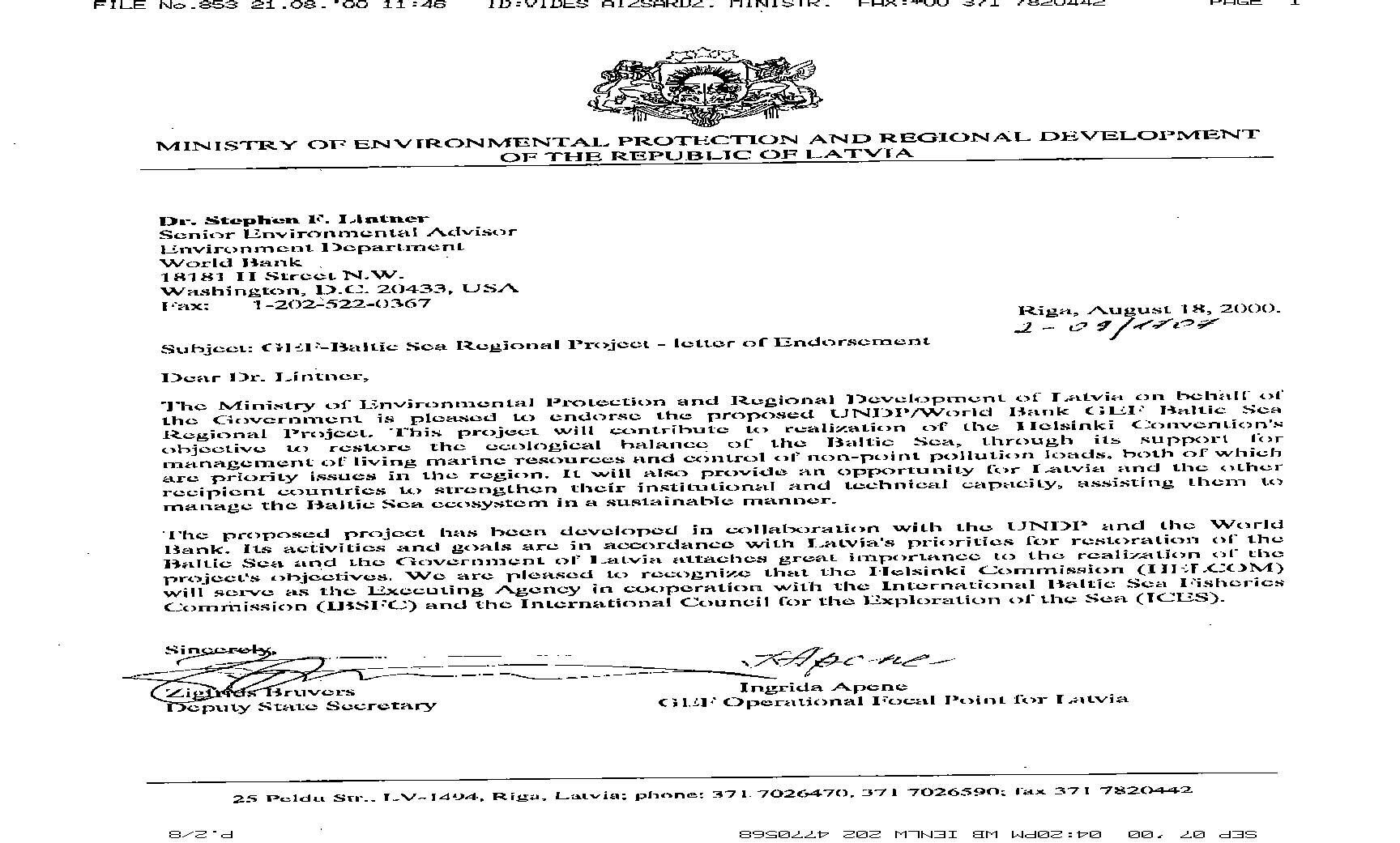
- 131 -
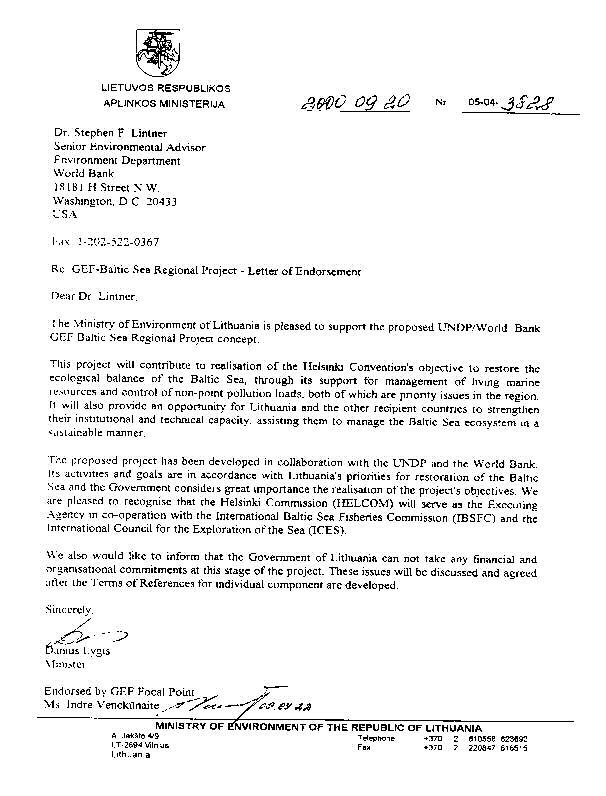
- 132 -
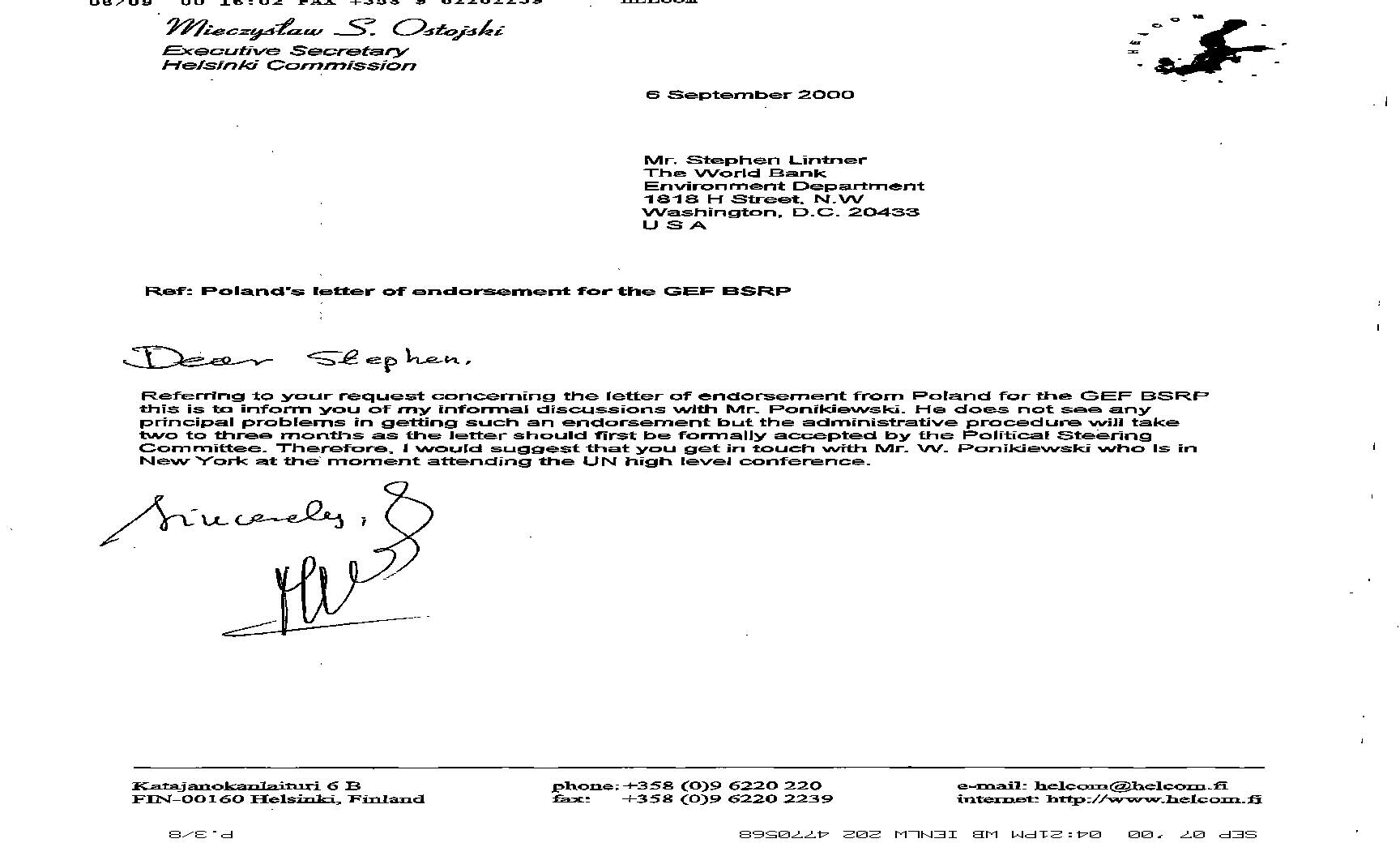
- 133 -
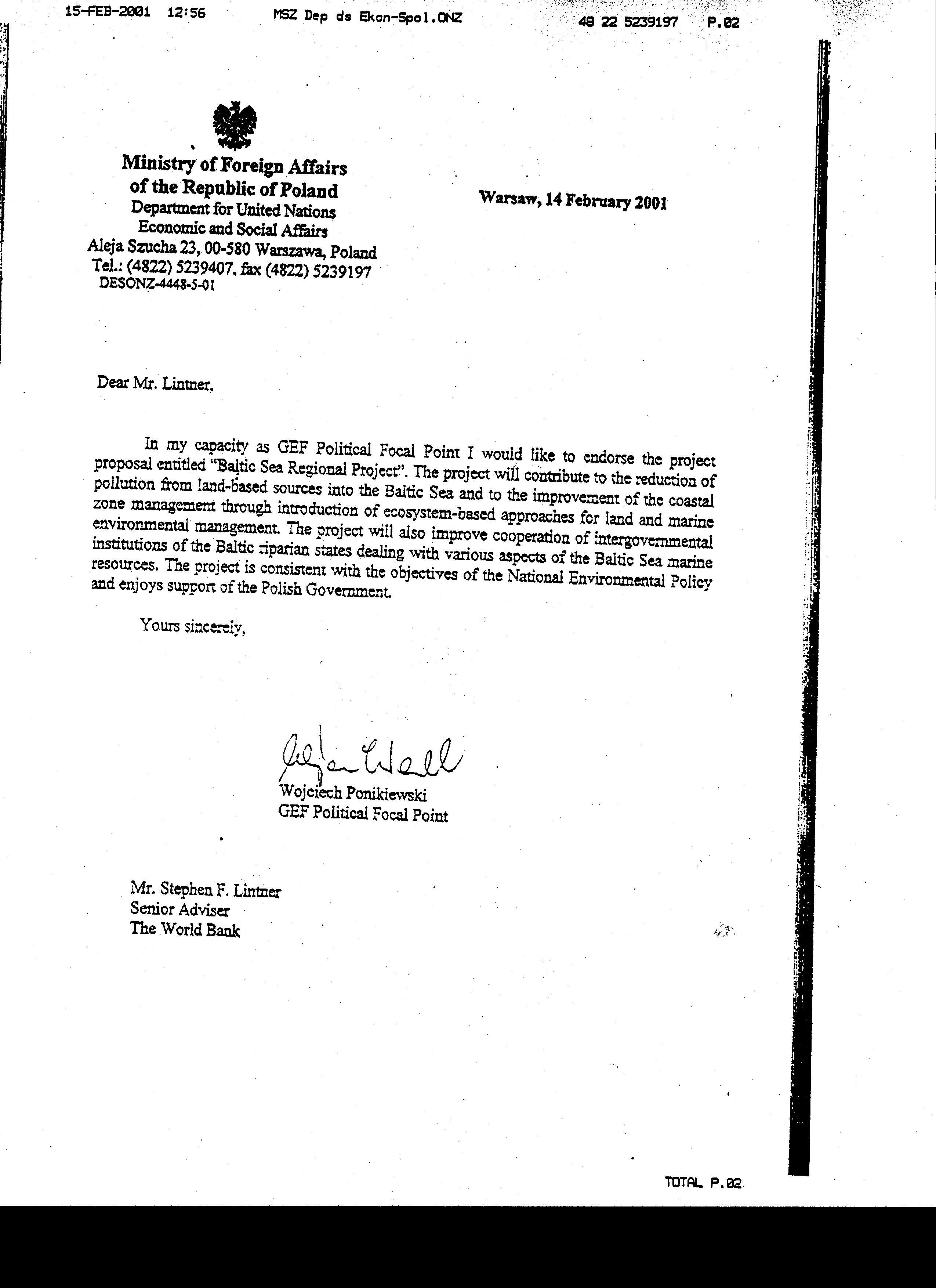
- 134 -
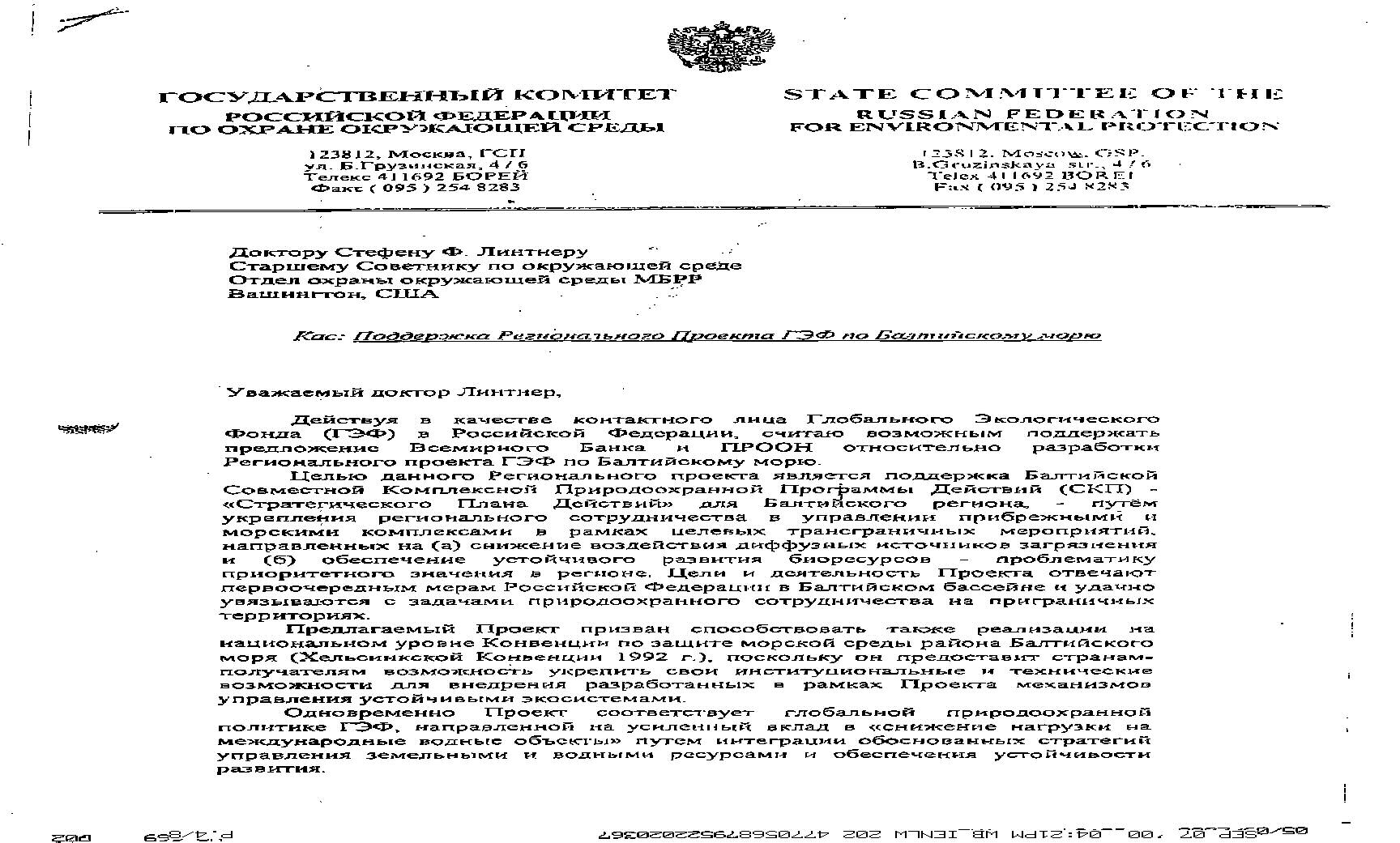
- 135 -
- 136 -
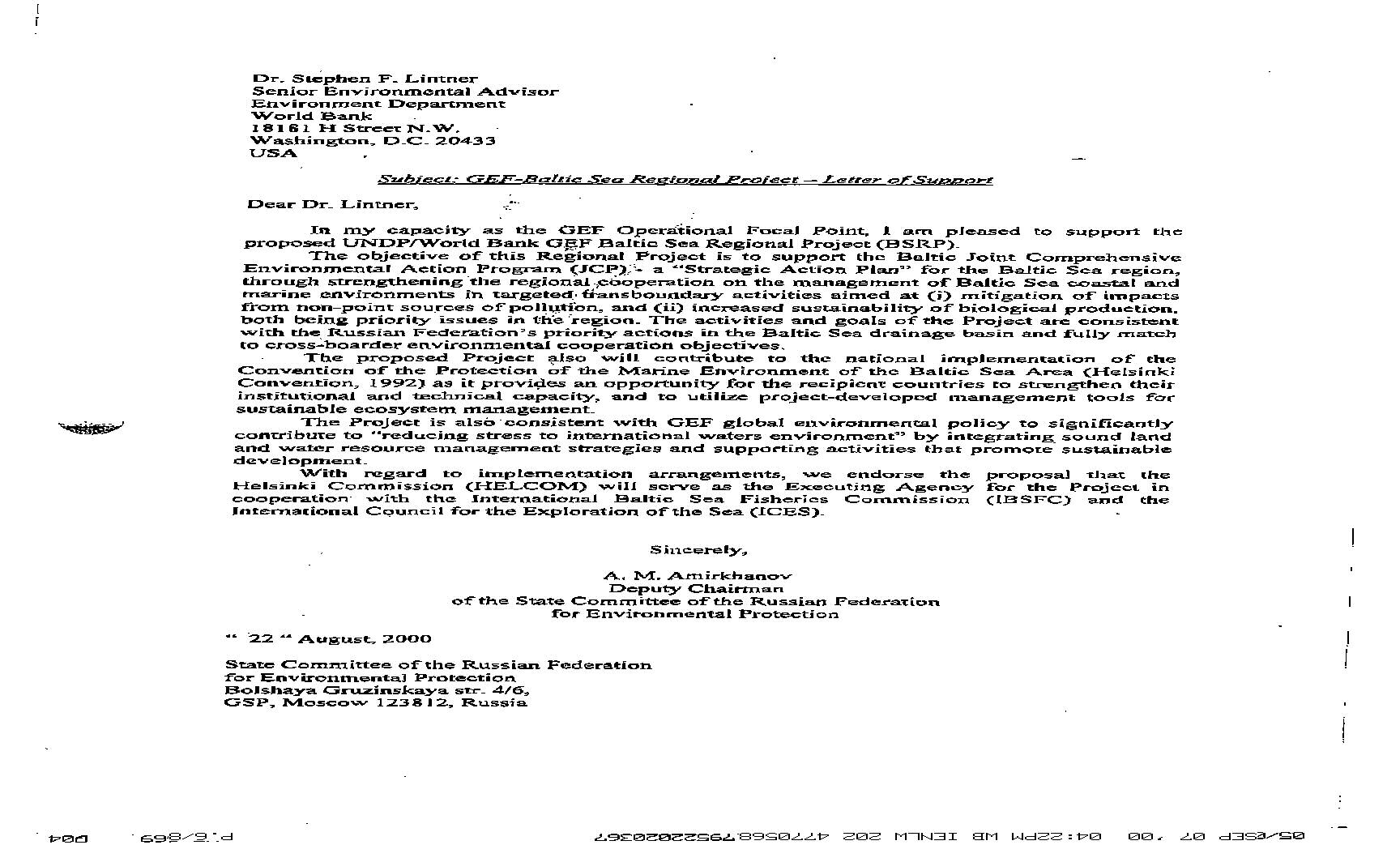
- 137 -
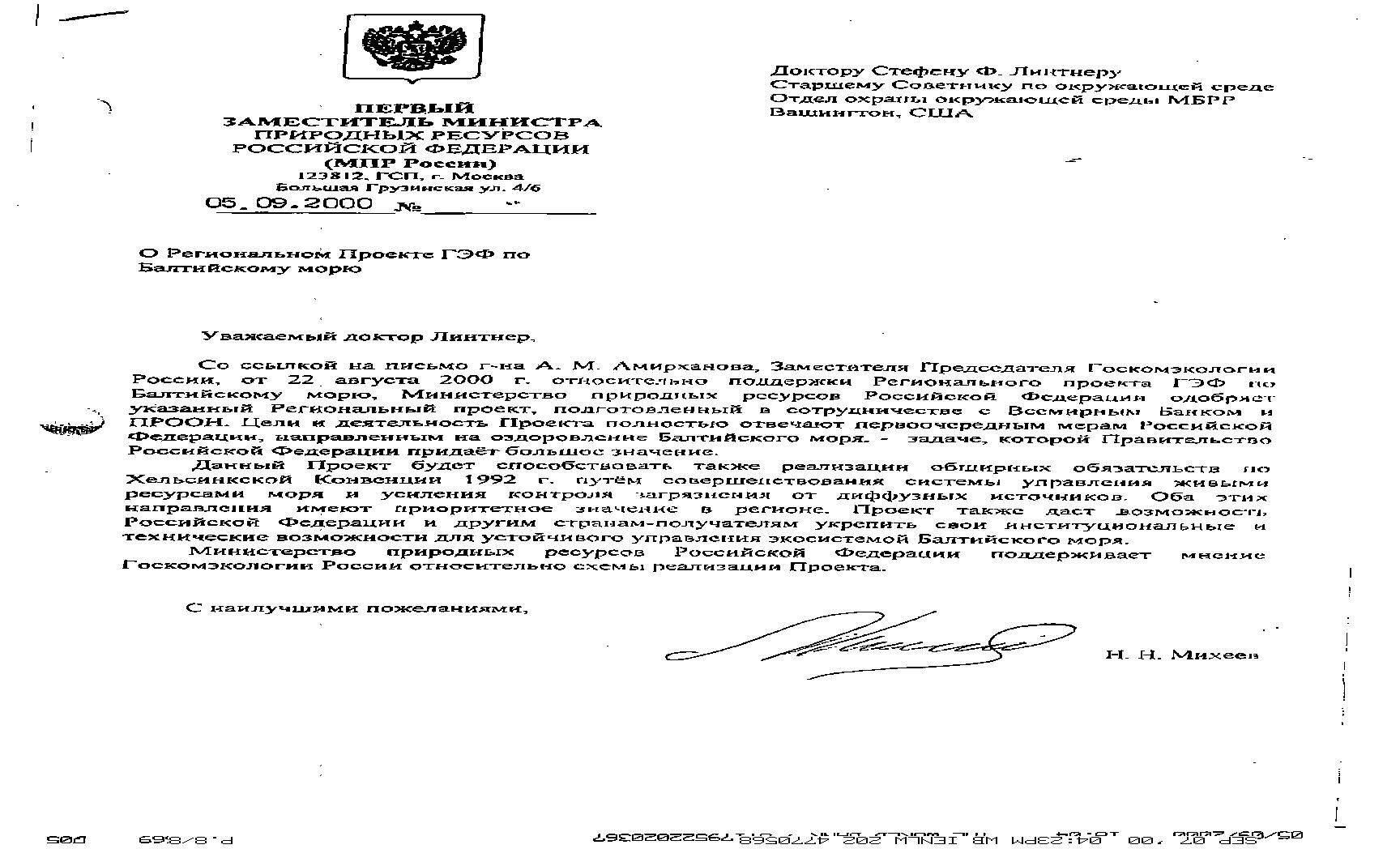
- 138 -
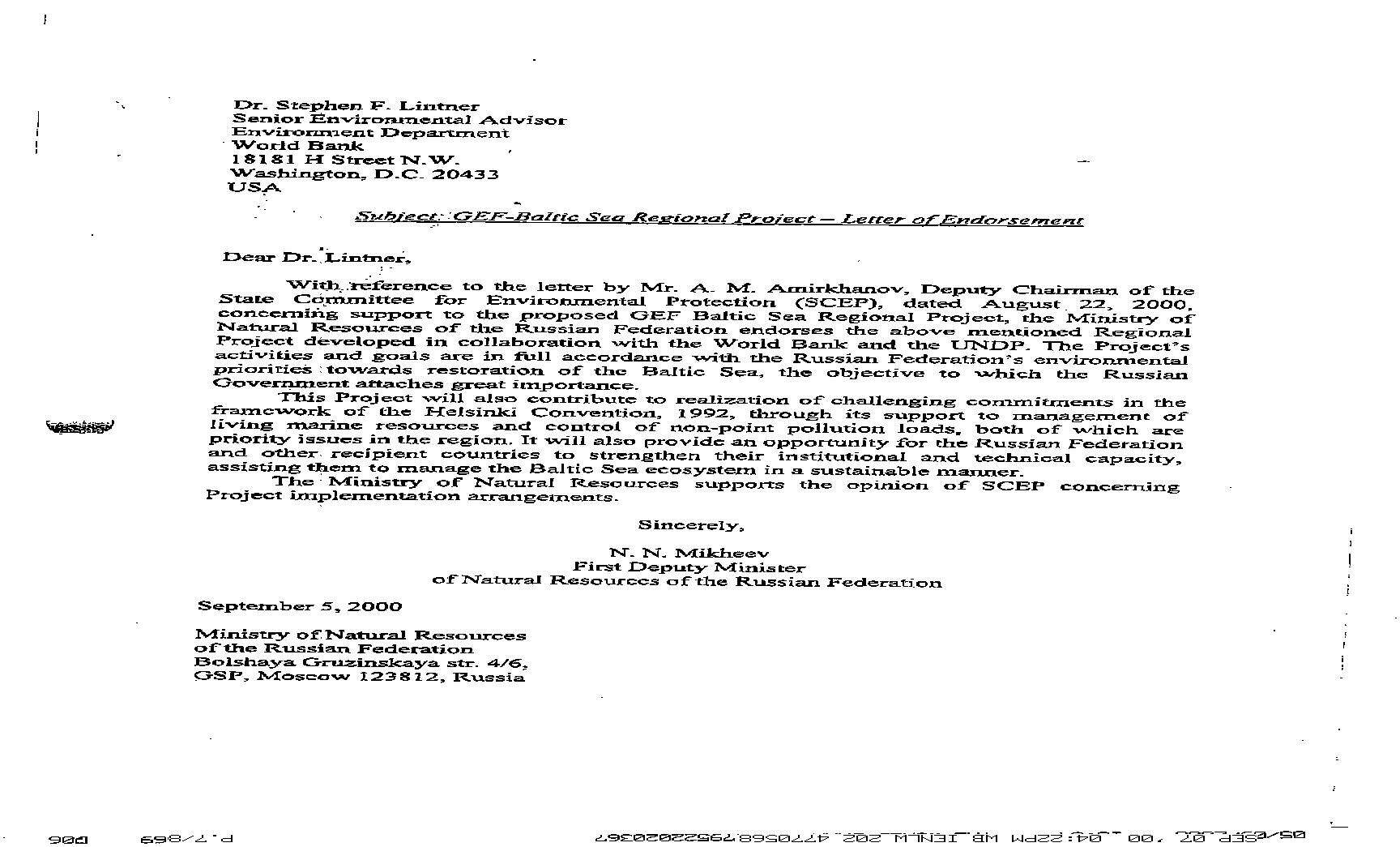
- 139 -
- 140 -